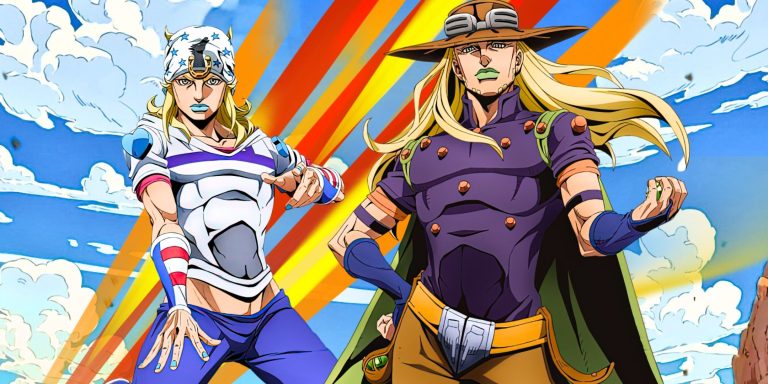

Ever since the bittersweet, universe-altering notes of Jolyne Cujoh’s finale faded in Stone Ocean, the collective consciousness of the global anime community has been locked on a single, blazing horizon. For over a decade, manga readers have spoken of Hirohiko Araki’s seventh narrative arc with hushed, almost reverent awe. Consistently holding court near the absolute summit of MyAnimeList’s all-time rankings, JoJo’s Bizarre Adventure: Part 7 – Steel Ball Run is widely considered Araki’s magnum opus—a staggering reinvention of his mythos that trades 1980s shonen bravado for a sprawling, existential, and blood-soaked American epic. Yet, as whispers of an impending anime production by David Production intensify across social feeds and industry forums, the anticipation is fraught with a unique tension. Bringing this 1890 trans-continental horse race to life is not just another seasonal milestone; it represents the most technically daunting and philosophically mature frontier the franchise will ever cross.
A Monumental Shift: How Ultra Jump Unleashed Araki’s Masterpiece
To understand the ravenous appetite for a Steel Ball Run anime, one must first appreciate the seismic structural shift that birthed it. Originally serialized in Weekly Shonen Jump in 2004 under the standalone moniker Steel Ball Run, Araki quickly made the career-defining decision to migrate the series to Shueisha’s monthly seinen imprint, Ultra Jump. Unshackled from the suffocating weekly deadlines and the demographic censorship of standard teenage-oriented magazines, Araki tore the Joestar bloodline down to its studs.
The result was a total narrative reset. Set against the sun-bleached, unforgiving backdrop of late-19th-century North America, Steel Ball Run reimagines the universe following the cosmic climax of Part 6. Araki abandoned neon-tinted urban labyrinths in favor of a 3,800-mile, coast-to-coast equestrian race from San Diego to New York City. The prize: fifty million dollars. But beneath the surface-level spectacle of eccentric frontiersmen, ruthless outlaws, and indigenous warriors, Araki engineered an intricate, morally ambivalent historical thriller grounded in trauma, imperialism, and the supernatural pursuit of divine intervention.
The Crucible of the Trail: Johnny Joestar and Gyro Zeppeli
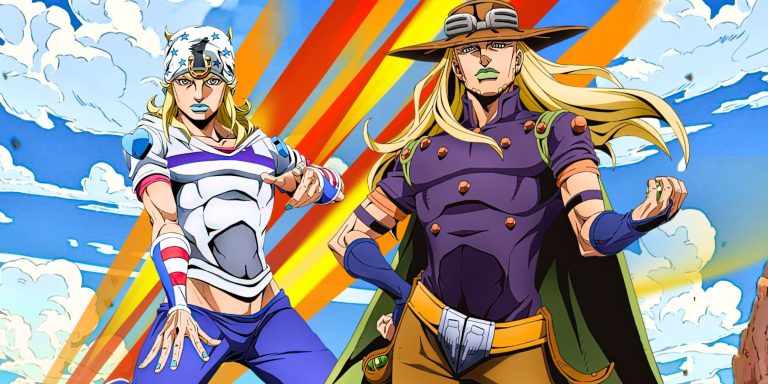
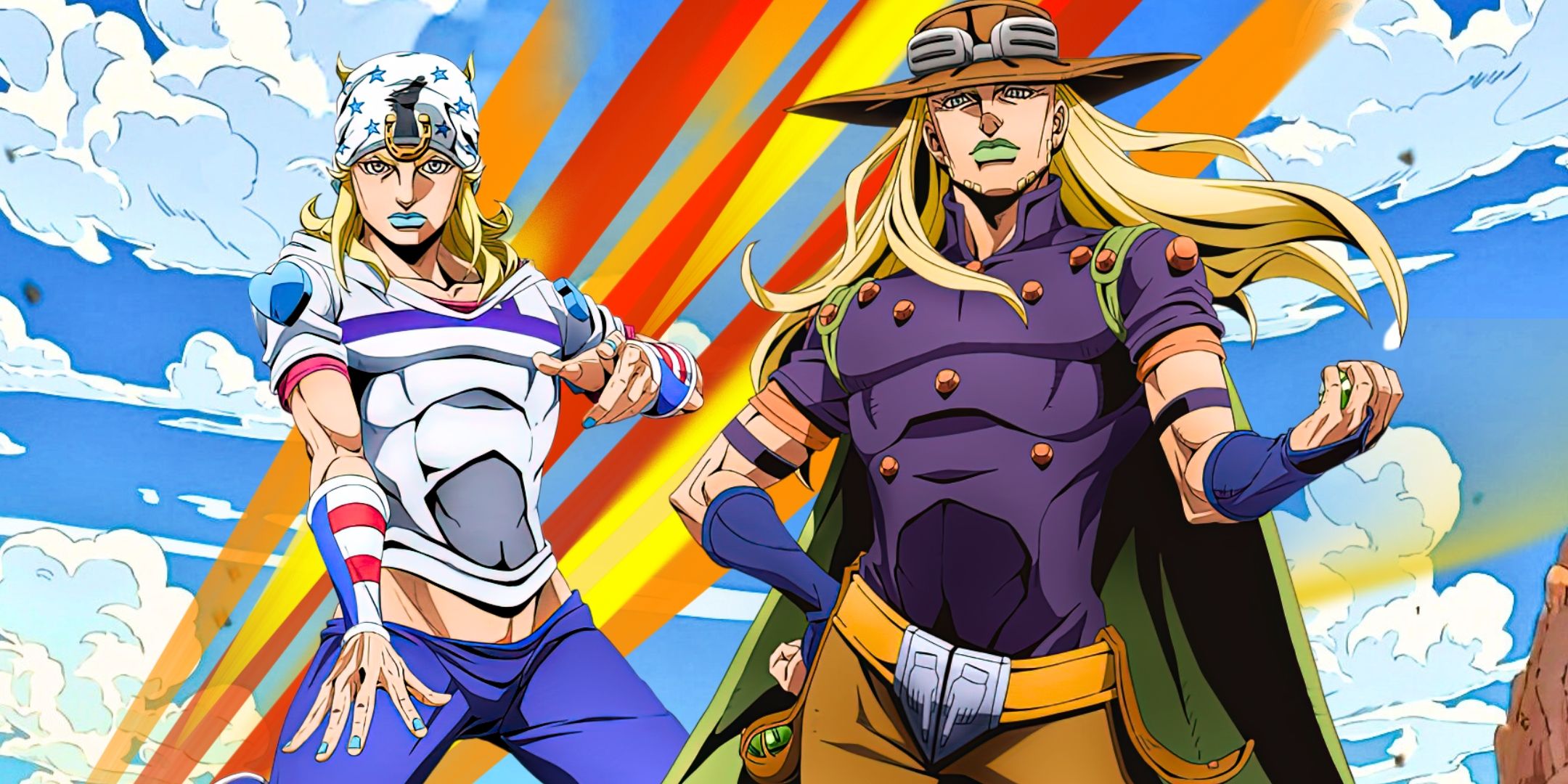
At the beating heart of Steel Ball Run is the most profoundly realized duo Araki has ever penned. In an industry flooded with stoic, uncompromisingly righteous protagonists, Johnny Joestar is an aberration. He is not Jonathan’s paragon of gentlemanly virtue, nor is he Jotaro’s cool-headed titan. Johnny is a disgraced, paraplegic former jockey whose hubris cost him his family, his career, and the use of his legs. Bitter, self-loathing, and harboring what Araki explicitly describes as a “dark determination”—a chilling willingness to kill anyone standing between him and his salvation—Johnny is an anti-hero whose internal journey toward self-worth is far more compelling than the race itself.
His foil, the flamboyant Neapolitan executioner Gyro Zeppeli, balances Johnny’s brooding desperation with exuberant levity, theatrical bravado, and a secret, noble cross to bear. Their dynamic eschews typical mentor-student tropes. It is an authentic, emotionally vulnerable brotherhood forged through shared campfires, absurdist conversational humor, and the violent crucible of survival.
The Spin vs. Stands: The Geometric Evolution of Combat
The duo’s mechanical mastery introduces what is arguably the most creatively distinct power system in modern manga: The Spin. While Stands remain integral to the later stages of the narrative, the Spin serves as an ancient, scientific discipline based on the Golden Ratio and Fibonacci sequence. Gyro’s steel spheres and Johnny’s evolving Stand, Tusk, manipulate centrifugal force into a reality-bending weapon.
Translating this visually into animation will require an extraordinary aesthetic vision. The Spin is not just kinetic energy; it is visual geometry, anatomical distortion, and gravitational distortion manifested on a battlefield. Watching Johnny evolve from weaponizing raw, nail-spinning bullets to unraveling the fundamental laws of interdimensional physics promises to be an absolute tour de force if David Production can nail the execution.
The David Production Dilemma: The Terrifying Physics of Horses
Despite the boundless narrative praise, industry insiders and sakuga connoisseurs know exactly why a Steel Ball Run announcement hasn’t materialized overnight: horses. In the animation medium, quadrupeds are notoriously universally feared. The anatomical complexity of a galloping horse—the shifting skeletal proportions, the ripple of musculature, the dust kick-up, and the unpredictable shifting of weight—is famously difficult to animate by hand in sustained 2D.
In Steel Ball Run, horses are not incidental background set dressings. They are active combatants, emotional anchors, and the literal vehicle through which the story moves across hundreds of chapters. A single high-speed chase involving four or five riders can reduce a mid-tier animation pipeline to ash.
David Production, which has handled every JoJo adaptation since 2012 with reverent stylistic flair, faces an unprecedented crossroads:
Will they rely heavily on 3D CGI models for the mounts, similar to the approaches seen in Wit Studio’s Attack on Titan or MAPPA’s Vinland Saga? Or can they pioneer a bespoke hybrid pipeline—blending cel-shaded dynamic models with hand-drawn 2D close-ups—that maintains the gritty, hyper-detailed linework of Araki’s peak illustration era? For the anime community, this technical conundrum is just as fascinating as the plot itself. The studio proved its mettle with the intricate kinetic physics of Fire Force, but tackling thousands of miles of dynamic equestrian pursuit is an entirely different beast.
Funny Valentine and the Morality of Manifest Destiny
No discussion of Steel Ball Run is complete without confronting its central antagonist: the 23rd President of the United States, Funny Valentine. Boasting a Stand with one of the most conceptually terrifying and visually complex abilities in fiction—Dirty Deeds Done Dirt Cheap (D4C)—Valentine elevates the narrative into high political philosophy.
Unlike previous megalomaniacal JoJo villains driven by personal vanity or sociopathic impulses like Dio Brando or Yoshikage Kira, Valentine operates with sincere, fanatical patriotism. His desire to secure the pieces of the Holy Corpse scattered across the American frontier is born from a desire to elevate his nation into an unassailable global hegemony, redirecting all misfortune away from its soil onto the rest of the world. Valentine’s famous “First Napkin” monologue is a chilling exploration of social conformity, power dynamics, and imperialist logic. When set against Johnny Joestar’s purely selfish quest to regain the use of his legs, the line between hero and villain blurs into brilliant, tragic shades of grey.
The Horizon Awaits: When Will the Race Begin?
The cultural appetite for JoJo’s Bizarre Adventure: Steel Ball Run has reached critical mass. In an era where prestige anime adaptations like Chainsaw Man, Frieren: Beyond Journey’s End, and Jujutsu Kaisen have elevated audience expectations regarding cinematic pacing and visual composition, an adaptation of Araki’s greatest work cannot afford to be merely “good.” It must be generational.
Whether David Production is quietly developing a groundbreaking hybrid workflow, or taking an extended hiatus to ensure production schedules do not buckle under the sheer weight of this trans-continental odyssey, one thing is certain: when that starting gun fires in San Diego, anime will witness the arrival of a modern masterpiece.
Are you hoping for a fully hand-drawn adaptation, or do you think high-end CGI is the only realistic way to bring the horses of Steel Ball Run to life? Who is your dream voice casting for Johnny and Gyro? Sound off in the comments below!