
Every milestone chapter in Eiichiro Oda’s magnum opus carries the weight of a cultural epoch. Chapter 100 gave us “The Legend Begins” as the Straw Hats plunged toward the Grand Line; Chapter 1000 redefined an entire generation of shonen with “Straw Hat Luffy” planting his crimson flag squarely into Kaido’s face atop Onigashima; and Chapter 1100 tore open our collective hearts via Bartholomew Kuma’s tragic communion with destiny. Now, the ticking clock of One Piece approaches the staggering summit of Chapter 1200. With the Straw Hat Pirates having formally crossed the threshold into the untamed, mythic territory of Elbaf, the narrative temperature has reached an all-time boiling point. The community is ablaze with speculative fervor, converging on a singular, earth-shaking premise: Chapter 1200 will not merely be an explosive skirmish, but the grand excavation of the Void Century’s greatest buried horrors and the terrifying liberation of Prince Loki’s divine, apocalyptic wrath.
The Anatomy of Milestone Chapters: Why 1200 Demands a Void Century Reckoning
Eiichiro Oda does not treat triple-digit zeroes as arbitrary publishing trivia; they are architectural linchpins designed to reframe the entire global board state. Egghead Island functioned as the broadcast that dismantled the World Government’s carefully manicured propaganda machine, with Dr. Vegapunk confirming the world is steadily sinking under the weight of an unresolved, eight-hundred-year-old conflict. If Egghead was the cerebral diagnosis of this dystopia, Elbaf is structurally engineered to be the archaeological autopsy.
For over two decades, Elbaf has stood as an unattainable horizon. It is the sanctum of the world’s most fearsome warrior race, the repository of the salvaged books of Ohara under the guardianship of Jaguar D. Saul, and the crucible where Big Mom’s childhood trauma took root. By the time Chapter 1200 rolls off the press, Oda will have methodically laid the pins down for a monumental strike. The narrative can no longer afford standard island-hopping antics. Chapter 1200 needs to bridge the macro-historical mysteries of Joy Boy with the visceral, localized powder keg of the Giant Kingdom, and all evidence points toward the subterranean foundations holding the realm together.
Beneath the Roots of Yggdrasil: The Sun Tree Eve vs. Treasure Tree Adam Paradox
To understand the ideological fault lines of Elbaf, one must look downward into the subterranean abyss beneath the branches of the world-tree. The flora of One Piece has long been a conduit for its most esoteric planetary lore. At the ocean floor sits the Sun Tree Eve, bathing Fish-Man Island in ambient light and spiritual hope while physically anchoring the Holy Land of Mary Geoise. Conversely, standing tall across the seas is the mythical Treasure Tree Adam, whose impervious wood carried Gol D. Roger’s Oro Jackson and Franky’s Thousand Sunny into legend.
The Subterranean Iron Vaults and Joy Boy’s Ancient Arsenal
A burgeoning theory circulating among dedicated theorycrafters suggests that the root system of Treasure Tree Adam does not merely nourish the fertile wilds of Elbaf; it serves as a colossal, petrified cage. If Mariejois sits above Eve’s canopy, hoarding the frozen straw hat and the remnants of the First Twenty Kingdoms, then Elbaf’s subterranean roots encircle the lost armories of Joy Boy’s fallen alliance.
During the catastrophic war of the Void Century, where island-clearing weapons like Uranus and Pluton cleaved the geography of the Earth, Elbaf was likely the unconquered bulwark. The theory suggests that resting within the tectonic bedrock of Elbaf are the skeletal remains of the Iron Giant’s contemporaries: biomechanical war relics, ancient automated armaments, and possibly the primary dynastic forge where ancient weapons were conceived. The Giants did not merely survive the Void Century through brute strength—they were the sentinels trusted by the Ancient Kingdom to quarantine technology capable of breaking the world. In Chapter 1200, an exploration or rupture of these subterranean depths could pull back the curtain on the original sin of the World Government, revealing that the true terror beneath Elbaf is not a creature, but the dormant legacy of mankind’s highest technological zenith.
Loki Unbound: The Psychopathology and Mythic Terror of the Accursed Prince
Standing directly between these buried secrets and the arriving Straw Hat contingent is the enigmatic figure of Prince Loki. Oda’s initial depictions of the “Cursed Prince” have severed our expectations of a conventional fairy-tale villain. Chained in massive seastone bindings across the frost-bitten wastes of Warland, blinded by bandages and sporting an unsettling, Cheshire-esque smirk, Loki introduces an unpredictable, chaotic-neutral element into the saga.
The “Divine Wrath” Fruit and the Parallels to Norse Ragnarok
The patricidal prince did not just commit regicide when he slaughtered his father, King Harald; he devoured a sacred, ancestral Devil Fruit that the royal family guarded for millennia. The thematic parallels to Norse mythology here are glaring and deliberately weaponized. Loki is the catalyst of Ragnarok—the harbinger of universal collapse who remains bound until the end of days. If his legendary Devil Fruit manifests a power tethered to primordial calamity (theories lean heavily toward a Mythical Zoan such as the Midgard Serpent Jörmungandr, the wolf Fenrir, or a necrotic Sun-devourer), then his liberation spells absolute ruin for the existing geopolitical hierarchy.
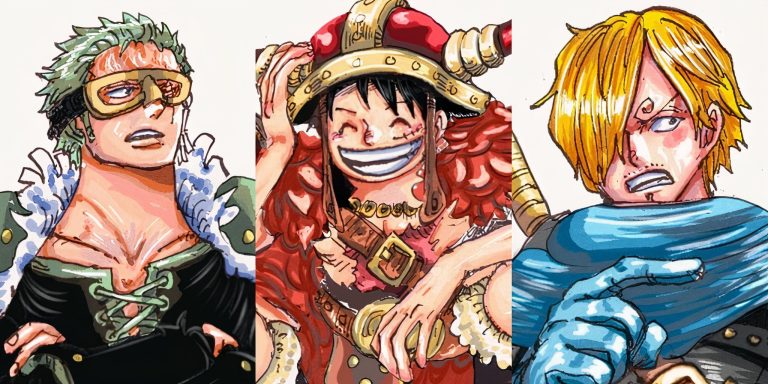
Psychologically, Loki represents the antithesis to the Giants’ traditional code of honorable warrior pride. Where Dorry and Brogy view battle through the lens of ancestral dignity, Loki embodies primal survival, nihilism, and an untethered thirst for autonomy. His seastone chains are a visual echo of Doflamingo’s thematic cage and Kaido’s physical invulnerability, yet Loki is distinct: he has sat in the pitch-black silence of his confinement listening to the reverberations of Vegapunk’s apocalyptic broadcast. He is not just waiting for freedom; he is waiting for a partner in madness. When Monkey D. Luffy—the reincarnation of the joyful warrior Nika—meets a chained god who hungers to burn the stage down, Chapter 1200 could present the most volatile ideological clash since the summit of Marineford.
The Convergence: Holy Knights, Straw Hats, and the Red Line’s Paranoia
The tragedy of Elbaf is that it will not remain an isolated stage. As the Red Line trembles from the revolutionary vanguard under Monkey D. Dragon and the global food blockades engineered by the Cross Guild, Mary Geoise is desperate. The World Government’s clandestine military enforcers, the God’s Knights—spearheaded by the insidious Saint Figarland Garling—cannot allow the Sun God Nika to form an unbroken pact with the war fleets of the Giant race. Charlotte Linlin once famously lamented that with the combined military might of Elbaf, she would have crushed Shanks, Whitebeard, and Kaido to claim the One Piece. Imu and the Gorosei understand this geopolitical calculus all too well.
A catastrophic convergence is brewing. If Chapter 1200 acts as the trigger point, we will not merely see Loki’s seastone shackles broken; we will see the sky split above Elbaf as the World Government deploys its most ruthless, aristocratic assassins to cleanse the island before the ancient war machines are reignited. The narrative stakes are intoxicating: Luffy must reconcile whether releasing an imprisoned patricide like Loki is a gamble worth taking to access the deep-seated history of the D. Clan, all while the celestial executioners descend from above.
The Fanbase on Tenterhooks: Deciphering Oda’s Narrative Endgame
Across social media hubs, digital forums, and passionate theory circles, the reception to this brewing conflict is characterized by an almost nervous reverence. Readers understand that the margins are narrowing. There are no more training arcs, no more narrative detours, and very few unanswered lore threads left in Oda’s quiver. The prospect of Loki representing a “Divine Wrath” that opposes both the World Government and the romanticized ideals of piracy injects a brilliant, three-dimensional grayness into the Final Saga.
If Chapter 1200 indeed unshackles Loki and exposes the subterranean war relics linking Elbaf to Joy Boy’s doomed resistance, One Piece will cross its definitive point of no return. The world will no longer be sliding quietly beneath the waves; it will be dragged screaming into the final, unsparing twilight of the gods. As the chains rattle against the iron bark of Adam, all eyes remain transfixed on Oda’s pen—waiting for the herald of the end.
What do you think lies beneath the sacred grounds of Elbaf? Will Prince Loki emerge as Luffy’s greatest final-saga rival or an apocalyptic ally against the World Government? Sound off in the comments below and keep your sails locked to Wibux.com for exhaustive anime analysis and weekly breakdown coverage!
One thought on “One Piece Chapter 1200 Theory: The Void Century War Relics Beneath Elbaf and Loki’s Unshackled Divine Wrath”