Ever since the cosmic, reality-shattering strings of Enrico Pucci’s Made in Heaven unraveled the universe in Stone Ocean, the anime sphere has held its collective breath for a singular announcement. For over a decade, Hirohiko Araki’s global fanbase has known that the conclusion of Jolyne Cujoh’s tragic crusade was not an ending, but a portal to something infinitely grander. We have arrived at the precipice of the promised land: JoJo’s Bizarre Adventure: Steel Ball Run. Long hailed by manga connoisseurs, literary critics, and hardcore JoJo loyalists as Araki’s definitive magnum opus, Part 7 represents a seismic reinvention of the franchise. Yet, as rumors surrounding David Production’s next move hit a fever pitch across industry backchannels, the discourse swings violently between boundless anticipation and existential dread. Bringing this sprawling, dust-choked, supernatural western to life is not merely the studio’s next production gig—it is their Everest.
The Seinen Shift: Why Steel Ball Run Transcends Shonen Tropes
To understand the sheer magnitude of the Steel Ball Run discourse, one must first recognize its unique place within the publication history of JoJo’s Bizarre Adventure. Part 7 began its serialization in 2004 within the pages of Weekly Shōnen Jump under the simple moniker Steel Ball Run, intentionally shedding the traditional franchise branding. However, its true metamorphosis occurred when Araki migrated the series to the monthly, seinen-oriented Ultra Jump in 2005. Freed from the editorial constraints and demographic sanitization of mainstream shonen, Araki unleashed an unprecedented narrative ambition.
Set against the vast, unforgiving panorama of an alternate 1890 America, the story pivots around a grueling, 6,000-kilometer cross-country horse race spanning from San Diego Beach to New York City. The cash prize of fifty million dollars serves as the superficial bait; the true catalyst is an intricate web of geopolitical espionage, existential self-actualization, and divine relics. By shifting to a monthly publication schedule, Araki had the breathing room to craft complex panel architectures, deeply contemplative character arcs, and a world dripping with moral ambiguity. There are no straightforward “righteous heroes” in Steel Ball Run; there are only desperate, damaged pilgrims carving their legacy into the American frontier.
From Hamon to the Golden Spin: Reimagining the Battle Shonen Physics
While Stands naturally return with mind-bending applications, Steel Ball Run anchors its supernatural mechanics in an entirely new discipline: The Spin. Unlike the breath-based Hamon of Parts 1 and 2, the Spin is a sacred mathematical principle derived from the Fibonacci sequence and the Golden Ratio. It is kinetic perfection harnessed into rotation, embodied most vividly by the steel spheres hurled by the enigmatic Gyro Zeppeli. This mechanic redefines combat throughout the narrative. Rather than relying solely on spiritual avatars punching through walls, fights become intricate geometric calculations where terrain, kinetic transfer, and velocity determine life and death. When this system converges with Johnny Joestar’s Stand, Tusk, Araki crafts an evolutionary hierarchy of power that feels intellectually earned rather than arbitrarily inflated.
The Broken and the Brash: Deconstructing Johnny Joestar and Gyro Zeppeli
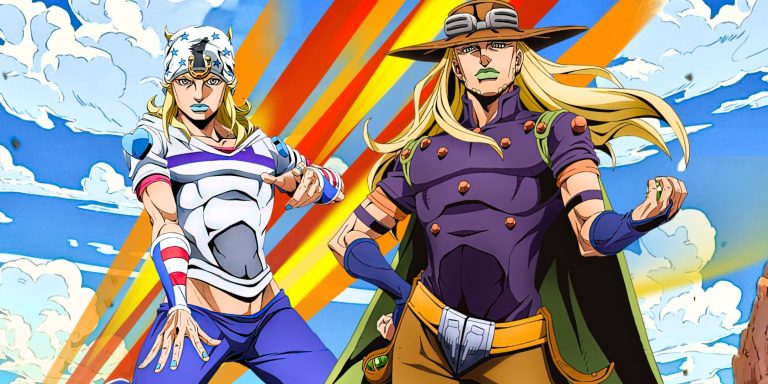
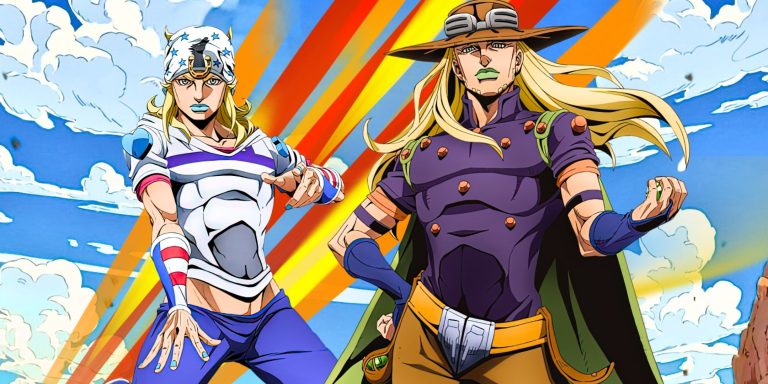
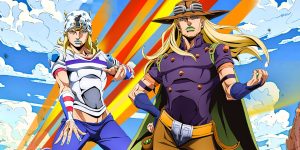
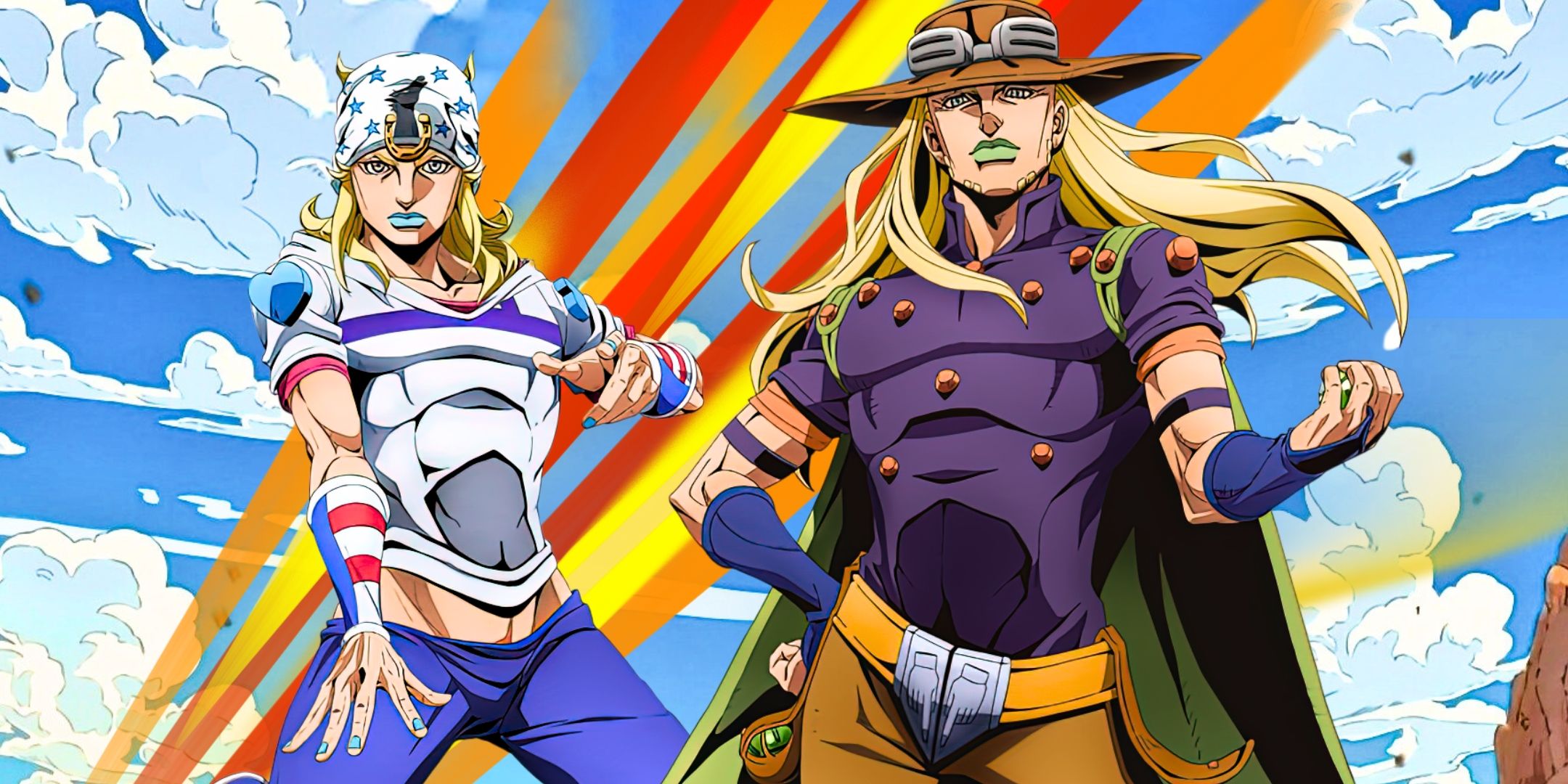
At the beating, bruised heart of Steel Ball Run lies the dynamic between Johnny Joestar and Gyro Zeppeli—unquestionably the most nuanced, emotionally resonant dual-protagonist partnership in Araki’s forty-year career. Johnny is a deliberate subversion of the noble Jonathan Joestar archetype. Paraplegic, bitter, and stripped of the narcissistic ego that defined his early career as an elite jockey, Johnny begins his odyssey not to save the world, but to rediscover his basic human dignity. As Johnny famously articulates, he isn’t trying to move from zero to positive; he is merely fighting to bring himself back from “negative” to “zero.”
Johnny’s psychology is shadowed by what Araki frequently terms “dark determination”—an unblinking, borderline-sociopathic willingness to kill if it means claiming the relics that might restore his legs. Counterbalancing Johnny’s grim obsession is Gyro Zeppeli, a disgraced executioner from the Kingdom of Naples whose boisterous, gold-toothed exterior conceals an intensely righteous mission of altruism. Gyro rides to secure amnesty for a condemned child who is entirely innocent of state crimes. Their camaraderie evolves organically through campfires, bizarre running gags about days of the week, and raw existential crises. Where previous JoJo alliances were defined by swift, mutual respect, Johnny and Gyro endure a trial-by-fire codependency that gives the narrative its devastating emotional weight.
The Animator’s Nightmare: Conquering the Equestrian Frontier
If Steel Ball Run is universally celebrated as a narrative triumph, it is equally feared across the anime industry as a production suicide pact. The elephant—or rather, the stallion—in the room is the sheer volume of equestrian animation required. In traditional hand-drawn 2D animation, quadrupedal motion is notoriously labor-intensive. Capturing the anatomical compression, muscular shifts, and intricate galloping mechanics of dozens of horses in a high-speed peloton across dust-swept plains is a logistical nightmare that has humbled even the most decorated animation pipelines.
David Production, who have adapted Parts 1 through 6 with fanatical stylistic fidelity, face their ultimate operational crossroad here. The production house cemented its reputation through bold flat-color pop aesthetics, literal on-screen sound effects (katakana SFX), and theatrical pacing. However, a pure 2D approach to hundreds of chapters featuring mounted combat across dynamic 3D landscapes is financially and temporally unfeasible in modern TV anime production.
Balancing Modern 3DCG Hybridization with Araki’s Renaissance Line Work
The solution inevitably points toward sophisticated 3DCG integration, a technique studios like MAPPA and Wit have heavily refined. The existential gamble for David Production lies in preserving the soul of Araki’s mid-2000s renaissance art style. During Part 7, Araki’s illustrations abandoned the hyper-muscular manga silhouettes of the 1980s in favor of classical Michelangelo-inspired anatomy, hyper-detailed leather textures, realistic facial bone structures, and meticulously textured cloth. If David Production opts for cel-shaded 3D horses, the integration between the 3D models and hand-drawn 2D riders must be seamless. A jarring clash in frame rate or textural depth could instantly shatter the cinematic immersion that Steel Ball Run demands.
The Crucible of Ideology: Funny Valentine and the Saint’s Corpse
A masterclass narrative requires a transcendent antagonist, and in 23rd President of the United States Funny Valentine, Araki delivered a sociopolitical juggernaut. Valentine does not seek world domination out of petty malice or a thirst for sadistic dominance. Instead, he is propelled by a radically unyielding, nationalistic utilitarianism. Driven by his desire to make the United States an untouchable geopolitical fortress, Valentine hunts the mummified parts of the “Saint’s Corpse”—widely implied to be the physical remains of Jesus Christ—scattered across the North American continent.
Valentine’s philosophical doctrine is encapsulated in his infamous “First Napkin” monologue—a thesis on power dynamics, initiative, and social hegemony that outshines even Yoshikage Kira’s desire for a quiet life or Diavolo’s pursuit of apex fate. Paired with his terrifying dimensional Stand, Dirty Deeds Done Dirt Cheap (D4C), Valentine turns Steel Ball Run into a complex ideological clash. By the final act, the lines between hero and villain are utterly decimated. Viewers will be forced to reckon with Johnny’s self-interested darkness versus Valentine’s selfless, yet horrifyingly cold, patriotism.
The Verdict: David Production’s Next Frontier
The anticipation surrounding the Steel Ball Run anime is more than just social media hyperbole; it is a cultural event waiting for its spark. Fans who felt somewhat alienated by the erratic, split-cour Netflix distribution model of Stone Ocean are desperately hoping for a return to weekly event-television pacing for Part 7. An adaptation of this magnitude cannot simply be pushed through a standard production assembly line. It requires substantial pre-production lead times, industry-leading 3D layout directors, and a musical score—perhaps invoking Ennio Morricone-esque spaghetti western acoustics crossed with aggressive progressive rock—capable of matching Araki’s desert odyssey.
Whenever David Production officially breaks their silence and drops that inaugural key visual of Johnny Joestar clutching the reins of Slow Dancer, it will mark the beginning of an era. Steel Ball Run is the definitive test of whether modern anime can faithfully adapt the most ambitious graphic literature of the 21st century without diluting its raw, poetic edge. The race of the century is looming on the horizon—and we are more than ready to ride.
What are your biggest hopes and fears for David Production’s adaptation of Part 7? Do you want to see a full hybrid 3DCG approach to the horses, or should they take the time for detailed 2D artistry? Drop your theories and character rankings in the comments below!