Ever since the melancholic, rain-slicked chords of “Distant Dreamer” signaled the conclusion of Stone Ocean in late 2022, a singular, obsessive question has haunted the anime ecosystem: When does the race begin? For over three decades, Hirohiko Araki’s multi-generational saga has defied the standard trajectories of mainstream manga. Yet, among its eight completed parts, none commands the quasi-mythic reverence reserved for Part 7: Steel Ball Run. Long hailed by critics and manga scholars as Araki’s undisputed magnum opus, the western-infused epic represents not merely another chapter in the franchise, but an unprecedented summit of artistic maturity, psychological depth, and mechanical complexity. As rumblings surrounding David Production’s studio pipeline grow louder, the impending transition from manga page to screen stands as anime’s most anticipated—and terrifying—endeavor.
The Trans-American Odyssey: Why Steel Ball Run Stands as Araki’s Magnum Opus
To understand the breathless hype surrounding a potential adaptation, one must comprehend the monumental pivot Araki executed in 2004. Shifting serialization from the rigid demographics of Weekly Shōnen Jump to the adult-oriented monthly pages of Ultra Jump unchained the mangaka from standard editorial constraints. The result was a radical aesthetic and thematic rebirth. Set in an alternate timeline against the backdrop of an 1890s trans-continental equestrian race from San Diego to New York, Steel Ball Run strip-mined the foundational DNA of JoJo’s Bizarre Adventure and reconstructed it with gritty, historical naturalism.
The series traded metropolitan cityscapes and flamboyant vampire castles for sun-scorched badlands, frosted prairies, and geopolitical conspiracies. Rather than leaning on arbitrary shōnen escalation, the narrative framed its central conflict around the pursuit of the mummified Corpse Parts of an unnamed holy figure—widely inferred to be Jesus Christ—scattered across the continental United States. Backed by the chillingly utilitarian patriotism of the antagonist, President Funny Valentine, the story discarded clear-cut morality in favor of raw, philosophical desperation. This is not a contest to save the world; it is a desperate scramble across an unforgiving continent where every mile claims blood, horseflesh, and ideals.
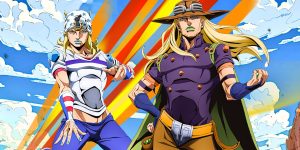
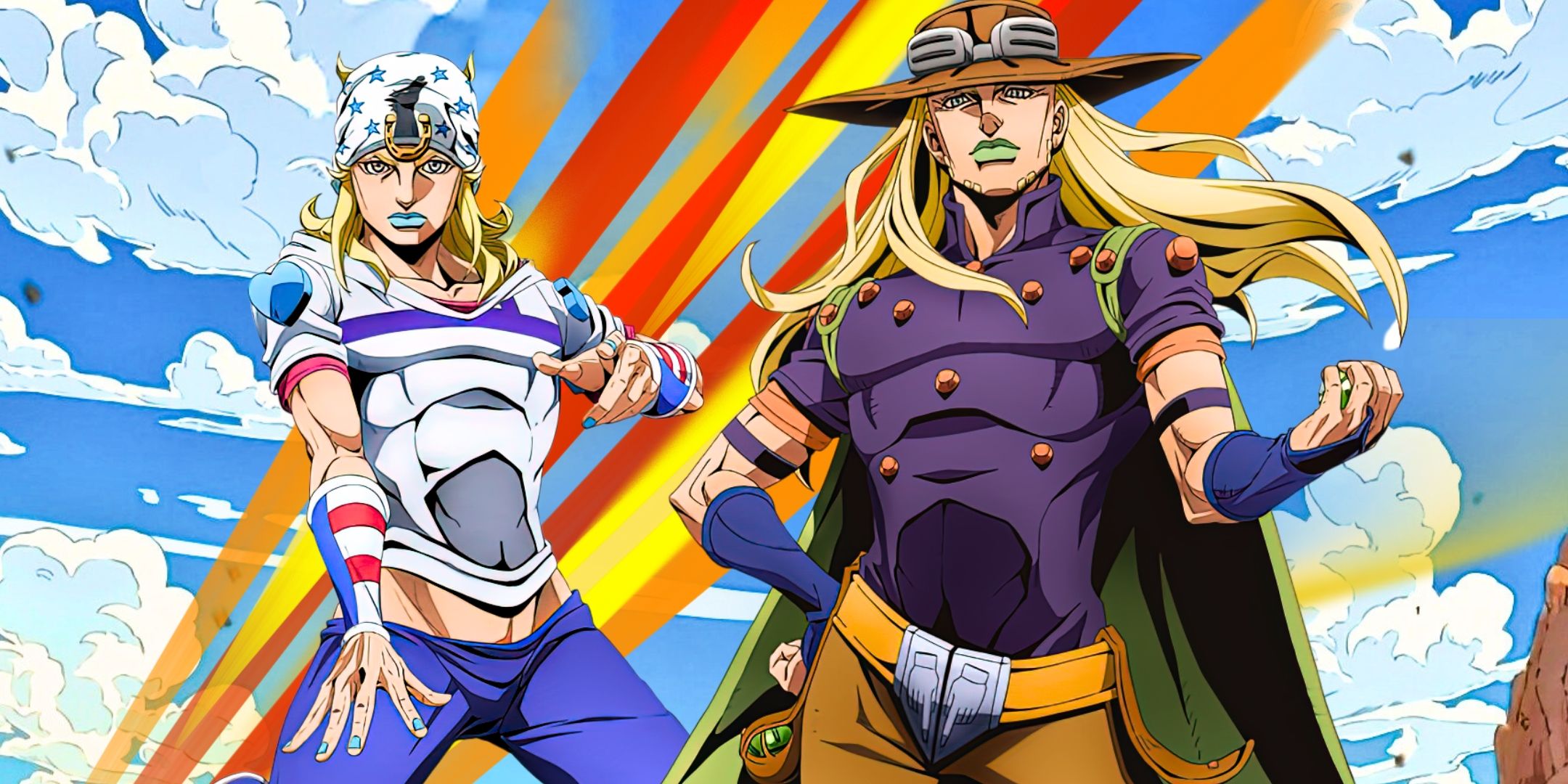
Johnny Joestar and Gyro Zeppeli: Deconstructing Broken Ambition and the Spin
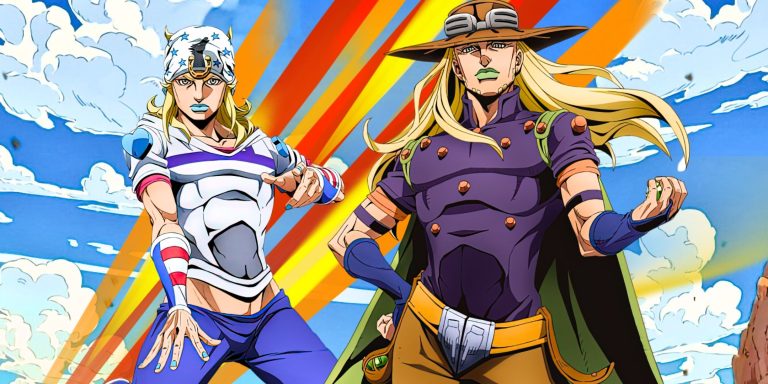
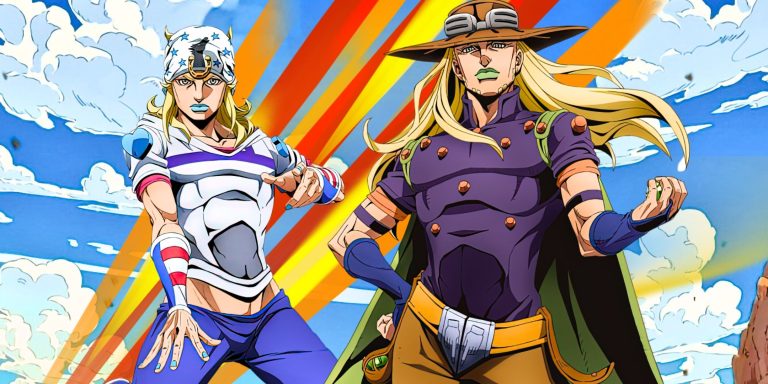
At the center of this blood-soaked sprint across the frontier sits what is arguably the most intricately layered duo in modern sequential art: Johnny Joestar and Gyro Zeppeli. Unlike Jonathan’s unblemished chivalry or Jotaro’s stoic coolness, Johnny begins his journey as an unlikable, disgraced former jockey prodigy whose reckless vanity cost him the use of his legs. Johnny’s internal narrative is defined by a fierce, unapologetic selfishness—what Araki famously visualizes as a flame of “Dark Determination” in his eyes. He is not driven by righteous virtue, but by the primal desire to return his life from “negative” to “zero.”
Complementing Johnny’s bitter realism is Gyro Zeppeli, a disgraced Neapolitan executioner operating under a paradox of duty and empathy. Gyro is flamboyant, absurdly humorous (his mid-race compositions about cheese and days of the week remain legendary among fans), yet fundamentally shattered by the cruel obligations of his royal executioner lineage. Their partnership avoids the superficial buddy-cop tropes common to adventure serials; instead, it evolves into an intimate, brotherly mentorship centered around the sacred geometry of The Spin.
Replacing traditional Hamon and heavily reimagining the manifestation of Stands, the Spin is a supernatural martial art rooted in the mathematics of the Golden Ratio. By channeling the infinite spiral found within nature through steel spheres, Gyro introduces a tactile, kinetic methodology of combat that challenges both Johnny’s physical limitations and his worldview. When Johnny’s Stand, Tusk, gradually evolves through distinct Acts alongside his mastery of the Golden Rectangle, it acts as a visual and psychological metaphor for his slow, excruciating crawl out of despair.
David Production’s Mount Everest: The Equestrian Animation Dilemma
While the story is universally celebrated, bringing Steel Ball Run to animated life presents a technical challenge of unprecedented proportions. David Production, the studio that has treated the franchise with religious fidelity since 2012, is facing its greatest structural challenge yet: animating horses.
The Nightmare of Four-Legged Motion
In the hierarchy of traditional 2D animation, few tasks are as notoriously resource-intensive, technically grueling, and financially ruinous as drawing galloping horses. Unlike two-legged humanoids whose movements can be cheated through stylized poses, foreshortening, and motion smears, quadrupedal biomechanics demand anatomical precision in every frame. In Steel Ball Run, horses are not incidental background props; they are primary characters that run, crash, suffer catastrophic injuries, and navigate torrential blizzards while executing supernatural maneuvers. Animating dozens of distinct steeds racing neck-and-neck over extended sequences would bankrupt a conventional 2D production schedule.
The Hybrid CGI Tightrope
The consensus within the industry points toward a hybrid workflow: 3D CGI models for the horses, paired with meticulously shaded 2D character assets for the jockeys. However, this method carries immense artistic risk. Past high-profile anime adaptations—most notoriously 2016’s Berserk—have collapsed under the dissonance of poorly blended CGI assets. If David Production leans on rigid, weightless 3D models, they risk extinguishing the hyper-detailed, cross-hatched, Caravaggio-inspired linework that defines Araki’s peak illustration era. For Steel Ball Run to succeed, the studio will likely need to employ the visionary technological workflows pioneered by studios like Orange or utilize bespoke cel-shaded pipelines that honor Araki’s dynamic camera angles without turning the race into a sterile video game cutscene.
Distribution Pitfalls: Reclaiming the Weekly Cultural Phenomenon
Beyond the technical obstacles, the discourse surrounding the adaptation is deeply entangled with distribution logistics. The fandom remains universally critical of Netflix’s batch-release strategy for Stone Ocean, which effectively suffocated the natural episodic discourse and community meme generation that propelled Parts 3 through 5 into global zeitgeist status. The pacing of Steel Ball Run—a sprawling, episodic race divided into distinct geographical stages—is tailor-made for traditional weekly releases.
A weekly distribution model is non-negotiable if Part 7 is to realize its cultural potential. The psychological tension of the “True Man’s World” arc, the labyrinthine horror of “Scary Monsters,” and the reality-bending climax of “D4C” demand time to breathe, speculate, and trend across digital spaces. Rumors suggesting an extended pre-production timeline suggest that the production committee may be reassessing their release mechanics, ensuring that when the green flag drops, the series receives the grand prestige broadcast cadence it warrants.
The Verdict: An Inevitable Masterwork in the Making
The anticipation for JoJo’s Bizarre Adventure: Steel Ball Run is not born of mere nostalgia or the momentum of a long-running franchise. It is fueled by the knowledge that Part 7 represents one of the rare instances where a legendary mangaka transcended their own limitations to produce a work of staggering, permanent brilliance. Johnny Joestar’s quest for redemption, Gyro Zeppeli’s profound lessons, and the high-octane spectacle of the trans-American circuit demand an adaptation that refuses to cut artistic corners.
David Production has proven their devotion across a decade of wild, colorful, genre-defining television. When they finally sound the starting gun on the beaches of San Diego, it will not just be another anime premiere; it will be the defining pop-culture sprint of the decade. Ready your saddles, master the Golden Rotation, and brace yourselves—the race across the continent is only a matter of time.
What arc from Steel Ball Run are you most anxious to see David Production tackle? Do you think a hybrid 3D/2D animation pipeline can do justice to Araki’s equestrian masterwork? Sound off in the comments below!