Ever since the melancholic, bittersweet chords of Duffy’s “Distant Dreamer” faded over the rebooted universe of Stone Ocean, a solitary, thunderous question has echoed throughout the global anime community: When will the horses run? For the uninitiated, the clamor surrounding an adaptation of JoJo’s Bizarre Adventure Part 7: Steel Ball Run might seem like standard-issue fandom impatience. But for those who have traversed the 1890 trans-American trail via Hirohiko Araki’s ink-stained pages, Steel Ball Run is not just the next chronological entry in a beloved franchise. It is Araki’s undisputed magnum opus—a staggering, genre-defying reinvention of supernatural fiction that transformed a flamboyant battle-shonen into an existential, dust-choked epic of historical Americana.
Yet, as anticipation reaches fever pitch, an immense technical and creative shadow looms over David Production. The studio that breathed vibrant life, signature pop-art palettes, and kinetic sound-effects into every Joestar generation now faces its most intimidating frontier yet. Adapting Part 7 is not merely a question of scheduling; it is an industrial endurance race against animating one of the most notoriously grueling motifs in medium history: horses, and lots of them.
A Clean Slate in the Dust: Araki’s Seinen Metamorphosis
To understand the near-religious reverence surrounding Steel Ball Run, one must contextualize its mid-2000s inception. Displaced from the original JoJo timeline following the climax of Stone Ocean, Araki staged a hard thematic reboot. Initially serialized in Weekly Shonen Jump before migrating to the monthly, mature-leaning pages of Ultra Jump in 2005, the narrative unshackled itself from editorial constraints. Araki’s transition to a monthly cadence allowed for an unprecedented elevation in draftsmanship, panel composition, and narrative maturity.
The canvas expanded into a 6,000-kilometer cross-country trek from San Diego Beach to New York City. On the surface, the race is an audacious capitalist spectacle organized by eccentric promoter Steven Steel, tempting gunslingers, outlaws, and aristocrats with a $50 million grand prize. Beneath the frontier dust, however, lies an occult geopolitical conspiracy involving the dismembered, mummified parts of a holy Saint’s Corpse. This shift allowed Araki to step away from traditional “monster-of-the-week” stand battles and ground his world in moral ambiguity, harsh survivalism, and a gritty, sun-baked atmosphere deeply indebted to classic Sergio Leone Westerns and Cormac McCarthy prose.
The Paraplegic and the Executioner: Character Psychology Redefined
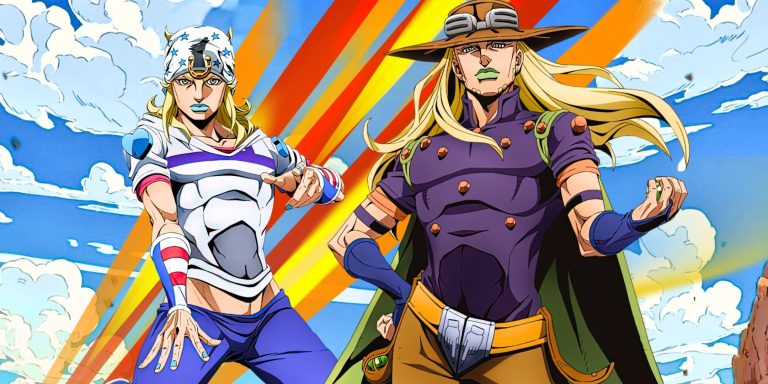
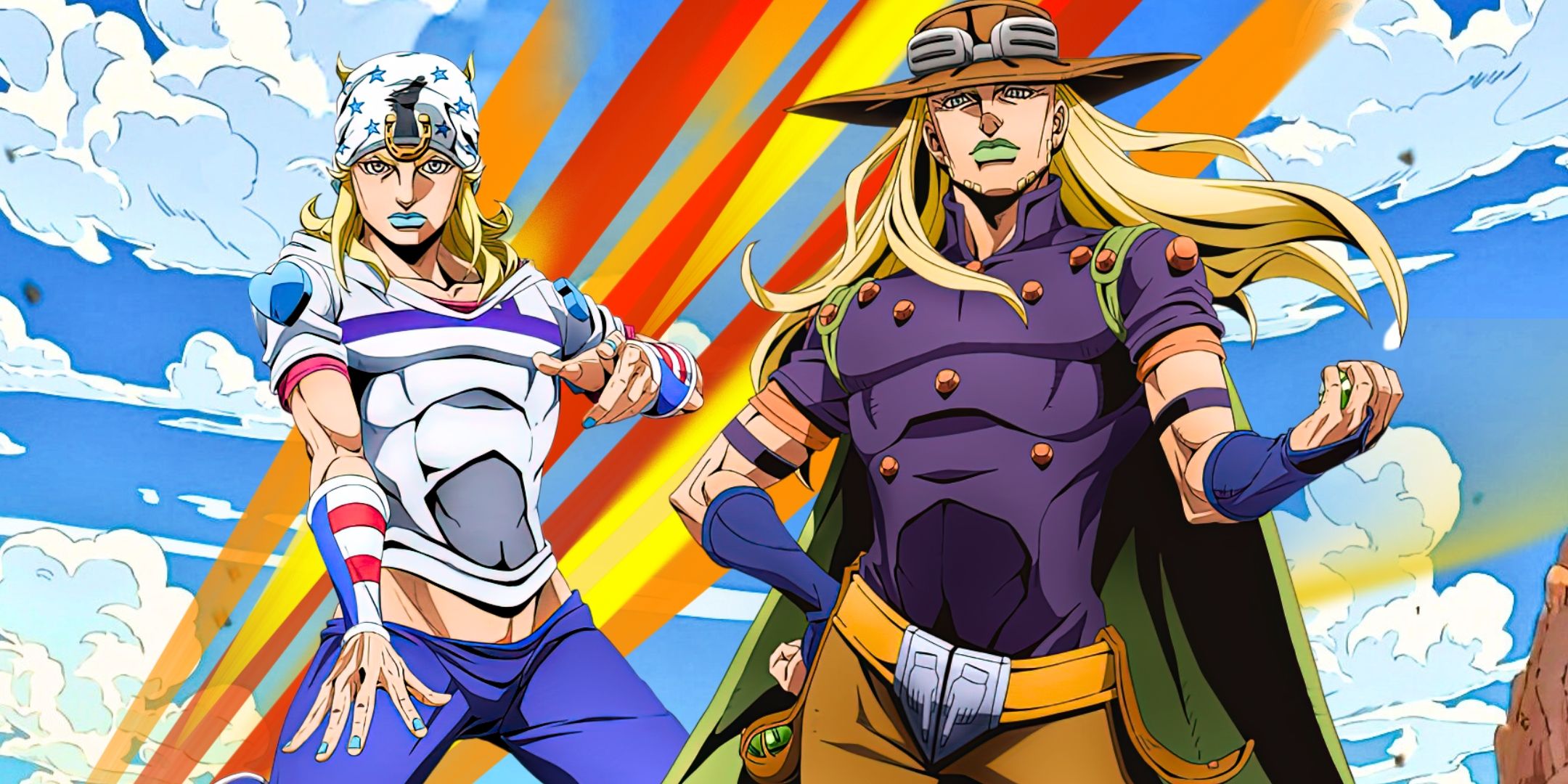
At the beating heart of this American odyssey is the dynamic between Johnny Joestar and Gyro Zeppeli, easily the most layered and psychologically resonant protagonist pairing Araki has ever penned. Johnny is a radical departure from the hyper-altruistic or unflappably stoic Joestars of past generations. A former horse-racing prodigy whose career and spine were shattered by his own petty arrogance, Johnny begins his journey not out of heroic duty, but out of desperate, selfish yearning. He joins the race solely because a brush with Gyro Zeppeli’s mystic weapon temporarily allowed his paralyzed legs to twitch.
Johnny possesses what Araki explicitly terms a “dark determination”—a cold, vacant glint in his eyes that signals a terrifying willingness to kill if it means dragging himself out of what he calls his “negative state.” He does not fight to reach glory; he fights merely to claw his way back to “zero.”
The Dynamic Duo and the Philosophy of the Spin
Counterbalancing Johnny’s brooding desperation is Gyro Zeppeli, a disgraced Neapolitan royal executioner armed with steel spheres, gold-capped teeth, and an irrepressible theatrical flair. Gyro’s quest is driven by quiet altruism—riding to win amnesty for an innocent child condemned to death back home. The camaraderie that develops between them—stitched together through shared campfires, absurd running gags, philosophical epiphanies, and mortal trauma—anchors the bizarre narrative in raw emotional reality.
This dynamic breathes fresh life into the franchise’s combat mechanics through The Spin. Far more scientifically and philosophically engaging than the brute-force stands of previous parts, the Spin is a physical discipline rooted in the Golden Ratio, Fibonacci spirals, and rotational physics. Johnny’s Stand, Tusk, evolves across distinct “Acts” in direct parallel with his psychological recovery and mastery of the Spin, culminating in one of the most conceptually jaw-dropping powers in manga history.
The Technical Nightmare: David Production and the Equestrian Hurdle
If the narrative of Steel Ball Run is a triumph, its realization in motion presents a terrifying industrial bottleneck. For veteran animators, there is an ancient, whispered adage: never make a project centered on running horses.
Equine locomotion is a quadrupedal gauntlet of complex bone structures, shifting muscles, and rhythmic weight distribution. Maintaining consistent, high-octane proportions of a galloping stallion in traditional 2D hand-drawn animation requires elite-tier sakuga talent that is unsustainable across a multi-cour, 30-to-40-episode production schedule. Now multiply that by dozens of racers storming across open plains, dodging supernatural projectiles, and battling mid-stampede.
David Production, alongside potential production partners, faces a critical crossroads:
- Hybrid CGI Implementation: The most realistic path forward mirrors contemporary high-budget anime—leveraging cutting-edge 3D CGI models for the horses while compositing hand-drawn 2D riders on top. However, this approach risks alienating fans if the cel-shading lacks the tactile, hyper-detailed cross-hatching of Araki’s modern art style.
- Stylized Compositing: The studio could lean heavily into dynamic camera angles, heavy speed lines, and extreme close-ups, saving full-body rotational shots for climactic sequences. David Production proved with Fire Force and Urusei Yatsura that their digital department is second to none, but the sheer volume of equestrian scenes makes Part 7 an entirely different beast.
Funny Valentine and the High Stakes of Ideological Warfare
One cannot discuss the enduring buzz of Steel Ball Run without invoking its central antagonist, the 23rd President of the United States: Funny Valentine. Boasting the dimensional-hopping Stand Dirty Deeds Done Dirt Cheap (D4C), Valentine elevates the narrative into high political and philosophical drama.
Unlike the psychotic hedonism of Dio Brando or Yoshikage Kira’s desire for domestic peace, Valentine is driven by an uncompromising, terrifying brand of pure patriotism. He genuinely believes that obtaining the Saint’s Corpse will protect America from all global suffering, redirecting misfortune to the rest of the world. The clash between Johnny’s personal survivalism and Valentine’s utilitarian fascism subverts traditional morality, ensuring the final acts of Part 7 linger long in the mind after the race concludes.
The Path Across the Salt Flats: When Will the Starting Gun Fire?
The online discourse surrounding Steel Ball Run is currently sustained by a thriving subculture of fan animators, bespoke musical compositions, and relentless social media sleuthing. David Production’s recent focus on other projects, alongside the broader industry’s ongoing reckoning with overwork and scheduling pressures, suggests that when Part 7 does surface, it will require an unprecedented window of pre-production.
Rushing Steel Ball Run would be an unforgivable disservice to what critics and readers overwhelmingly regard as one of the greatest sequential art achievements of the 21st century. The fandom understands this. The prolonged silence isn’t a sign of hesitation; it is the breathless anticipation before the starting gun detonates on the shores of San Diego.
How do you think David Production should tackle the legendary equestrian animation of Part 7? Are you holding out for pure 2D or ready to embrace hybrid CGI? Let your voice be heard in the comments below!