Ever since Enrico Pucci’s Made in Heaven accelerated the original timeline into cosmic oblivion at the climax of Stone Ocean, the anime community has occupied a collective state of breath-holding anticipation. For over a decade, David Production pulled off what critics once considered impossible: adapting Hirohiko Araki’s idiosyncratic, fashion-forward, genre-defying generational epic with immaculate fidelity and boundless stylistic flair. Yet, across forum threads, animator roundtables, and festival convention floors, every conversation inevitably circles back to a single monumental horizon: JoJo’s Bizarre Adventure Part 7: Steel Ball Run.
Universally lauded alongside Miura’s Berserk and Inoue’s Vagabond as one of the towering achievements of modern manga, Steel Ball Run is not simply the next chapter in an anthology. It is an absolute metamorphosis. By transporting readers to an alternate 1890 across the sweeping expanse of the American frontier, Araki discarded the constraints of traditional battle shonen to engineer a mature, metaphysical, and morally grey western-thriller. As rumors swirl regarding pre-production whispers and studio scheduling, the question is no longer whether David Production will adapt it, but whether modern television animation can survive the sheer logistical ambition required to bring it to life.
The Seinen Evolution: Araki’s Trans-American Magnum Opus
To understand the near-mythic reverence surrounding Steel Ball Run, one must contextualize its publication history. When serialization began in 2004 in Weekly Shonen Jump, it was briefly presented simply as Steel Ball Run, omitting the JoJo moniker entirely. However, the title’s shift to the monthly Ultra Jump in 2005 marked an artistic renaissance for Araki. Unshackled from grueling weekly deadlines and the demographic sanitized limits of juvenile shonen, Araki indulged in longer-form narrative architecture, visceral anatomical detail, and philosophically complex antagonist motivations.
The premise is deceptively straightforward: a grueling, 3,850-mile equestrian race across the continental United States from San Diego Beach to New York City, lured by a grand prize of fifty million dollars. Yet beneath the dust and adrenaline lies a web of esoteric espionage, where competitors unwittingly become pawns in a geopolitical race to retrieve the mummified Holy Corpse—relics granting godlike reality manipulation. In the 23rd President of the United States, Funny Valentine, Araki created an antagonist whose ruthless, utilitarian nationalism (“taking the first napkin”) acts as a devastating philosophical foil to our deeply broken protagonists.
The Golden Ratio: Johnny, Gyro, and the Mechanics of the Spin
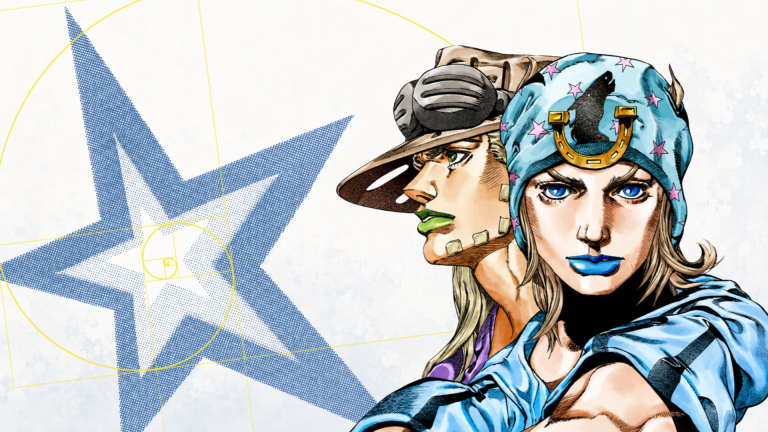
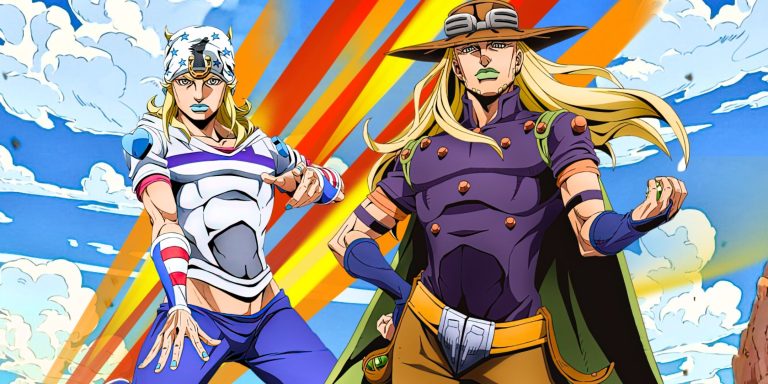
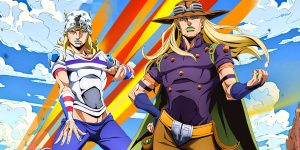
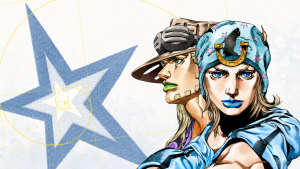
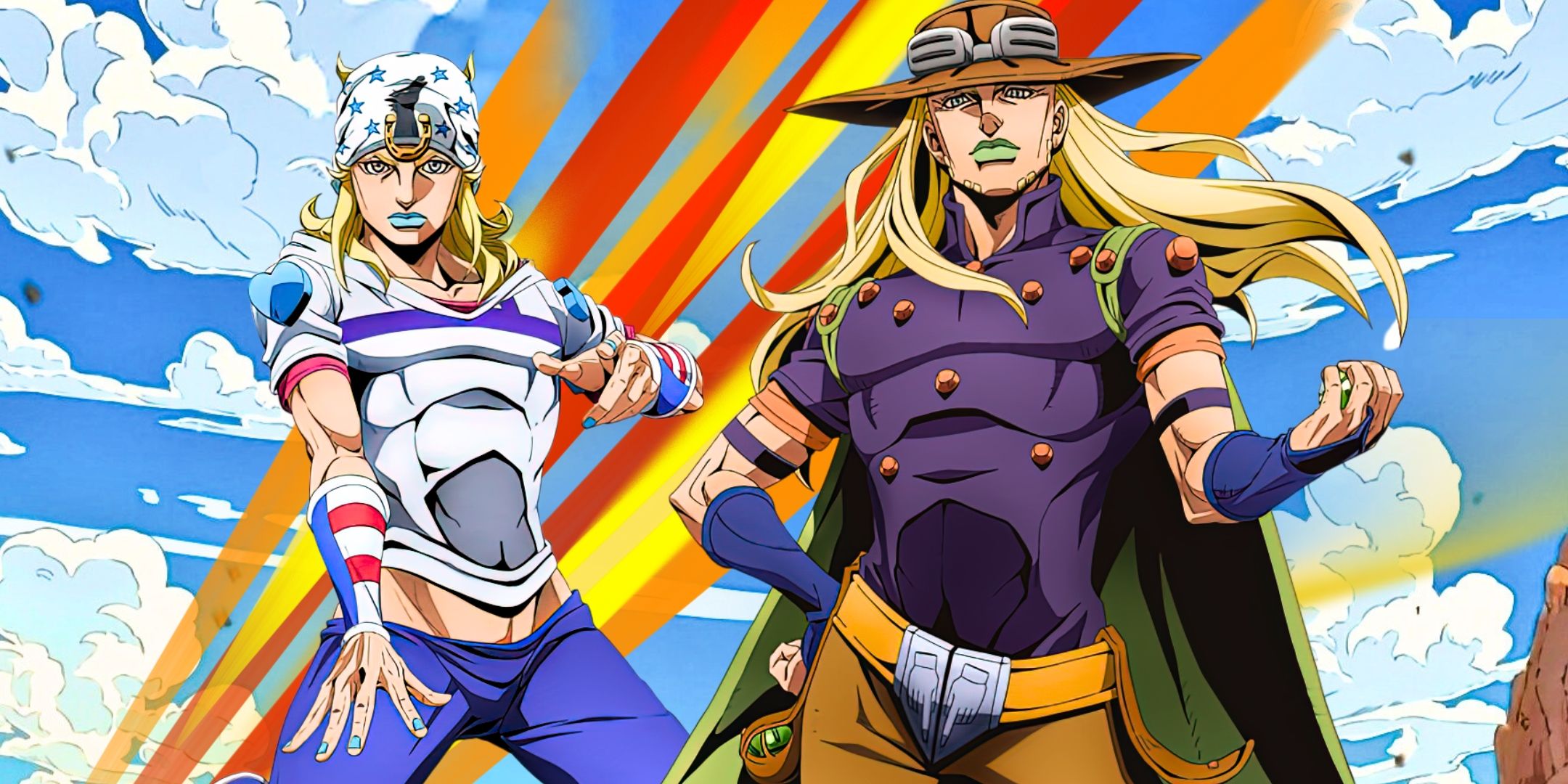
At the beating emotional heart of this race lies the greatest dual-protagonist dynamic Araki has ever penned. In sharp contrast to Jonathan Joestar’s unassailable gentlemanly purity or Jotaro Kujo’s unshakeable stoicism, Johnny Joestar enters the story not as a hero, but as a fallen idol. A prodigal jockey paralyzed from the waist down following an act of petty hubris, Johnny lives in bitter isolation until he encounters Gyro Zeppeli, a brash Neapolitan executioner wielding mystic, rotational steel spheres.
From Tragedy to Transcendence: The Dark Determination
Johnny’s journey is not a hero’s quest to save the world; it is an agonizing, intensely personal struggle to move from “negative to zero.” Paralyzed both physically and spiritually, Johnny’s drive is marked by what Araki explicitly characterizes as “dark determination”—a chilling willingness to sacrifice anything or anyone to reclaim his mobility and dignity. His Stand, Tusk, mirrors this psychological trajectory, evolving through iterative “Acts” as Johnny internalizes deeper philosophical realities of existence and grief.
The Executioner’s Grace: Gyro Zeppeli and the Spin
Gyro Zeppeli, by contrast, is an astonishing collision of operatic silliness and tragic nobility. While cracking bizarre jokes about mozzarella cheese and flaunting gold-plated teeth inscribed with “GO! GO! ZEPPELI,” he carries the harrowing moral burden of his family’s hereditary role as state executioners, seeking the prize money to buy a royal pardon for an innocent child. Through Gyro, Araki introduced the Spin—a metaphysical martial art based on the Fibonacci sequence and the Golden Ratio. Replacing Hamon as the technical counterpart to Stands, the Spin marries real-world mathematics with kinetic shonen mysticism, culminating in attacks that can literally drill holes through dimensional barriers.
The Horsehair Dilemma: David Production’s Greatest Technical Crucible
If the narrative of Steel Ball Run is a masterpiece, its animation adaptation is an executive and logistical minefield. There is an industry adage among Japanese animators: nothing destroys a production schedule faster than water, crowds, and four-legged animals. Steel Ball Run features all three, sustained over dozens of volumes of high-speed equestrian combat.
Animating horses in traditional 2D sakuga demands masterclass draftsmanship; capturing the skeletal anatomy, muscle flexion, and shifting perspective of hundreds of galloping steeds across rolling deserts and snowbound valleys is economically unfeasible for a multi-cour television run. WIT Studio notably circumvented this with strategic framing and 3D hybrids in early seasons of Attack on Titan, but Steel Ball Run cannot afford to keep horses off-screen—they are the literal vehicles of character progression and Stand activation.
The critical question dominating industry discourse is how David Production will navigate the inevitable integration of CGI. While modern cel-shaded 3D rendering has made remarkable strides (as seen in Orange’s Trigun Stampede), JoJo’s visual brand relies heavily on eccentric hatching, shifting non-diegetic color palettes, and heavy-contrast cross-hatching that mimics Araki’s ink work. Merging 3D equine mechanics with bespoke 2D character models without falling into the uncanny valley will determine whether this adaptation ascends to legendary status or collapses under technical compromise.
Appointment Viewing: Fan Expectation in a Post-Binge Era
The anticipation for Steel Ball Run is also deeply entangled with viewer frustrations regarding distribution. The release of Stone Ocean suffered immensely from Netflix’s batch-drop strategy, which completely evaporated the weekly community discourse, real-time fan theories, and communal viral memes that previously defined the cultural footprint of Golden Wind and Stardust Crusaders.
For Part 7, both domestic Japanese audiences and global fans are unequivocally demanding a return to serialized, weekly broadcasts. The narrative structure of the race, divided into explicit “Stages” and punctuated by sudden-death sniper standoffs (such as the legendary “True Man’s World” sequence featuring Ringo Roadagain), is tailor-made for episodic cliffhangers. Furthermore, the sonic landscape promises to be sensational: fans are already eagerly speculating how veteran composer Yugo Kanno might fuse traditional Ennio Morricone spaghetti-western whistling, acoustic blues guitars, and the franchise’s trademark brass-heavy orchestral bombast.
Verdict: Waiting at the San Diego Shoreline
JoJo’s Bizarre Adventure: Steel Ball Run is the ultimate white whale of modern anime. It represents an unprecedented intersection of historical epic, psychological introspection, and genre-defying supernatural action. David Production possesses an unmatched track record of treating Araki’s legacy with reverence, but this project demands an evolution of their internal pipelines, bolder technological experimentation, and unprecedented budgeting.
Whenever the starting pistol finally fires and Johnny and Gyro mount their horses on screen, anime history will witness a watershed moment. Until the official teaser visual drops, the community remains firmly in Gyro’s posture: studying the golden rectangle, waiting for the wind to shift, and preparing for the wildest ride in the medium’s history.
How do you think David Production should tackle the horses: full 2D sakuga for key moments, or stylised 3D integration? Drop your thoughts, favorite fights, and dream voice-cast choices in the comments below!