When the final frames of Stone Ocean faded to the evocative chords of Duffy’s “Distant Dreamer” in late 2022, an entire generation of anime fans exhaled a collective, bittersweet breath. The multi-generational war between the Joestar bloodline and DIO had officially crossed its finish line. Yet, for anyone fluent in the gospel of Hirohiko Araki, the end of the original universe was merely a preamble to the main event. Ever since, the anime community has occupied a state of feverish, electric anticipation for the holy grail of modern sequential art: the adaptation of JoJo’s Bizarre Adventure: Steel Ball Run.
Currently standing shoulder-to-shoulder with Berserk atop global manga rating aggregates, Steel Ball Run is widely considered Araki’s undisputed magnum opus. It represents the pinnacle of his stylistic evolution, pivoting from punch-ghost kineticism into an existential, dust-choked American epic. But bringing Part 7 to life is not just another production cycle for David Production; it is an epochal trial that could redefine what is technically possible in televised anime.
A Soft Reboot into Greatness: Araki’s Seinen Renaissance
To understand why the buzz surrounding Steel Ball Run burns hotter than an Arizona midday sun, one must understand its origin. Debuting in 2004 in Weekly Shonen Jump before migrating to the monthly, mature pastures of Ultra Jump, Part 7 freed Araki from the grueling weekly release treadmill and the editorial constraints of teen-focused manga. The shift fundamentally transformed his storytelling.
Set against the backdrop of an alternate-history 1890, the Steel Ball Run race is a punishing, 6,000-kilometer cross-country trek from San Diego to New York. With a staggering fifty-million-dollar purse on the line, the narrative combines Sergio Leone’s grit with H.P. Lovecraft’s creeping metaphysical terror. Freed from shonen archetypes, Araki traded clear-cut moral paradigms for shades of pragmatic gray, presenting a frontier where survival requires ruthlessness, and every character carries a personal wound seeking salving.
Johnny Joestar and Gyro Zeppeli: Dynamic Duality and the Dark Determination
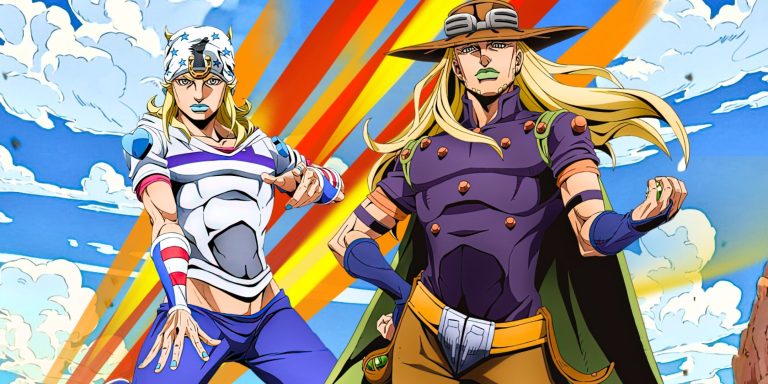
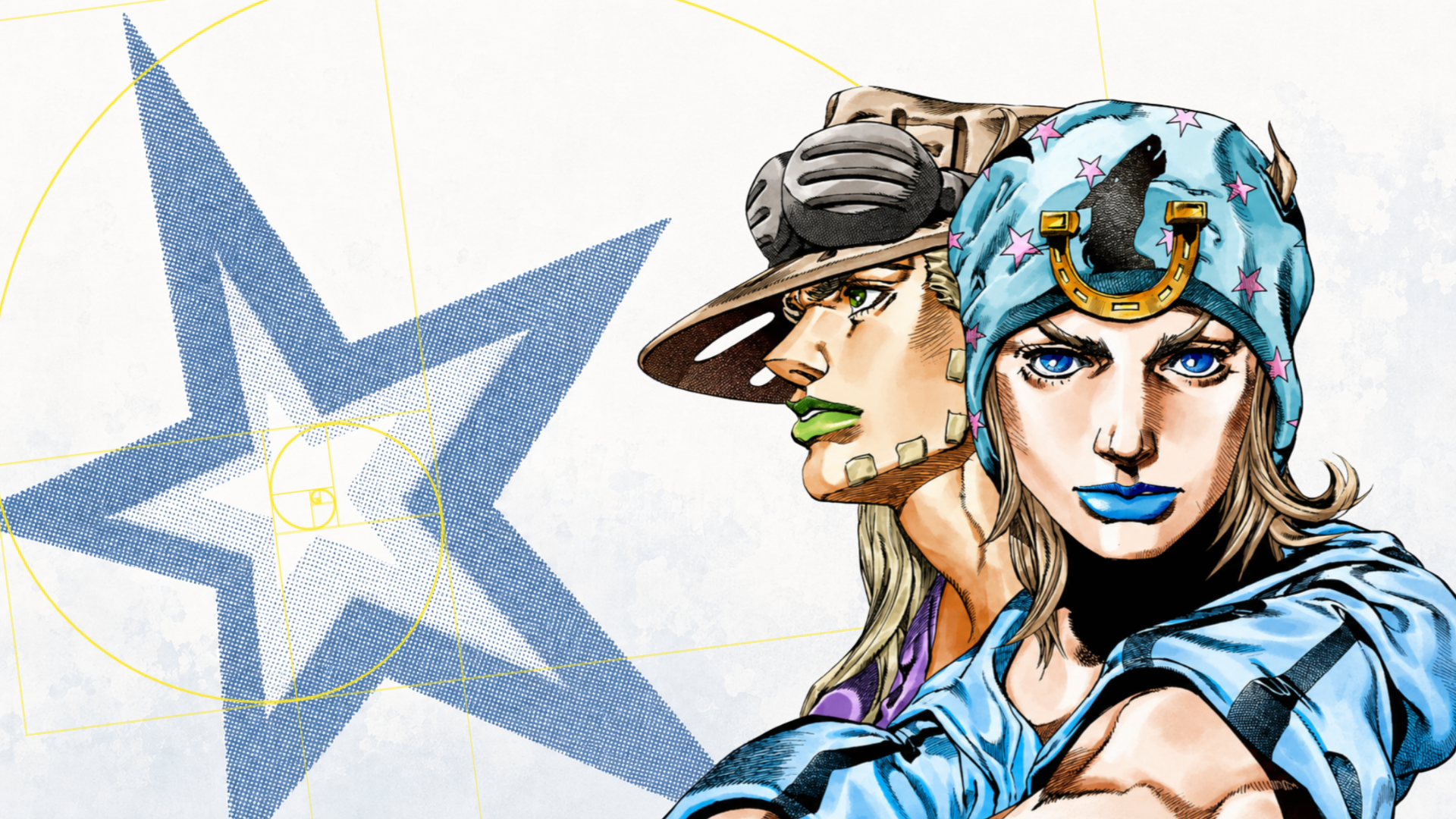
At the center of this storm lies the greatest central duo Araki has ever penned. In subverting expectations, Araki stripped his new “JoJo” of the unyielding nobility seen in Jonathan or Jotaro. Johnny Joestar begins his journey not as a savior, but as a fallen idol: a former horse-racing prodigy whose hubris cost him the use of his legs, leaving him bitter, cynical, and emotionally paraplegic.
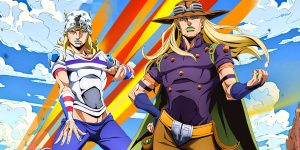
His foil and mentor, Gyro Zeppeli, is an eccentric Neapolitan executioner armed with mystical spinning steel spheres, grillz spelling out “GO! GO! ZEPPELI,” and a hidden code of honor that drives him to save an innocent child from the gallows. Where Johnny is sullen and morally ambiguous—often wielding what Araki terms “dark determination,” a cold-eyed willingness to kill for his goals—Gyro provides eccentric levity, philosophical depth, and relentless charisma.
From Hamon to the Golden Spin: The Geometry of Combat
Combat in Steel Ball Run ditches conventional battle tropes in favor of the Spin: an ancient, mathematically derived technique based on the Golden Ratio and the Fibonacci spiral. By harnessing the physical principles of rotation, Gyro and Johnny manipulate kinetic energy in ways that bridge early JoJo’s Hamon and the bizarre, conceptual Stand battles of modern eras.
Johnny’s Stand, Tusk, serves as an unprecedented visual metaphor for physical and mental rehabilitation. Evolving through multiple “Acts” as Johnny comes to terms with his trauma and deepens his understanding of the Golden Rectangle, the Stand transforms Johnny’s fingernails into high-caliber projectiles, eventually escalating into a localized, dimension-shattering force of infinite rotation. It is an astonishing narrative mechanic that blends tactical martial arts with raw psychological catharsis.
The Stallion in the Room: David Production’s Technical Gauntlet
If the thematic landscape of Steel Ball Run is ambitious, its physical logistics are downright terrifying for an animation studio. The primary reason David Production has taken its time—letting side projects like Urusei Yatsura breathe in the interim—boils down to a single, notorious industry nightmare: horses.
In traditional hand-drawn 2D animation, quadrupeds are among the most labor-intensive subjects imaginable. A horse’s gait involves complex skeletal shifts, rippling muscular anatomy, and perspective challenges that break the back of even veteran key animators. Now multiply that by dozens of steeds galloping simultaneously through sandstorms, rivers, and dense forests over the course of roughly twenty-four to thirty-six episodes.
The industry consensus suggests David Production must walk a razor-thin tightrope. A pure 2D approach could cause crippling scheduling collapses; a heavy-handed, poorly integrated 3D CGI approach risks alienating a fan base that demands Araki’s signature linework and hatching. To succeed, the studio will likely need a hybrid pipeline similar to Orange’s work on Trigun Stampede or MAPPA’s grander set-pieces in Vinland Saga: sophisticated 3D models augmented with extensive 2D hand-drawn draw-overs to preserve the auteur’s gritty, crosshatched aesthetic.
The Corpse, the President, and Political Metaphysics
Beyond its equine hurdles, Steel Ball Run boasts what many consider the most nuanced antagonist in anime history: Funny Valentine, the 23rd President of the United States. Valentine is neither a cartoonish dictator nor an apocalyptic nihilist; he is an ultra-nationalist driven by an unshakable, high-minded patriotic fervor. His goal is to assemble the mummified pieces of a divine Holy Corpse scattered across the continent to guarantee eternal prosperity for America at the direct expense of the rest of the world.
His Stand, Dirty Deeds Done Dirt Cheap (D4C), allows him to traverse parallel dimensions, treating mortality itself as a disposable resource. Valentine’s philosophical debates with Johnny—centering on who gets to take the “first napkin” to set society’s rules—elevate Steel Ball Run from a competitive sports manga with superpowers to an astonishing inquiry into destiny, collective responsibility, and American exceptionalism.
The Horizon: A New Paradigm for JoJo
The buzz surrounding Steel Ball Run is not just idle internet chatter; it represents the threshold of a new epoch for the franchise. The series holds the potential to capture the demographic that outgrew traditional battle shonen and now craves the narrative complexity of Vinland Saga, Attack on Titan, or Chainsaw Man. If David Production can harness the technical ingenuity required to render the galloping dust and geometric majesty of the Spin, Part 7 won’t just be an adaptation—it will be an undisputed cultural event.
The starting gun has not yet fired, but the saddle is strapped, the spurs are spinning, and the trail is calling. The only question that remains is whether you are prepared to witness Araki’s masterpiece in motion.
Which moment from Steel Ball Run are you most desperate to see animated—Johnny’s breakthrough with Tusk Act 4, or the tragic serenade of the Pizza Mozzarella song? Let us know in the comments below!