For more than a decade, the anime adaptation of Hirohiko Araki’s multi-generational epic, JoJo’s Bizarre Adventure, has operated like a relentless locomotive. From the Victorian melodrama of Phantom Blood to the dimensional collapse of Stone Ocean, David Production has painstakingly transformed Araki’s eccentric pop-art tapestries into dynamic television gold. Yet, ever since Jolyne Cujoh’s curtain call on Netflix in late 2022, a deafening silence has hung over the franchise. The international fandom has existed in a collective state of breath-holding, waiting for the singular green light that promises to shatter the internet: JoJo’s Bizarre Adventure Part 7: Steel Ball Run.
To call Steel Ball Run mere “hype” drastically undersells its cultural footprint. Routinely vying with Kentaro Miura’s Berserk for the number two spot of all-time highest-rated manga on platforms like MyAnimeList, Part 7 is universally heralded as Araki’s magnum opus. A reinvention that resets continuity, narrative conventions, and thematic boundaries, it represents both the apex of supernatural storytelling and the greatest technical trial David Production will ever encounter.
The Great American Shift: Rebuilding the Mythos from Shonen to Seinen
When Araki launched Steel Ball Run in 2004, it was initially serialized without the explicit “JoJo” moniker before pivoting to Shueisha’s monthly seinen magazine, Ultra Jump. This structural migration liberated the creator from the grueling weekly deadlines and thematic guardrails of standard shonen manga. The consequence was an astronomical leap in artistic detail, psychological nuance, and philosophical maturity.
Set across a fictionalized late-19th-century America, the narrative anchors itself to an unprecedented spectacle: a grueling, coast-to-coast equestrian race spanning 6,000 kilometers from San Diego to New York City, boasting a staggering $50 million grand prize. On its glossy surface, the event is a capitalist fever dream organized by visionary promoter Steven Steel. Beneath the sand, sweat, and gunpowder, however, lies an occult quest for scattered relics that hold the metaphysical destiny of the world.
This historical revisionism allowed Araki to step away from the straightforward punch-ghost dynamic established in Stardust Crusaders. Instead, Steel Ball Run unfurls as an existential frontier thriller—a blend of Cormac McCarthy bleakness, Sergio Leone tension, and trademark JoJo surrealism.
A Dual Pilgrimage: Johnny Joestar, Gyro Zeppeli, and the Spin
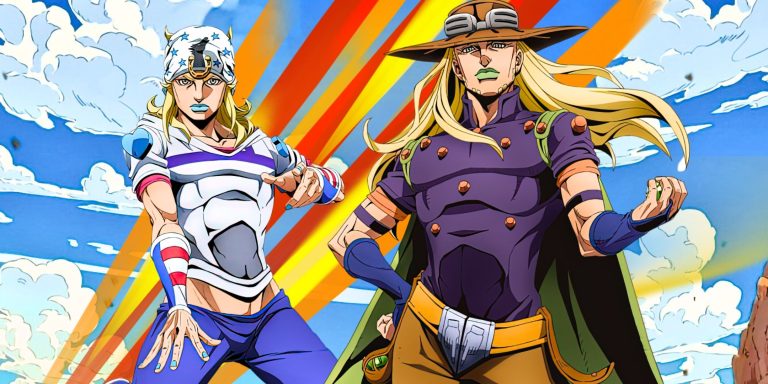
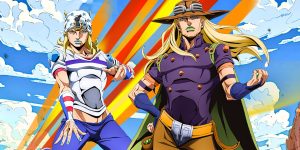
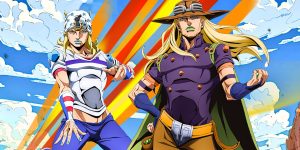
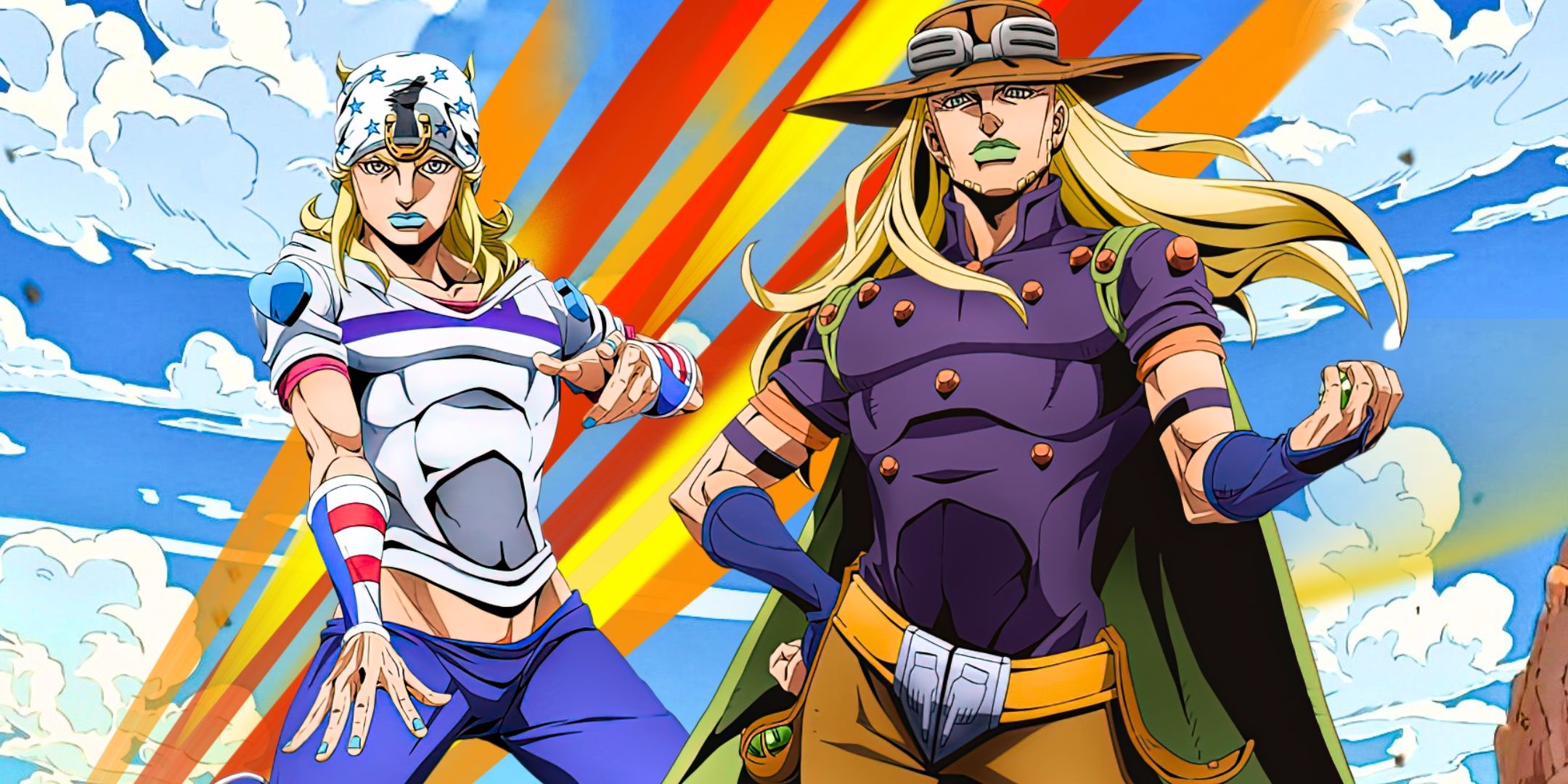
At the beating heart of Part 7’s critical reverence is the relationship between its twin leads, Johnny Joestar and Gyro Zeppeli. Far removed from the infallible moral fortitude of Jonathan Joestar or the swaggering cool of Jotaro Kujo, Johnny represents a daring, radically vulnerable subversion of the traditional protagonist archetype.
Johnny Joestar: The Gravity of Negative Zero
Crippled from the waist down following an act of youthful arrogance, Johnny is a fallen prodigy jockey drowning in depression, bitterness, and self-pity. Araki does not write him as an inspiring beacon of resilience; he writes him as a desperate man clawing for a shred of spiritual salvation. Johnny’s ultimate goal isn’t to save humanity or defeat evil—it is to bring his fractured existence from “negative” back to “zero.” His Stand, Tusk, mirrors this inner journey, evolving through distinct “Acts” that chart his psychological healing and deepening connection to the mystical phenomena surrounding him.
Gyro Zeppeli: Steel, Honor, and the Golden Ratio
Balancing Johnny’s dark, smoldering interiority is Gyro Zeppeli: an eccentric Neapolitan executioner armed with specialized throwing orbs, an absurd sense of humor, and teeth etched with “GO! GO! ZEPPELI.” Gyro seeks the race’s purse solely to secure royal amnesty for an innocent child condemned to death. Beyond his flamboyant bravado, Gyro acts as Johnny’s mentor, initiating him into the legacy of The Spin—an ancient kinetic technique rooted in the Fibonacci sequence and the mathematical perfection of the Golden Ratio.
The dialogue between Johnny and Gyro stands as Araki’s finest character writing to date. Their quiet campfires under star-drenched deserts, punctuated by bizarre running gags about days of the week or mozzarella cheese songs, lend emotional weight to the brutal, high-stakes gunfights waiting over the next hill.
The Equestrian Hurdle: David Production’s Technical Crossroads
If the narrative of Steel Ball Run is universally acclaimed, its road to television screens is fraught with logistical terror. The central barrier standing between pre-production and broadcast can be summed up in a single word: horses.
In modern 2D animation, quadrupeds—and horses in particular—are notoriously regarded as the ultimate production nightmare. Maintaining anatomical correctness, complex skeletal motion, and musculature across thousands of dynamic frames is an exhausting, budget-draining ordeal. In Steel Ball Run, horses are not incidental background set dressings; they are core narrative vehicles engaged in ferocious cavalry skirmishes across unpredictable terrain.
Studio executives and industry insiders have repeatedly acknowledged this dilemma. David Production faces an enormous stylistic tightrope:
- Full 2D Hand-Drawn Animation: Visually majestic, but a logistical impossibility over a projected 36-to-48-episode run without catastrophic outsourcing or production implosions.
- Hybrid 3DCG Rendering: The most realistic methodology, utilizing high-end cel-shaded models for mounted sequences blended with hand-drawn character close-ups.
The studio’s work on Fire Force and Urusei Yatsura demonstrates that their compositing and stylistic flair are stronger than ever. Furthermore, the industry has seen miraculous leaps in CG-2D symbiosis through studios like Orange (Trigun Stampede) and MAPPA’s handling of complex set pieces. If David Production can harness custom cel-shaded rigs that preserve Araki’s gritty, cross-hatched line art, the technical barrier will turn into an artistic triumph.
From Saint’s Corpses to Manifest Destiny: The Ideological War
The mythos of Steel Ball Run ascends from a magnificent western to an all-time classic once the true nature of the race’s objective is unveiled: gathering the mummified pieces of the Holy Corpse. This macabre MacGuffin brings the protagonists into direct collision with the 23rd President of the United States, Funny Valentine.
Valentine is widely considered one of the most compelling antagonists in manga history. Operating with the reality-shifting Stand Dirty Deeds Done Dirt Cheap (D4C), Valentine is entirely devoid of standard villainous sadism. He is an unyielding patriot driven by radical utilitarianism, convinced that taking “the first napkin” will secure endless prosperity for his young nation at the expense of the rest of the planet. The collision between Valentine’s chilling political vision and Johnny’s raw, personal survivalism elevates the climax into a sprawling philosophical tragedy.
A Trans-Continental Destiny Awaits
Whether David Production unveils the teaser at the next franchise showcase or makes the world wait another calendar year, the cultural appetite for JoJo’s Bizarre Adventure: Steel Ball Run will not diminish. Part 7 is the golden fleece of anime adaptations—a watershed moment where high-concept supernatural combat, tragic historical adventure, and unmatched character intimacy converge.
The horses are at the starting gate, the desert wind is blowing, and when the whistle finally blows, anime fandom will bear witness to one of the greatest journeys ever committed to the screen.
What are your biggest hopes and fears for the Steel Ball Run anime adaptation? Do you think David Production should lean into 3D equestrian animation, and who is your dream voice cast for Gyro Zeppeli? Sound off in the comments below, and keep your browsers locked to Wibux.com for breaking anime news, deep-dive analyses, and exclusive breakdowns.