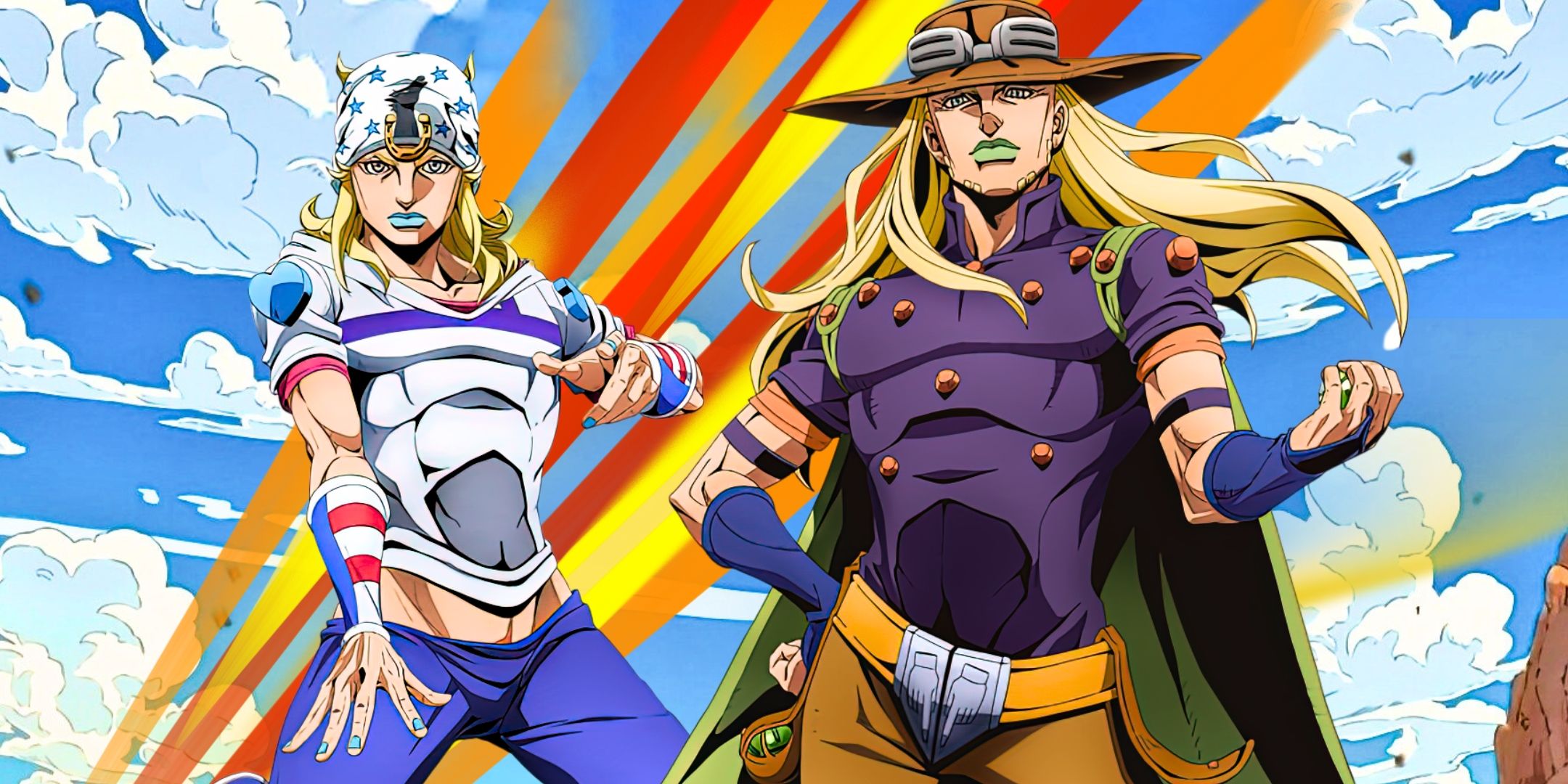
Ever since the melancholic, universe-resetting notes of Duffy’s “Distant Dreamer” brought Stone Ocean to an emotional close in late 2022, an unspoken countdown began within the global anime community. For over a decade, David Production has pulled off one of the most astonishing creative marathons in contemporary media: faithfully transforming Hirohiko Araki’s generational, multi-era manga into a kinetic, hyper-stylized anime phenomenon. Yet, every milestone achieved across six distinct parts was always overshadowed by a singular, looming question whispered across forums, convention halls, and Reddit threads: When will we get Steel Ball Run?
Ranked consistently alongside Kentaro Miura’s Berserk and Takehiko Inoue’s Vagabond as one of the highest-rated manga of all time, JoJo’s Bizarre Adventure: Part 7 – Steel Ball Run represents both the pinnacle of Araki’s artistic evolution and an unprecedented technical gauntlet for any animation studio daring enough to tackle it. As industry rumblings intensify and fan anticipation reaches a fever pitch, it is time to dissect the narrative, philosophical, and mechanical gravity of the anime adaptation that could redefine David Production’s legacy forever.
The Reinvention of Araki’s Mythos: From Shonen Spectacle to Seinen Masterwork
To understand the near-mythic reverence surrounding Steel Ball Run, one must understand its origin. Debuting in Weekly Shonen Jump in 2004 before transitioning to the monthly seinen magazine Ultra Jump, Part 7 freed Hirohiko Araki from the rigid editorial constraints of weekly shonen deadlines. The result was transformative. Araki seized the opportunity to indulge in wider panoramic compositions, intricate paneling, and an uncompromising, morally grey thematic canvas.
Set in an alternate 1890, the narrative centers on the eponymous Steel Ball Run: a grueling, 6,000-kilometer cross-country horse race spanning from San Diego to New York City, carrying a staggering $50 million grand prize. What begins as an homage to classic Western cinema and American manifest destiny rapidly morphs into an occult geopolitical proxy war. By resetting the continuity after the cataclysmic events of Stone Ocean, Araki liberated himself from decades of baggage, crafting a standalone odyssey that simultaneously deconstructs and elevates every hallmark of the franchise.
Johnny Joestar and Gyro Zeppeli: Dual Protagonism and Moral Ambiguity
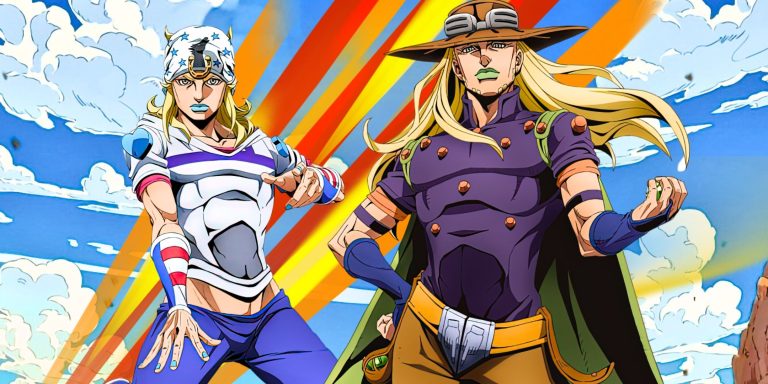
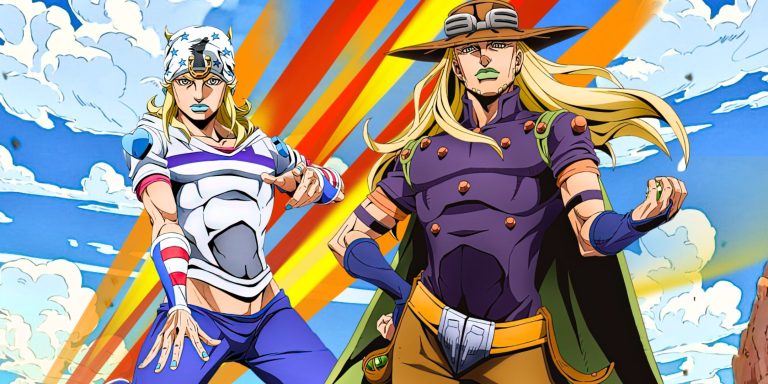
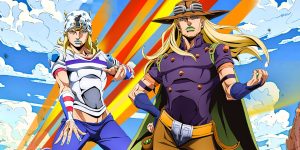
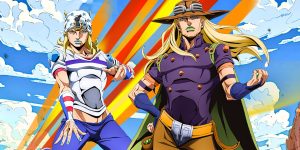
At the beating heart of Steel Ball Run lies what is arguably the most intricately written duo in modern manga history: Johnny Joestar and Gyro Zeppeli. Their dynamic moves far beyond the classic hero-mentor tropes established by Jonathan Joestar and Will A. Zeppeli in Part 1, embodying a messy, emotionally raw interdependence.
Johnny Joestar’s Dark Determination
Unlike his righteous ancestors, Johnny Joestar is fundamentally broken. A former prodigy jockey struck down by arrogance and paralyzed from the waist down, Johnny enters the race not out of nobility, but out of a desperate, borderline-feral obsession to reclaim his ability to walk after witnessing the kinetic wonder of Gyro’s steel balls. Throughout the narrative, Araki frequently draws attention to the “dark determination” burning in Johnny’s eyes—a terrifying willingness to sacrifice anything, or anyone, to claw his way out of spiritual and physical stagnation. His Stand, Tusk, mirrors this agonizing psychological journey, evolving across four distinct “Acts” that trace Johnny’s transition from a helpless, crawling outcast to a master of universal physics.
Gyro Zeppeli and the Legacy of the Spin
Complementing Johnny’s introverted cynicism is Gyro Zeppeli, a disgraced Neapolitan executioner whose flamboyant swagger and gold-plated teeth mask a noble, self-sacrificing quest to save an innocent child from state execution. Gyro introduces the narrative to the Spin—a supernatural martial art grounded in the geometry of the Golden Ratio. Far more conceptually elegant than the sheer brute force of later Stand battles, the Spin revitalizes the rotational energy principles of early JoJo “Hamon” (the Ripple), weaving mathematical mysticism into the kinetic combat of the American frontier.
The Elephant in the Room: David Production’s Equestrian Nightmare
If the narrative of Steel Ball Run is a masterpiece waiting to be realized, its logistical reality is an animator’s waking nightmare. Ask any veteran director or key animator about the most difficult subjects to draw in 2D animation, and the answer is universally identical: horses.
Anatomy, dynamic muscle flexing, galloping gaits, and perspective shifts make equestrian animation notoriously labor-intensive. In Steel Ball Run, horses are not incidental background set dressing; they are primary characters that run, leap, collide, bleed, and sprint across varied terrains for hundreds of consecutive chapters. In previous anime adaptations—such as Wit Studio’s work on Attack on Titan or MAPPA’s production of Vinland Saga—studios have increasingly relied on CGI integration to manage cavalry charges and riding sequences.
However, David Production’s signature visual grammar relies heavily on exaggerated 2D poses, hard lines, and Araki’s iconic color-shifting palettes. Fully rendering the race sequences in traditional hand-drawn 2D could bankrupt a studio or stretch production schedules into multi-year delays. Conversely, relying on poorly integrated 3D CGI risks alienating one of the most passionate fanbases in anime. To conquer Part 7, David Production will likely need to forge a revolutionary hybrid workflow—potentially partnering with specialized 3D powerhouses like Studio Orange or Sanzigen—to deliver cell-shaded equestrian motion that seamlessly matches their legendary 2D character artistry.
The Saint’s Corpse, Funny Valentine, and Socio-Political Weight
Beyond the logistical spectacle, the upcoming anime adaptation carries immense thematic weight through its antagonist, Funny Valentine. The 23rd President of the United States serves as the ultimate subversion of ideological villainy. Operating under the conviction that the ends entirely justify the means, Valentine seeks the scattered mummified relics of the Saint’s Corpse to secure absolute prosperity and geopolitical hegemony for America at the expense of the rest of the world.
His Stand, Dirty Deeds Done Dirt Cheap (D4C), introduces mind-bending multiversal mechanics that will demand extraordinary visual direction to parse on screen. The ideological clash between Valentine’s utilitarian, imperialist nationalism and Johnny’s deeply selfish, localized pursuit of personal redemption transforms Steel Ball Run from an action-adventure into a layered exploration of faith, patriotism, and existential worth. When brought to life with full voice acting and a sweeping orchestral/western-fusion score, these confrontations will undoubtedly dominate seasonal anime discourse.
The Inevitable Stampede: Why the Wait Will Be Worth It
Rumors regarding early pre-production, voice cast auditions, and timeline roadmaps continue to swirl through the anime industry pipeline. While David Production has kept official announcements close to the chest—diverting attention toward intermediate spin-offs and diverse studio projects—the production of Steel Ball Run is less a question of “if” and entirely a question of “when.”
Adapting Hirohiko Araki’s magnum opus requires patience, unprecedented technical innovation, and immense budgetary commitment. Rushing Part 7 would be a creative disservice to one of sequential art’s greatest achievements. But when that first official trailer finally drops—when the whistle of the trans-American wind gives way to the thunderous roar of hooves across the San Diego desert—it will signal the start of an anime era unlike anything we have seen before.
Now it’s your turn, Wibux readers: How do you think David Production should tackle the challenge of animating the horses? Who is your dream voice casting for Gyro and Johnny? Sound off in the comments below!