
When the anime world lost Akira Toriyama in March 2024, an entire global collective paused to mourn an architect of modern mythology. Toriyama did not merely draw manga; he constructed a visual lexicon that taught generations of creators how to balance kinetic momentum, slapstick whimsy, and operatic stakes. With the broadcast premiere of Dragon Ball Daima, fans are not simply tuning in for another season of ki blasts and Super Saiyan hair recolors—they are witnessing the sensei’s final curtain call. Commissioned to commemorate the franchise’s 40th anniversary, Daima serves as Toriyama’s heartfelt swansong, diving headfirst into an intoxicating cocktail of classic adventurism, untapped worldbuilding, and cinematic martial arts.
Far from a disposable nostalgia trip, the series premiere immediately dispels the cynical fears that this would be a hollow rehash of Dragon Ball GT. Instead, Daima proves to be an authoritative re-anchoring of the mythos, trading the universe-destroying power-scaling of Dragon Ball Super for the intimate, ground-level magic that made Goku’s earliest travels across Mount Paozu so unforgettable.
The Shadow of the Demon Realm: Unraveling the Makai Lore
For four decades, the Demon Realm (Makai) existed primarily in the periphery of Toriyama’s sandbox. It was a shadowy realm occasionally referenced in databooks, briefly personified by Dabura in the Majin Buu arc, and expanded upon exclusively through non-canon video games like Dragon Ball Heroes and Xenoverse. In Daima‘s masterfully paced double-length opening episode, Toriyama finally takes full ownership of this uncharted subterranean multiverse, legitimizing decades of speculative lore with his singular design sensibility.
Beyond Dabura and the Realm of the Supreme Kais
The premiere wastes no time introducing the new power dynamics governing the Demon Realm following Dabura’s demise at the hands of Majin Buu. We meet King Gomah, a neurotic and opportunistic ruler who steps into the power vacuum alongside Degesu—the younger brother of Universe 7’s Shin (the Supreme Kai)—and Dr. Arinsu, a brilliant, aloof scientist who immediately commands attention. This family dynamic alone blows the franchise’s theological framework wide open: the Supreme Kais and the denizens of the Demon Realm are intrinsically linked through divine genetics, peeling back layers of cosmology that have remained opaque since 1994.
Furthermore, the premiere reframes Namekian history with seismic implications. The revelation of Neva, an ancient Demon Realm Namekian who created a unique set of Dragon Balls guarded by the towering “Tamagami,” re-contextualizes Piccolo’s lineage. Toriyama seamlessly weaves these grand, mythological additions into a narrative driven by petty villainy: King Gomah, terrified of the Earthlings who defeated Buu, uses these sinister orbs to make a wish that strikes directly at the Z-Fighters’ core.
Miniaturized Nostalgia: The Psychology Behind the De-Aging
When Toei Animation first revealed that Goku and his comrades would be transformed into children, the collective skepticism of the fandom was palpable. Memories of Goku’s miniature tenure in 1996’s Dragon Ball GT elicited groan-worthy flashbacks of lost power and pacing issues. Yet, within the first thirty minutes of Daima, Toriyama’s thematic intent becomes razor-sharp: shrinking the cast is not a marketing gimmick; it is an ingenious narrative equalizer.
Subverting the GT Comparisons
Unlike GT, which isolated Goku with Pan and Trunks while benching the rest of the ensemble, Gomah’s wish systematically targets everyone associated with the Babidi incident. Watching Vegeta seethe with pint-sized fury, Piccolo struggle to adjust his elongated limbs, and Master Roshi return to toddler-hood injects an organic, character-driven comedy that modern Dragon Ball has desperately lacked. It transforms powerhouses who routinely grapple with the gods into physical underdogs once more.
For Goku, this physical reduction strips away the sterile omnipotence of God Ki and Ultra Instinct. By robbing him of his mature reach and muscle mass, Daima forces the Saiyan prodigy back to his roots. The premiere lovingly restores the Nyoibo (Power Pole) to his arsenal, re-establishing physical spacing, momentum, and tactile weapon-play. Goku’s psychology shifts back to that of an eager student trying to understand his center of gravity, grounding the protagonist in ways that make his upcoming battles feel genuinely dangerous again.
Visual Splendor: Toei Animation’s Peak Kinematic Craft
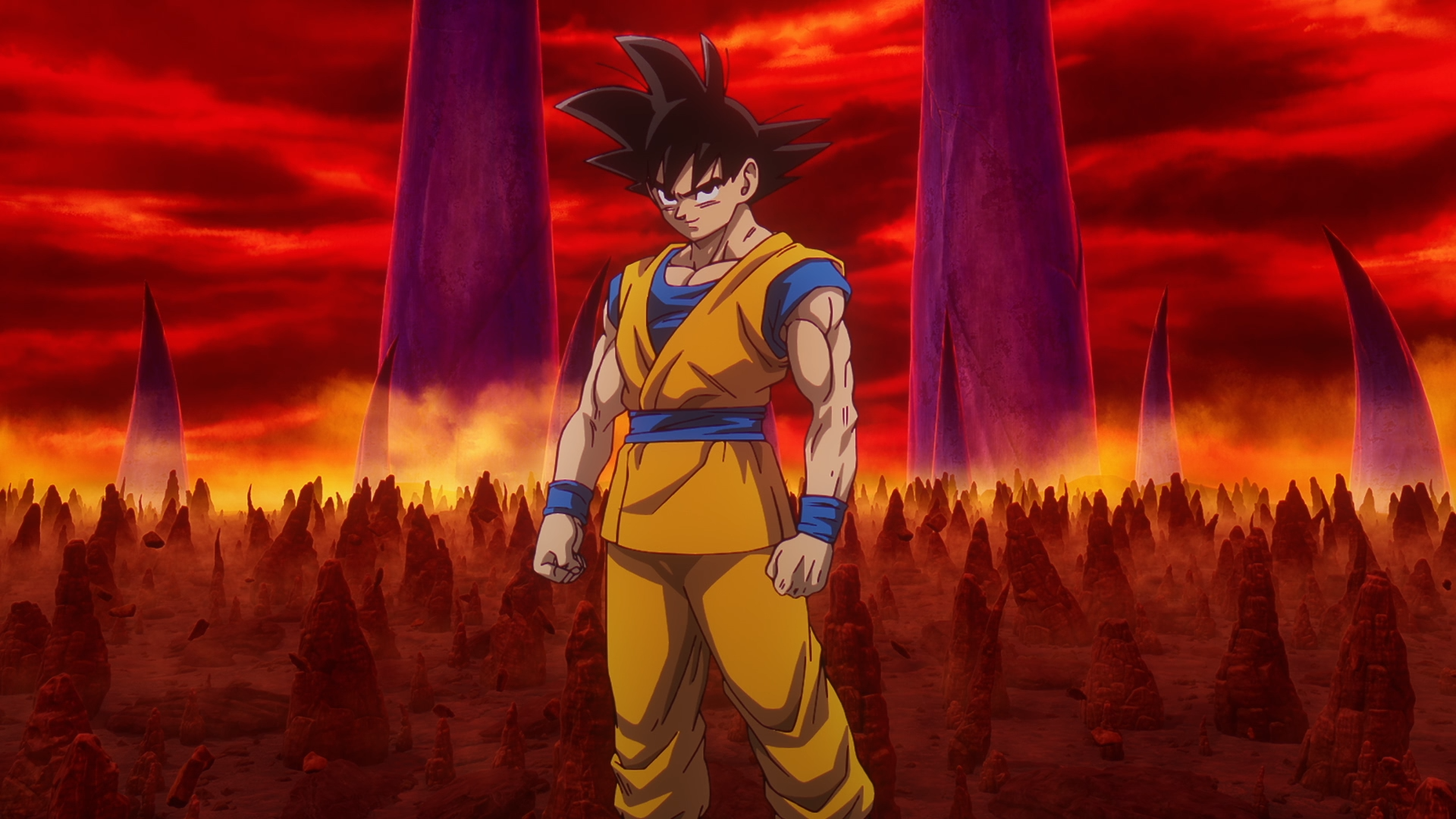
Visually, Dragon Ball Daima stands as an absolute triumph for Toei Animation. Helmed by veteran directors Aya Komaki (One Piece: Wano Arc) and Yoshitaka Yashima, and anchored by legendary character designer Katsuyoshi Nakatsuru, the premiere operates at a level of kinematic fluidity typically reserved for high-budget theatrical features like Dragon Ball Super: Broly.
The Legacy of Toriyama’s Aesthetic Precision
What immediately stands out is the production’s reverent adherence to Toriyama’s iconic late-era art style: rounder silhouettes, expressive faces, and immaculate mechanical designs. The strange biomechanical ships, quirky gadgets, and culinary oddities of the Demon Realm feel ripped straight from Toriyama’s personal sketchbooks. There is an earthy, tactile warmth to the background art that makes the Third Demon World feel alive, eerie, and undeniably charming.
When the action finally ignites, the choreography abandons the repetitive, strobe-lit flurry-punches and beam struggles that have long plagued serialized shonen. Instead, the premiere delivers breathtaking, sequence-by-sequence hand-to-hand combat. Hits carry concussive weight, footwork dictates counter-attacks, and the camera moves with dynamic fluidity around the environment. It is a stunning visual manifesto that honors martial arts as a language of character expression rather than mere spectacle.
Community Pulse and Emotional Resonance: A 40-Year Odyssey
The global reception to Dragon Ball Daima has been an extraordinary convergence of grief, celebration, and genuine critical acclaim. Fans across social feeds and dedicated forums have noted that the premiere feels less like an assembly-line product and more like a passion project overseen with meticulous care. The opening theme, “Jaka Jaan”—a collaboration between Grammy-winning producer Zedd and Japanese duo C&K, with lyrics penned by Yukinojo Mori—captures an infectious, adventurous energy that perfectly encapsulates the shift from grim apocalyptic battles to uninhibited exploration.
Honoring a Sensei’s Parting Gift
There is an undeniable emotional weight underpinning every frame of this premiere. Akira Toriyama was deeply involved in Daima from its inception, drafting the story, designing nearly every character and vehicle, and fleshing out the dialogue far more intimately than he did for Dragon Ball Super. Knowing that this is his final completed vision elevates the viewing experience into something sacred.
Toriyama didn’t want his audience to remember his universe as a bleak cosmic battlefield where power levels dictate worth. Through Daima, he reminds us of what made us fall in love with his world in the first place: the sheer, joyous thrill of stepping onto a flying cloud, heading into the unknown with a loyal friend, and discovering that the universe is far larger, stranger, and more wonderful than we ever imagined.
The Verdict: Goku’s Eternal Journey
The premiere of Dragon Ball Daima accomplishes the impossible: it rejuvenates a 40-year-old franchise by stripping away its bloated excesses and celebrating its foundational core. Packed with pristine animation, profound additions to canon lore, and Toriyama’s inimitable spirit, the series stands as a brilliant, heartwarming testament to the medium’s greatest pioneer. The adventure has only just begun, and the road ahead looks brighter than ever.
What did you think of the Dragon Ball Daima premiere? Did the deep-dive into the Demon Realm live up to your expectations, or are you still pining for Ultra Instinct? Drop your theories in the comments below, and stay tuned to Wibux.com for our weekly episode breakdowns!