Few titles in the history of serialized manga occupy a pedestal quite as revered—or as fiercely guarded—as JoJo’s Bizarre Adventure: Part 7 – Steel Ball Run. Consistently rubbing shoulders with Kentaro Miura’s Berserk atop global critical aggregators, Hirohiko Araki’s sweeping, revisionist Western epic is broadly recognized as his magnum opus. Ever since the melancholic final chords of Stone Ocean faded in late 2022, bringing the thirty-five-year-old original Joestar bloodline saga to an emotional close, the global anime fandom has held a collective, nervous breath. The question is no longer whether Steel Ball Run deserves an anime adaptation; it is whether the modern industry, and David Production specifically, possesses the technical wizardry and sheer resolve required to bring Araki’s sprawling 1890 trans-American race to life without collapsing under the weight of its own ambition.
The Seinen Rebirth: Hirohiko Araki’s Trans-Continental Odyssey
To understand the current buzz surrounding Steel Ball Run, one must appreciate the radical paradigm shift it represented for Araki himself. Serialized initially in Weekly Shonen Jump before migrating to the monthly, mature pastures of Ultra Jump in 2005, Part 7 unshackled the author from the relentless weekly grind and demographic constraints of typical teen-centric manga. The result was transformative: longer chapters allowed for expansive, cinematic panelling, richer historical worldbuilding, and morally ambiguous storytelling that completely subverted the established JoJo blueprint.
Set against the vast, unforgiving expanse of late-19th-century North America, the narrative follows the Steel Ball Run—a grueling, coast-to-coast equestrian race spanning from San Diego Beach to New York City, featuring a jaw-dropping fifty-million-dollar purse. Yet behind the dust, blood, and commercial bravado orchestrated by eccentric promoter Steven Steel lies a geopolitical conspiracy anchored by the pursuit of the mummified relics of a holy figure. By cleanly severing ties with the continuity of Parts 1 through 6, Araki gave newcomers a pristine entry point while presenting veteran fans with a deeply subversive masterwork that trades neon urban brawls for dust-choked prairie survivalism.
Johnny and Gyro: Deconstructing the JoJo Dynamic
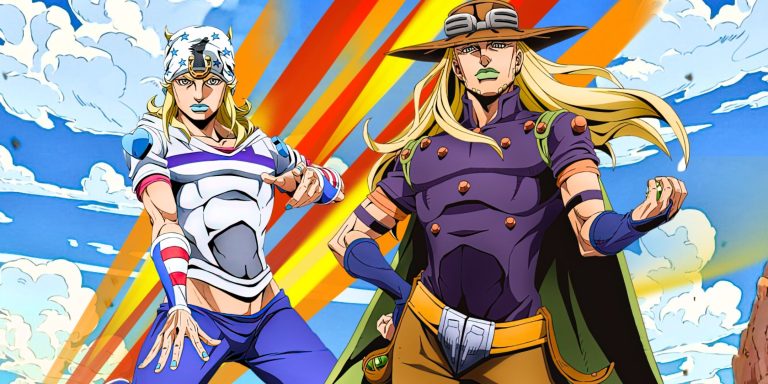
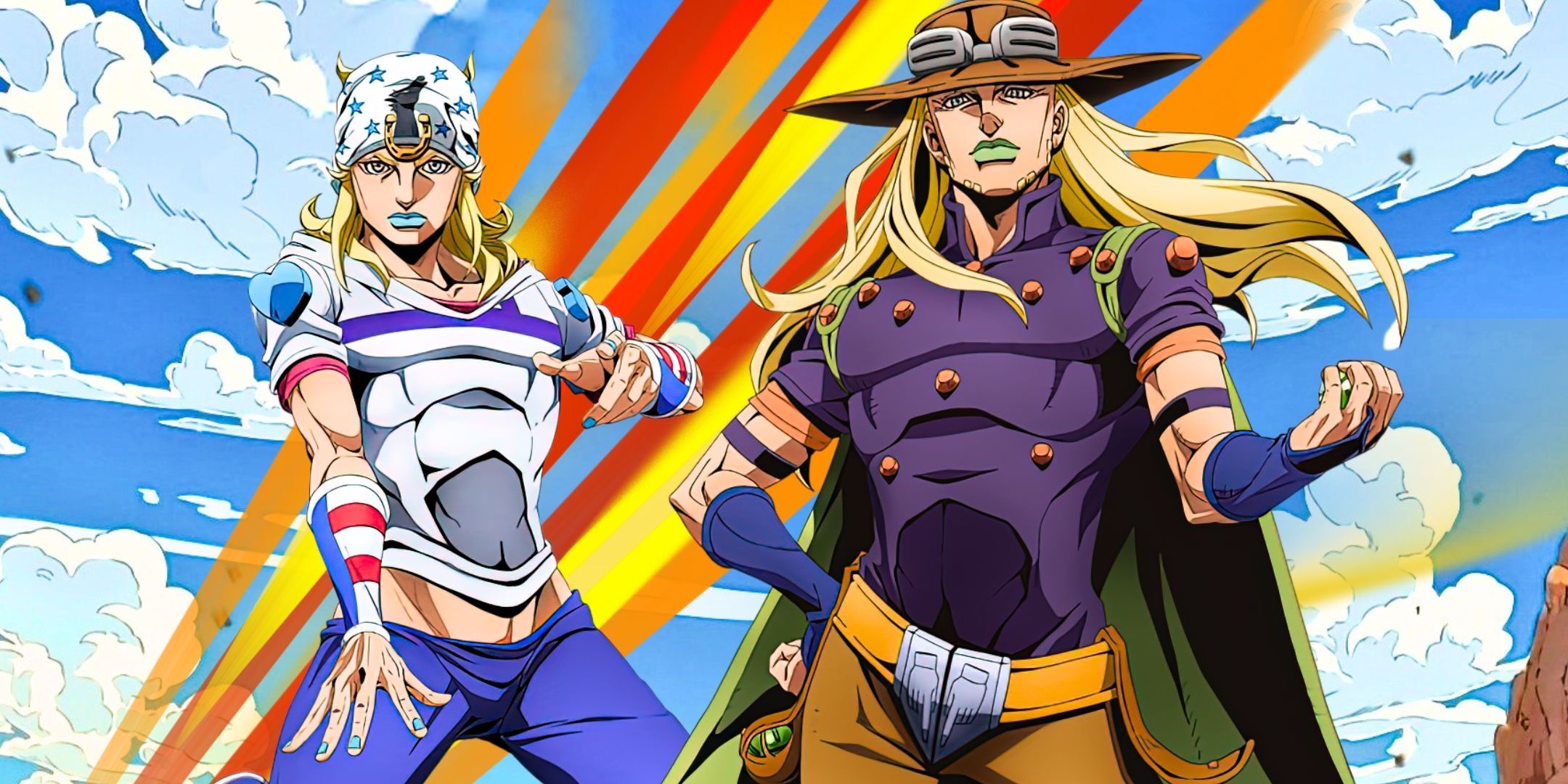
At the center of this dust storm is the single most compelling dual-protagonist dynamic Araki has ever penned. In subverting expectations, Araki eschewed the inherently chivalrous archetypes of Jonathan or Jotaro to deliver Johnny Joestar: a former horse-racing prodigy whose hubris cost him the use of his legs, leaving him a bitter, cynical shell of a man. Johnny is not propelled by high-minded notions of heroic duty; he is driven by a desperate, selfish yearning to reclaim his baseline humanity—a trait Araki visualizes as a terrifying, pitch-black determination in his eyes.
The Saint, the Sinner, and the Spin
Contrasting Johnny’s brooding desperation is Gyro Zeppeli, a disgraced executioner from the Kingdom of Naples whose boisterous, grill-flashing eccentricity conceals a profound moral crisis. Their journey along the race trail avoids the superficial tropes of shonen camaraderie. Instead, their relationship evolves into a hard-earned mentorship founded on emotional vulnerability, mutual survival, and the esoteric mechanics of The Spin.
Replacing the biological mysticism of Hamon and refining the metaphysical mechanics of Stands, the Spin represents an ancient rotational art based on the Fibonacci Sequence and the Golden Ratio. Whether channeled through Gyro’s spherical steel or Johnny’s increasingly grotesque, evolutionary Stand, Tusk, the technique grounds the supernatural combat in tangible geometry and kinetic motion. It is an intellectual martial art tailored for long-distance tactical duels, requiring David Production to visually communicate mathematical perfection amidst raw, bloody chaos.
The Equestrian Crucible: David Production’s Technical Everest
If fans are perpetually clamoring for an official greenlight, industry insiders are looking at the production logistics with pragmatic apprehension. The open secret of anime production is simple: horses are an animator’s nightmare. A four-legged, muscular animal running at full gallop requires a complex, multi-layered shifting of weight, anatomy, and rhythmic muscle displacement that routinely breaks traditional 2D production schedules.
Steel Ball Run is not a narrative where horses occasionally appear in the background of a town square; it is an equestrian pursuit from its opening sprint to its final confrontation. Dozens of distinct steeds—from Johnny’s dappled palomino, Slow Dancer, to Diego Brando’s agile thoroughbred, Silver Bullet—must navigate dynamic terrains at breakneck speeds while their riders engage in physics-defying firearm and Stand skirmishes.
For David Production, the studio that successfully cracked the aesthetic codes of Araki’s garish color-shifting palettes and signature physical sound effects, Part 7 poses an unprecedented crossroad:
Will they rely heavily on 3DCG models for the horses? As demonstrated by contemporary productions across the industry, poorly integrated CGI quadrupeds run the disastrous risk of looking plastic, stiff, and disconnected from hand-drawn riders, instantly shattering audience immersion. Conversely, committing to full, traditional 2D animation for thousands of dynamic galloping frames would necessitate a lavish budget and an impossibly prolonged production cycle. Rumors swirling within the community suggest that David Production may be waiting for technological pipelines to mature, experimenting with cel-shaded hybrid rendering—perhaps even tapping the stylistic expertise of Kamikaze Douga (the visionary team behind JoJo’s legendary classic CGI openings)—to ensure the horses possess the kinetic weight and grittiness Araki’s ink demands.
Patriotism and Nihilism: The Moral Landscape of Part 7
Beyond its logistical hurdles, Steel Ball Run demands an adaptation because its thematic maturity represents the thematic zenith of the franchise. In President Funny Valentine, Araki created an antagonist who defies simplistic villainy. Armed with the reality-hopping Stand Dirty Deeds Done Dirt Cheap (D4C) and an unflinching, nationalist zeal, Valentine’s pursuit of the Saint’s Corpse serves as a profound interrogation of American exceptionalism, sacrifice, and imperialist ambition.
The philosophical clash between Valentine’s utilitarian belief that the ends justify the means and Johnny’s raw, agonizing search for spiritual resurrection elevates the narrative far above standard genre conventions. It is a story where the lines between virtue and vice blur under the blinding desert sun, requiring voice talent, art direction, and musical composition that lean heavily into cinematic neo-Western tones rather than the flamboyant pop-punk sensibilities of Diamond is Unbreakable or the sleek fashion-house drama of Golden Wind.
The Verdict: The Horizon Beckons
While David Production and Warner Bros. Japan remain tight-lipped, dropping occasional side-project crumbs like the Thus Spoke Kishibe Rohan OVAs, the eventual announcement of JoJo’s Bizarre Adventure: Steel Ball Run remains an inevitability. The global demand is simply too titanic to ignore, and the artistic payoff is too historic to leave abandoned in the archives of Shueisha.
When Johnny Joestar finally crawls across the starting line on our screens, it will mark the beginning of one of the most audacious production gambles in modern anime history. If David Production can conquer the logistical terrors of the trail, they will not merely deliver another successful JoJo season—they will deliver an anime masterpiece for the ages.
How do you think David Production should handle the equestrian animation in Part 7? Do you prefer a prolonged wait for top-tier 2D animation or a polished 3DCG hybrid pipeline? Sound off in the comments below, and stay tuned to Wibux.com for all your anime breakdowns and industry scoops!