Ever since the bittersweet notes of “Distant Dreamer” faded over the rebooted horizon of Stone Ocean, a deafening silence has hung over the anime industry. For casual observers, the generational saga of the Joestar bloodline reached its definitive conclusion in the coastal waters of Florida. But for the initiated—the millions of manga connoisseurs who hold Hirohiko Araki’s creative renaissance in reverence—the real journey hasn’t even begun yet. We are standing on the precipice of an epochal adaptation: JoJo’s Bizarre Adventure: Steel Ball Run. Trading blows with Kentaro Miura’s Berserk for the crown of the highest-rated manga of all time on MyAnimeList, Part 7 is not merely the next installment in a venerable franchise; it is widely considered Araki’s magnum opus, a breathtaking synthesis of American frontier mythos, mechanical philosophy, and gut-wrenching character tragedy.
Yet, the murmurings across message boards, animation leaks, and industry panels carry an undercurrent of nervous reverence. Bringing Steel Ball Run to the small screen is arguably the most daunting technical and narrative challenge David Production has ever confronted. From the kinetic chaos of galloping thoroughbreds to the metaphysical gravity of the Golden Spin, the transition of Araki’s Ultra Jump masterpiece into motion is David Production’s true final frontier.
The Rebirth of Araki’s Mythos: Across the Continental Divide
To understand the unprecedented buzz surrounding a potential anime announcement, one must understand what Steel Ball Run represents in the greater canon of serialized sequential art. Serialized initially in Weekly Shonen Jump before migrating to the monthly, creator-liberating confines of Ultra Jump in 2005, Part 7 unbound Araki from the grueling pacing constraints of traditional shonen. The monthly format allowed his pen to breathe, his linework to evolve into a dense, cross-hatched, Renaissance-inspired tapestry, and his themes to explore uncompromising, morally gray territories.
Set in 1890, the series follows the namesake Steel Ball Run race—a cutthroat, 6,000-kilometer equestrian dash across the continental United States, spanning from San Diego Beach to the heart of New York City. With a staggering fifty-million-dollar purse orchestrated by the charismatic yet enigmatic promoter Steven Steel, the race draws a gallery of eccentric daredevils, outlaws, and international oddities. However, beneath the dust, gunpowder, and roaring crowds lies an international conspiracy steeped in eldritch mysticism: a desperate scavenger hunt for the mummified, miraculous relics of an ancient Saint, embedded across the American heartland.
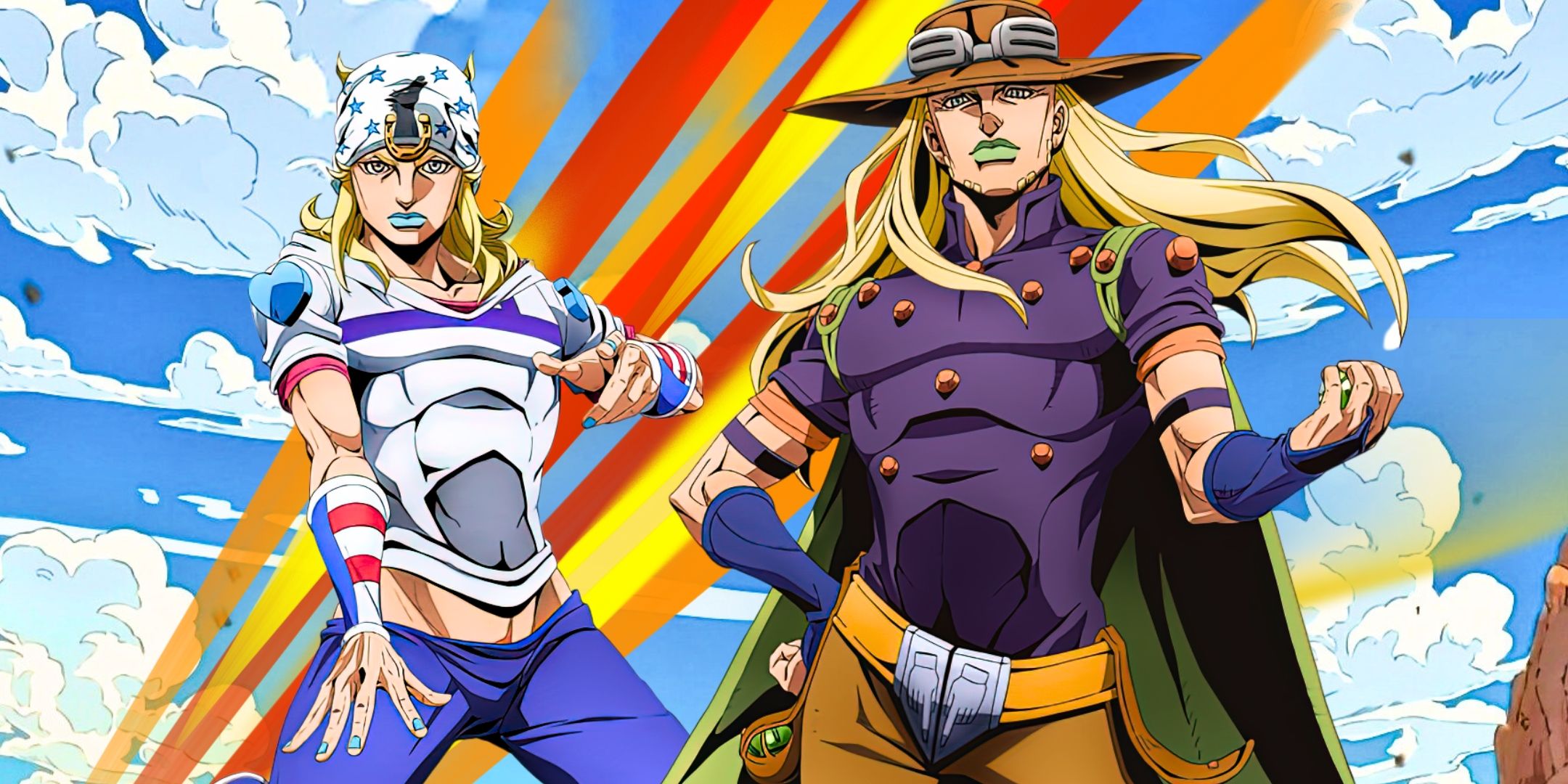
The Tragedy of Johnny Joestar and the Wisdom of Gyro Zeppeli
Where previous JoJo iterations leaned heavily on stoic archetypes or juvenile rebels armed with unshakable moral compasses, Steel Ball Run pivots into psychological deconstruction through arguably the finest two-man ensemble in manga history.
The Dark Ambition of a Paraplegic Prodigy
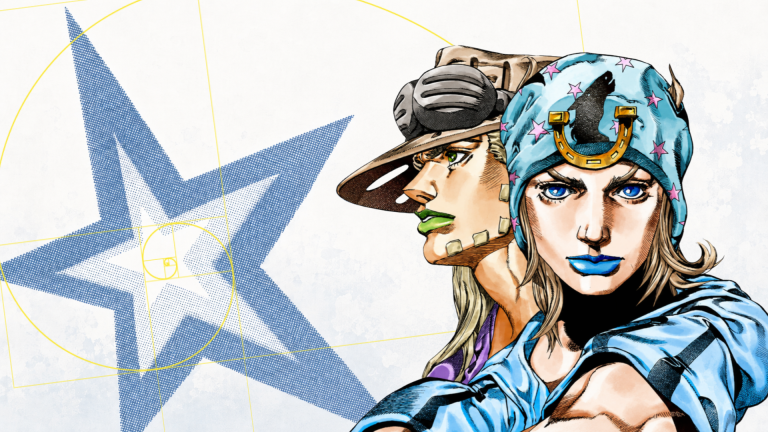
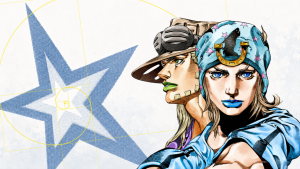
Johnny Joestar is not a hero; in his own words, he is merely trying to reach “zero.” A disgraced, arrogant equestrian prodigy whose reckless pride resulted in a gunshot wound that paralyzed him from the waist down, Johnny begins the story as a cynical, hollow shell of a man. His defining characteristic is not Jonathan’s gentlemanly nobility or Jotaro’s cool detachment, but an unnerving, almost terrifying desperation. When Johnny discovers that the rotational energy wielded by a flamboyant Neapolitan traveler can temporarily revitalize his legs, his pursuit of that miracle is single-minded. Araki deliberately renders Johnny with “dark determination”—a visceral, pitch-black resolve burning in his eyes that often blurs the line between protagonist and antagonist.
The Golden Spin and Neapolitan Soul
Counterbalancing Johnny’s brooding desperation is Gyro Zeppeli, a character whose infectious charm masks an equally suffocating familial burden. Serving as an executioner for the Kingdom of Naples, Gyro enters the trans-American race not for personal glory, but to win amnesty for an innocent child condemned to death by the state. Armed with the Steel Balls—spherical conduits of the “Spin,” an ancient, kinetic discipline governed by the mathematical perfection of the Fibonacci sequence—Gyro acts as Johnny’s reluctant mentor, foil, and soulmate.
Their dynamic elevates the narrative beyond standard battle-manga conventions. In between fighting off grotesque assassination squads, the two spend chapters lounging beneath campfires, singing absurd songs about cheese, and contemplating their existential mortality. It is a genuine, organic friendship forged in blood, dirt, and coffee beans, demanding an immense amount of delicate tonal balancing from whichever voice actors are handed the mantle.
The Equestrian Nightmare: David Production’s Ultimate Technical Crucible
If the narrative acclaim of Steel Ball Run is undisputed, its prolonged absence from the anime release calendar points directly to an undeniable practical hurdle: horses are an animator’s worst nightmare. In the annals of traditional 2D hand-drawn animation, accurately rendering quadrupeds in dynamic, anatomically sound locomotion is notoriously time-consuming and prohibitively expensive. In Steel Ball Run, horses are not incidental background props; they are primary vehicles of combat, constantly shown pivoting, sprinting, colliding, and shifting their skeletal musculature under shifting desert suns.
Industry insiders have long posited that David Production’s delay in greenlighting the adaptation stems entirely from pre-production pipeline engineering. Relying entirely on hand-drawn frames for dozens of simultaneously running horses across 24 to 36 episodes would grind any modern animation studio into financial and physical exhaustion. Conversely, leaning heavily on unpolished, low-framerate 3D CGI risks alienating one of the most passionate fanbases in anime culture, evoking the widespread visual disasters of projects like Berserk (2016).
The solution likely lies in an advanced hybrid methodology. Taking cues from cutting-edge implementations seen in Studio Orange’s portfolio or David Production’s own stylistic flourishes in Fire Force, Part 7 will necessitate custom-built, highly detailed 3D equestrian rigs mapped with hand-drawn, cel-shaded textures, seamlessly blended alongside hyper-stylized 2D rider close-ups. Preserving Araki’s detailed shading and kinetic speedlines will require a level of visual orchestration that David Production has yet to execute on this scale.
The Saint’s Corpse and the Subversion of Manifest Destiny
Beyond the mechanical challenges, an anime adaptation must preserve the narrative’s biting ideological critique. At the center of the race’s grand conspiracy sits President Funny Valentine, widely heralded as the most compelling antagonist Araki has ever conceived. Wielding the reality-hopping Stand Dirty Deeds Done Dirt Cheap (D4C), Valentine is the ultimate embodiment of weaponized patriotism.
Valentine’s philosophy—encapsulated by his iconic parable of “taking the first napkin”—explores the terrifying consequences of utilitarianism and American expansionism. He does not seek the Saint’s Corpse for petty tyranny, but to ensure America’s undisputed prosperity at the explicit expense of the rest of the world’s suffering. By framing Johnny’s intensely selfish quest for personal salvation against Valentine’s self-righteous, imperialist crusade for national dominance, Araki turns traditional shonen morality completely on its head. Capturing the intellectual weight of these confrontations requires a director who understands political drama just as deeply as supernatural martial arts.
The Horizon Awaits: When Will the Starting Pistol Fire?
While David Production and Warner Bros. Japan remain tight-lipped, the momentum surrounding Steel Ball Run has reached an undeniable fever pitch. The conclusion of Part 6 provided a natural palate cleanser, and the ongoing serialization of The JOJOLands has refocused global interest on Araki’s alternate universe. The appetite for this story is not merely active; it is voracious.
Adapting Steel Ball Run is a monumental gamble. It requires an astronomical budget, an uncompromising technical strategy for its equestrian action, and a creative team willing to embrace the sprawling, mature, dust-caked weirdness of Araki’s greatest work. But if David Production can harness the power of the Golden Ratio, they will deliver an anime adaptation that doesn’t just satisfy expectations—it will redefine what modern prestige anime can achieve.
How do you think David Production should tackle the horse animation challenge—full 2D, stylized hybrid CGI, or something entirely new? Who is your dream voice cast for Johnny Joestar and Gyro Zeppeli? Sound off in the comments below, and keep your browsers locked to Wibux.com for all your breaking anime dispatches!