Ever since the melancholic, bittersweet chords of Jolyne Cujoh’s destiny settled across the reset universe in Stone Ocean, the international anime community has held a singular, collective breath. For more than a decade, Hirohiko Araki’s multi-generational saga has enjoyed one of the most celebrated, stylistically faithful adaptations in contemporary pop culture, meticulously steered by David Production. Yet, no matter how monumental the triumphs of Stardust Crusaders or Golden Wind were, seasoned fans and manga literati have perpetually eyed a distant, dust-choked horizon: the late 19th-century American frontier of JoJo’s Bizarre Adventure: Steel Ball Run.
Widely heralded as Araki’s magnum opus—frequently locked in neck-and-neck battles with Kentaro Miura’s Berserk for the highest-rated manga of all time on aggregators like MyAnimeList—Steel Ball Run is far more than a routine sequel. It represents a total structural, thematic, and philosophical rebirth. With rumors swirling, animation leaks persistently debunked, and production timelines perpetually scrutinized, the buzz surrounding an SBR anime adaptation has transformed from idle wish fulfillment into the most scrutinized industrial waiting game in modern animation.
The Holy Grail of Shonen-Turned-Seinen: Araki’s Masterpiece Unleashed
To understand the immense anticipation surrounding Part 7, one must understand its tumultuous creative genesis. When Steel Ball Run began serialization in 2004 in Weekly Shonen Jump, it was initially presented without the iconic “JoJo” moniker explicitly dominating its title. However, the true turning point occurred when the series transitioned to the monthly seinen magazine Ultra Jump in 2005. Freed from the oppressive weekly grind and the content restrictions of a juvenile target demographic, Hirohiko Araki experienced an unprecedented artistic renaissance.
The premise is deceptively direct yet utterly audacious: an 1890 trans-continental horse race spanning from San Diego Beach to New York City, featuring a lucrative $50 million grand prize. Yet beneath the spectacle of galloping hooves, steam engines, and eccentric international racers lies an occult political conspiracy involving the search for the scattered, mummified relics of Jesus Christ. Steel Ball Run deconstructs the American mythos of Manifest Destiny, interweaving historical fiction with supernatural espionage. The series trades the claustrophobic urban standoffs of earlier parts for sweeping, desolate landscapes, existential grit, and an artistic density that remains unmatched in Araki’s fifty-year career.
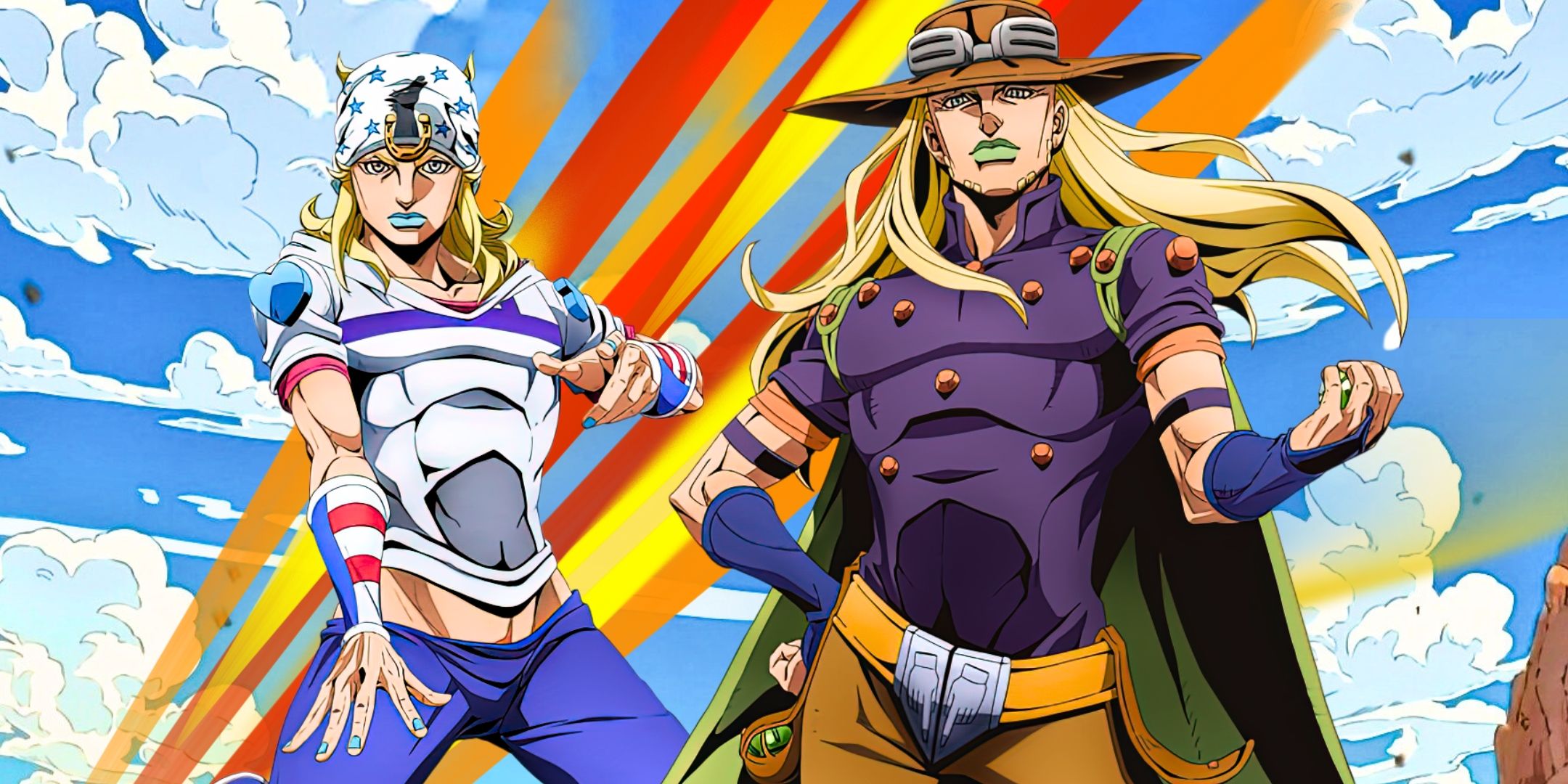
Johnny Joestar and Gyro Zeppeli: The Deconstruction of the JoJo Dynamic
At the beating heart of Part 7’s narrative majesty is the profound relationship between its dual protagonists. While previous arcs indulged in the aristocratic chivalry of Jonathan Joestar or the slick, untouchable coolness of Jotaro Kujo, Steel Ball Run strips its leads of traditional moral invulnerability.
Johnny’s “Dark Determination” vs. Gyro’s Eccentric Nobility
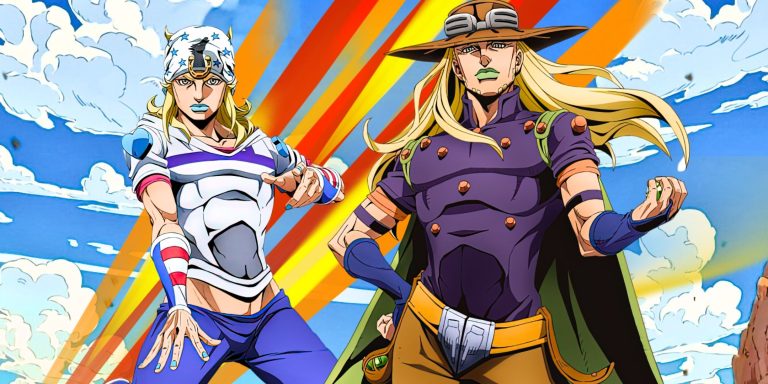
Johnny Joestar is unlike any protagonist in Shonen Jump history. A former prodigy jockey paralyzed from the waist down due to his own youthful arrogance, Johnny begins his journey not out of altruism, but from a raw, agonizing hunger to reclaim his body and find purpose. He is cynical, morally compromised, and exhibits what Araki famously terms “dark determination”—the icy willingness to kill without hesitation if it brings him closer to his goal. Johnny’s arc is not about becoming a hero; it is about clawing his way from “negative” back to “zero.”
Serving as the vibrant counterweight to Johnny’s grim pathology is Gyro Zeppeli. Armed with steel balls, gold-plated grillz spelling out “GO! GO! ZEPPELI,” and a seemingly bottomless repertoire of terrible puns and operatic non-sequiturs, Gyro initially appears to be the comic relief. In reality, he is an exiled executioner from the Kingdom of Naples, participating in the race to secure royal amnesty for an innocent child condemned to death. The dynamic between Johnny and Gyro evolves from reluctant transactional partnership to the most emotionally nuanced, brotherly bond ever committed to Araki’s pages.
The Spin: Re-engineering the Supernatural Power System
Part 7 marks a foundational pivot in combat philosophy. Rather than leaning purely on conventional Stands from the opening bell, Araki introduces The Spin—a mystical martial art rooted in the mathematics of the Golden Ratio and the Fibonacci sequence. Passed down through the Zeppeli bloodline, this kinetic technique harnesses rotational energy via specialized steel orbs, manipulating flesh, friction, and even gravity itself.
When Stands inevitably manifest—such as Johnny’s evolving guardian, Tusk, and Gyro’s elusive Ball Breaker—they act as metaphysical extensions of this mathematical mastery. The combat in Steel Ball Run moves away from straightforward slugfests into cerebral, hyper-strategic spatial puzzles that demand flawless visual execution on screen.
The Equestrian Nightmare: David Production’s Ultimate Technical Bottleneck
Why has the green light for Steel Ball Run taken so long? The answer lies not in a lack of studio enthusiasm, but within the cold, uncompromising realities of modern 2D animation pipelines: horses.
In the animation industry, quadrupeds—and horses in particular—are notoriously regarded as animators’ graveyards. Their complex skeletal anatomy, muscular shifting, and distinct four-beat gait cycles require exceptional technical discipline. Multiply that by dozens of horses sprinting simultaneously across dynamic, dust-blown Western terrains, and the workload balloons exponentially. Historically, anime adaptations that rely heavily on horses (such as early seasons of Kingdom or specific setpieces in Attack on Titan) have had to lean heavily on polarizing, immersion-breaking 3D CGI models.
David Production, celebrated for its hyper-stylized color-palette shifts, bold sound-effect typography, and textural fidelity, faces an immense aesthetic challenge. To render Steel Ball Run using flat, unpolished 3D horse assets would spark an immediate rebellion from a hyper-critical global fanbase. The studio must devise an innovative, hybridized production pipeline—blending expertly cel-shaded, custom-rigged 3D assets with meticulously hand-drawn 2D corrective passes. Doing so requires extensive pre-production, specialized engineering, and a budget that dwarfs previous seasons.
Corpse Parts, Cosmic Morality, and Funny Valentine
The stakes of Part 7 are escalated further by its primary antagonist, Funny Valentine, the 23rd President of the United States. Valentine represents a quantum leap in Araki’s villainous writing. Possessing the inter-dimensional Stand Dirty Deeds Done Dirt Cheap (D4C), Valentine is driven not by sadistic sadism or petty villainy, but by a chilling, uncompromising hyper-patriotism.
His philosophy—encapsulated in his iconic “First Napkin” monologue—asserts that society is governed solely by the one who seizes the primary advantage, dictating order to the masses. Valentine’s conviction is so absolute, and his willingness to sacrifice himself across parallel dimensions so unwavering, that the moral polarity between antagonist and protagonist continually blurs. Capturing the philosophical tension of this ideological war will require an adaptation with mature pacing, evocative voice casting, and zero narrative sanitization.
The Fandom’s Horizon: Preparing for the Green Light
While an official green light has not yet been formally unveiled by Warner Bros. Japan or David Production, the industry tea leaves suggest that the gears are inevitably grinding into motion behind closed doors. David Production’s recent pipeline management, coupled with the continued commercial dominance of JoJo merchandising and museum exhibits, paints Part 7 as an eventuality rather than an uncertainty. When the official teaser finally drops, it will be an internet-shattering event, sparking a new golden age for the franchise.
Until then, the enduring buzz surrounding Steel Ball Run serves as a testament to Hirohiko Araki’s narrative foresight. It stands as an untamed, transcendent work of art—a western odyssey waiting for its definitive cinematic realization. When that starting pistol finally fires, the anime landscape will never be the same.
What are your biggest hopes and fears for the Steel Ball Run anime adaptation? Do you think David Production should use 3D CGI for the horses, or wait for an exclusively hand-drawn production? Drop your theories in the comments below!