

Four decades after an eccentric boy with a monkey tail stumbled out of Mount Paozu and into the cultural consciousness, Dragon Ball remains the foundational pillar of modern shonen. Yet, the arrival of Dragon Ball Daima carries a profound, bittersweet resonance that no marketing campaign could ever manufacture. Premiering in the wake of Akira Toriyama’s untimely passing in March 2024, the series is not just another celebratory installment for the franchise’s 40th anniversary—it stands as the maestro’s definitive swansong. Far from a corporate victory lap, the premiere of Daima proves to be an intoxicating, visually sumptuous return to Toriyama’s purest creative instincts: an exhilarating blend of whimsical folk fantasy, mechanical eccentricity, and raw martial arts kinetics that strips away decades of multiversal bloat to rekindle the primal joy of adventure.
The Heavy Crown of a Final Masterpiece
In an industry often dictated by committee-driven production pipelines, Dragon Ball Daima feels astonishingly, unmistakably Toriyama. Unlike previous modern iterations where the creator supplied broad narrative outlines and left execution to others, Toriyama’s fingerprints are embedded into the very marrow of Daima. He conceptualized the story, drafted the lore-dense world mechanics, meticulously drafted the character designs, and even penned specific vehicular schematics. The premiere radiates that distinct creative signature—a buoyant, mischievous confidence that refuses to take itself too seriously while quietly revolutionizing decades-old canon.
For longtime fans, the emotional weight of viewing Toriyama’s final screenwriting credit cannot be overstated. There is a luminous warmth to the dialogue and an unhurried, curious pacing that recalls the golden age of Dr. Slump and early Dragon Ball. Toriyama was never an author obsessed with rigid cosmic hierarchies or cold power-scaling debates; he was a master cartoonist who loved the thrill of the uncharted horizon. In handing down this final journey, he offers fans a therapeutic reminder of why the world fell in love with his universe in the first place.
Beyond the Mortal Coil: Demystifying the Demon Realm
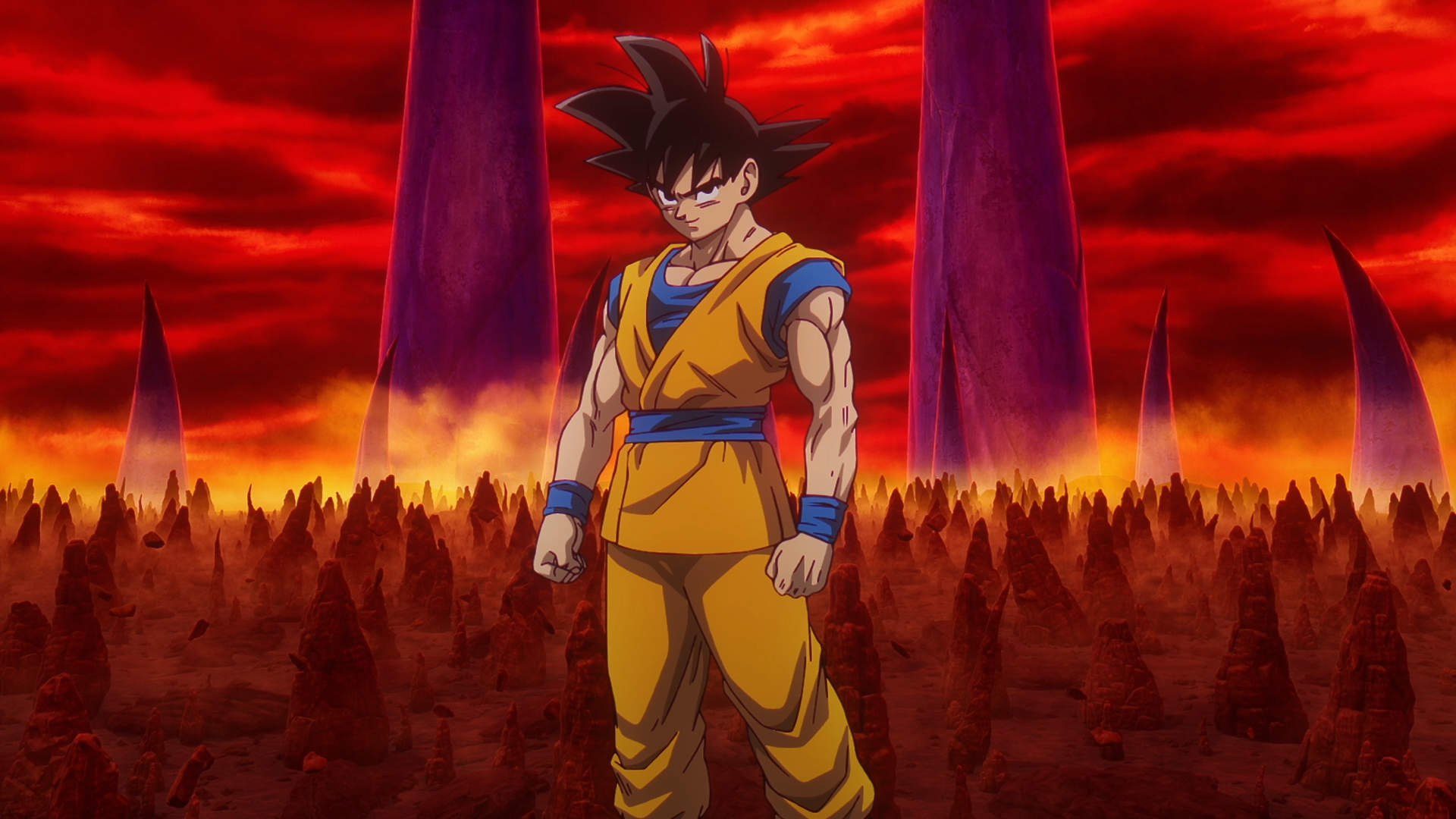
For decades, the Demon Realm (Makai) existed as a tantalizing footnote within canonical Dragon Ball lore. Aside from Dabura’s brief tenure as Babidi’s mind-controlled pawn in the Majin Buu saga—and various non-canon spin-offs in video games like Super Dragon Ball Heroes—the sinister underworld was largely left to the imagination. The Daima premiere radically upends this omission, instantly dedicating significant narrative real estate to unspooling the socio-political topography of the Dark Demon Realm.
The Geopolitics of Makai: Gomah, Degesu, and the Tamagami
The story kicks off right where Toriyama’s original manga concluded its dramatic peak: the immediate aftermath of Majin Buu’s defeat. Through the voyeuristic screens of King Gomah—the self-appointed successor to the demonic throne—and his scheming subordinate Degesu (the younger brother of the Supreme Kai), we witness how Earth’s climactic battle reverberated across dimensions. Dabura’s demise created a catastrophic power vacuum, leaving Gomah terrified that Earth’s hyper-competent mortals could turn their gaze toward his kingdom next.
Toriyama enriches this realm with brilliant diegetic world-building. We learn of the Demon Realm’s tripartite division, the atmospheric hazards that suppress biological capabilities, and the presence of the Tamagami—monstrous, ancient guardians tasked with protecting the Demon Realm’s own localized set of Dragon Balls. This is classic Toriyama cosmology: introducing terrifying mythical concepts only to filter them through comedic bureaucratics and petty royal squabbles. Gomah’s preemptive strike against Earth is motivated not by grand conquest, but by pure, cowardly self-preservation.
Kinesthetic Brilliance: Katsuyoshi Nakatsuru and the Rebirth of Hand-to-Hand Combat
From an aesthetic and technical standpoint, the premiere of Dragon Ball Daima is a masterclass in modern television production, signaling a quantum leap forward from the early, turbulent days of Dragon Ball Super. Under the directorial stewardship of Yoshitaka Yashima and Aya Komaki, alongside character designs by franchise veteran Katsuyoshi Nakatsuru, Toei Animation has assembled an absolute dream team of animators.
Nakatsuru’s designs bridge the gap between contemporary digital clarity and the tactile, rounded character aesthetics of mid-90s anime. The premiere boasts lush, storybook backgrounds and character models that emote with buoyant fluidity. But the real triumph lies in the show’s philosophical shift regarding action choreography. For years, the franchise has relied heavily on planetary-scale ki blasts, kaleidoscopic beam struggles, and hyper-accelerated teleportation skirmishes. Daima consciously pivots back to grounded, spatial martial arts.
Watching Goku navigate combat with his original, iconic Power Pole (Nyoibo) is a cinematic revelation. The choreography emphasizes center-of-gravity shifts, leverage, tangible impact frames, and dynamic camera pans that celebrate the art of kung-fu cinema. The combat feels bone-crunching yet playful, trading astronomical destruction for infectious physical spectacle. It is a heartfelt tribute to Toriyama’s lifelong love affair with Jackie Chan films and classical martial arts literature.
Subverting the Multiversal Stakes: The Genius of the ‘Mini’ Reset
When the promotional materials for Daima first surfaced, some skeptical corners of the fandom hastily drew comparisons to 1996’s polarizing Dragon Ball GT, fearing an uninspired nostalgia cash-grab centered around de-aging the cast. The premiere aggressively dismantles those anxieties. Transforming the Z-Fighters into children—labeled affectionately in-universe as “mini”—is not merely a gimmick; it is an ingenious narrative reset designed to conquer the inescapable dragon of shonen storytelling: power creep.
By forcing Earth’s greatest defenders into diminutive, biologically constrained bodies, Daima immediately strips away the safety nets of godly transformations and world-breaking forms. Ultra Instinct, Super Saiyan Blue, and cosmic deity summons are rendered irrelevant. In their place, Goku, Vegeta, Piccolo, and their allies must rely once more on wit, environmental awareness, and sheer martial discipline. It shifts the stakes from apocalyptic survival to an intimate, survivalist fantasy adventure. This creative maneuver breathes fresh vitality into characters who had grown so omnipotent that ordinary conflict had lost its teeth.
A Bittersweet Masterwork: Toriyama’s Eternal Gift to Shonen
The global reception to Dragon Ball Daima’s opening salvo has been an overwhelming wave of emotional catharsis. Fans and critics across the globe have marveled at the sheer love poured into every frame, recognizing that this production is treating Toriyama’s final vision with the reverence it rightfully commands. It captures the elusive spirit that made the franchise a global phenomenon: boundless curiosity, sharp comedic timing, and an unyielding passion for self-betterment through martial arts.
As Goku leaps aboard the cross-dimensional spacecraft, pole in hand, staring into the swirling depths of the Demon Realm, it feels less like an ending and more like the opening chapter of an eternal myth. Akira Toriyama may have stepped beyond this mortal coil, but through Daima, his spirit remains entirely alive—grinning mischievous, sketching wondrous machines, and beckoning us forward into the magical unknown.
What were your favorite moments from the Dragon Ball Daima premiere? Did the stunning return of the Power Pole hit your nostalgic heartstrings, or are you more fascinated by the dark lore of the Demon Realm? Sound off in the comments below, and keep your scouters locked on Wibux.com for all your weekly Daima breakdowns!