

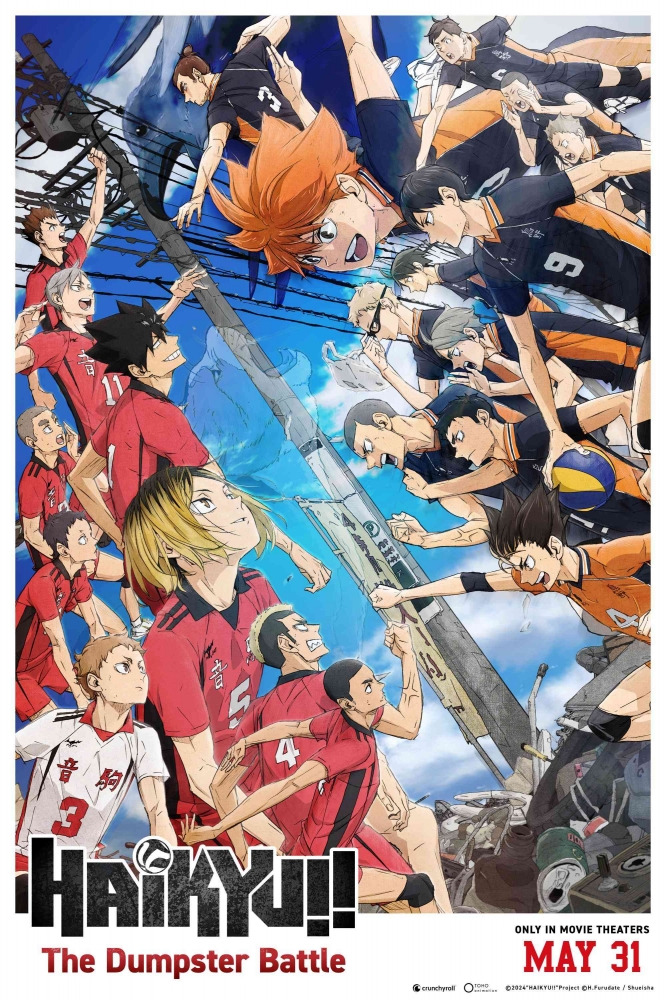
Few events in modern shonen carry the emotional resonance and historic inevitability of Karasuno High facing Nekoma High. When Haruichi Furudate first introduced the generational rivalry between the former powerhouse “Crows” of Miyagi and the defensive savants of Tokyo’s “Cats,” it was framed as a battle of ghost stories—a forgotten promise between two legendary coaches that never came to pass on the national stage. Now, following an earth-shattering theatrical run that grossed over $100 million worldwide, Haikyu!! The Dumpster Battle (Gomi Suteba no Kessen) has officially landed on global streaming platforms. For fans who have tracked every bump, set, and psychological breakthrough since 2014, its digital debut offers something far greater than mere convenience: it invites an obsessive frame-by-frame dissection of what may very well be the single greatest match in sports anime history.
The Weight of Heritage: A Rivalry Forged in Respect, Not Malice
Modern sports anime often relies on hyperbolic antagonism to establish stakes. Whether it is the hyper-egoism of Blue Lock or the superhuman theatrics of Kuroko’s Basketball, conflicts are frequently amplified through bitter personal vendettas. Haikyu!!, however, has always operated on a vastly different emotional wavelength. The Karasuno versus Nekoma clash—affectionately dubbed “The Dumpster Battle” after the urban scavenger motifs of crows and alley cats—is completely devoid of animosity. Instead, it is fueled entirely by mutual reverence and the lingering promise made decades prior between Coaches Ikkei Ukai and Yasufumi Nekomata.
Because both teams spent countless summer training camps trading blood, sweat, and barbecue ribs in Shinzen and Tokyo, there are no tactical secrets left to hide. Every rotation, habit, and offensive quirk is an open book. This turns the encounter into an extraordinarily pure contest of philosophical friction: Karasuno’s frantic, ever-evolving kinetic onslaught versus Nekoma’s patient, unyielding, circulatory defense. When the match finally unfolds on the orange court of the Tokyo Metropolitan Gymnasium, the tension does not stem from fear of failure, but rather the unbearable realization that this game—the one they have dreamed of playing on the official national stage—can only happen once. There are no practice rematches tomorrow. One team must pack their bags.
The Architect vs. The Monster: Kenma Kozume’s Psychological Enclosure
At the beating heart of The Dumpster Battle lies an intimate, asymmetrical psychological duel between two players who could not be more diametrically opposed: Nekoma’s brilliant yet lethargic setter, Kenma Kozume, and Karasuno’s irrepressible decathlon-engine, Shoyo Hinata.
Clipping the Crow’s Wings
Kenma treats volleyball not as a sport, but as an optimization puzzle. Understanding that Karasuno’s offense operates at its peak when Hinata is allowed to run wild and create chaos as the ultimate decoy, Kenma devises an insidious, low-variance trap. Rather than attempting to block Hinata outright—a fool’s errand against his sheer rotational speed—Kenma systematically limits his run-up space through precision ball placement.
Director Susumu Mitsunaka frames this psychological squeeze with chilling visual metaphor. Hinata is not just being outmaneuvered; he is being literally boxed in. The animation pulls into claustrophobic medium shots, framing Hinata behind imaginary iron bars as Nekoma’s defense denies him the floor space required for his signature horizontal takeoff. For a kid whose entire identity is predicated on the exhilarating feeling of soaring above the net, Kenma’s suffocating strategy represents an existential crisis.
The Breakthrough and the “Fun” of Exhaustion
Yet, true to Furudate’s thematic core, genius in Haikyu!! is never static. Hinata’s counter-response is not an act of blind fury, but a crystallization of his entire technical evolution: the high-trajectory open spike, launched from a vertical broad jump taught by Kageyama and honed through sheer desperation. Hinata forces his way above the birdcage, shocking Kenma out of his tactical complacency. The climax of this character arc does not belong to a point scored, but to the collective gasp of the audience when an utterly drained Kenma looks across the net, wipes the sweat from his hair, and whispers four words that validate years of storytelling: “This is fun.”
Production I.G’s Kinetic Masterclass: The Genius of the First-Person POV
Compressing a 33-chapter manga arc into an 85-minute feature film was met with justified skepticism by the community upon its initial announcement. Critics worried that the narrative would be stripped of its foundational interior monologues. However, Production I.G answered those concerns with sheer cinematic bravura, leveraging director Susumu Mitsunaka’s return to deliver some of the most inventive visual storytelling the studio has ever produced.
The pinnacle of this technical pedigree arrives during the match’s breathlessly chaotic final rally. Rather than keeping the camera detached along the sideline, the perspective abruptly drops straight into Kenma’s eyes. For nearly two minutes, viewers experience the match in an unrelenting, claustrophobic first-person shot that mimics the dizzying, lung-burning reality of elite athletic exhaustion:
The camera pans frantically between teammates shouting callouts; sweat literally smears across the digital lens, blurring peripheral vision; sneakers squeak against hardwood with hyper-tactile urgency; and the volleyball feels heavier with every touch. The animation doesn’t just show us what exhaustion looks like—it makes the viewer feel the lactic acid pooling in Kenma’s limbs. By anchoring the climax of a sports anime in the physical fragility of a character who historically hates exertion, Production I.G elevates a routine rally into an unforgettable sensory triumph.
Subverting Shonen Tropes: The Beautiful Tragedy of the Final Whistle
Perhaps the most poignant aspect of The Dumpster Battle is how it reframes victory and defeat. In traditional shonen, a loss is often painted as a devastating tragedy or a prompt for a prolonged training arc. Here, the final point doesn’t end on a blazing super-spike or an impossible block. It ends on an unforced, anti-climactic human error: a sweaty palm slipping off a volleyball, denying Kenma the chance to keep the ball alive.
The anti-climax is the entire point. There are no bitter tears of resentment. Tetsuro Kuroo—whose mentorship of Karasuno’s Kei Tsukishima during the Tokyo training camp ultimately handed Karasuno the very tools to defeat Nekoma—beams with pride. Tsukishima’s deadpan, cynical demeanor crumbles into genuine appreciation for the sport. When Kuroo shakes hands with Sawamura, and Coach Ukai Jr. shares a phantom handshake across the net with Coach Nekomata through television screens and decades of memory, the film solidifies its thesis: the tragedy of tournament sports isn’t losing—it’s that the game must eventually end.
Verdict: The Gold Standard for Modern Sports Animation
As Haikyu!! The Dumpster Battle settles into its streaming era, its reputation as an unmitigated masterpiece is secure. By choosing intimacy over melodrama, prioritizing technical innovation over padding, and honoring the deep emotional bonds cultivated over a decade of serialized media, the film stands tall as sports anime perfection. It is a triumphant, tear-stained love letter to youth, rivalry, and the sheer joy of chasing a ball across a gym floor until your lungs give out.
Did The Dumpster Battle live up to your expectations, or did you miss the traditional episodic pacing? What was your reaction to that mind-bending POV final rally? Let us know your thoughts in the comments below!