


When Senku Ishigami cracked out of his stone chrysalis in the opening moments of Dr. STONE, counting over 117 billion seconds in total darkness, modern anime witnessed the birth of an unconventional shonen revolution. Where typical genre brethren rely on esoteric chakra systems, demon bloodlines, or boundless willpower to conquer insurmountable odds, Riichiro Inagaki and Boichi’s magnum opus championed a drastically different superpower: the iterative, unyielding march of human technology. Now, with the announcement and unfolding rollout of Dr. STONE: Science Future, the fourth and final season produced by TMS Entertainment, the Kingdom of Science stands on the precipice of its most audacious undertaking yet. The series is leaving the dirt of post-apocalyptic Earth behind, rocketing into the cold vacuum of space for a lunar confrontation that promises to unravel the foundational mystery of the petrification event.
From Stone Speeches to Apollo Ambitions: The Escalation of the Kingdom of Science
Few narratives in contemporary pop culture have managed such a breathtaking escalation of scale without collapsing under their own conceptual weight. What began as a primitive survival story centered on sulfur collection and crude pottery rapidly evolved into an industrial marathon. We have watched Senku and his allies synthesize sulfa drugs, cast light bulbs, engineer steam engines, and construct diesel-guzzling oceanic vessels. Yet, the leap toward the lunar surface in Science Future shifts the anime from historical reenactment to full-blown hard science fiction.
Building the Modern World from the Soil Up
The road to the Moon is not merely a plot device; it is a mechanical triumph. In Science Future, the narrative forces the Kingdom of Science to construct an entire global supply chain across continents to secure the rare minerals, synthetic polymers, and precision microchips required for rocketry. This geopolitical and industrial roadmap turns the entire planet into an open-world laboratory. The sheer audacity of engineering a multi-stage Saturn V-style rocket with nothing but recovered knowledge and sheer human labor embodies the core thesis of Inagaki’s storytelling: no single human achieves progress alone, but humanity as a collective is capable of defying planetary boundaries.
The Haunting Enigma of Why-Man: Deconstructing the Architect of the Green Light
Every scientific endeavor requires a catalyst, and for the Kingdom of Science, that catalyst is an ominous broadcast echoing across the dead airwaves. The introduction of Why-Man—the spectral entity repeatedly transmitting the chilling English query “WHY?” across global frequencies—remains one of the most brilliant tonal shifts in modern anime. In an instant, Dr. STONE transitioned from an exuberant celebration of human ingenuity into an eerie, cosmic thriller tinged with existential dread.
The Chilling Broadcast on the Lunar Surface
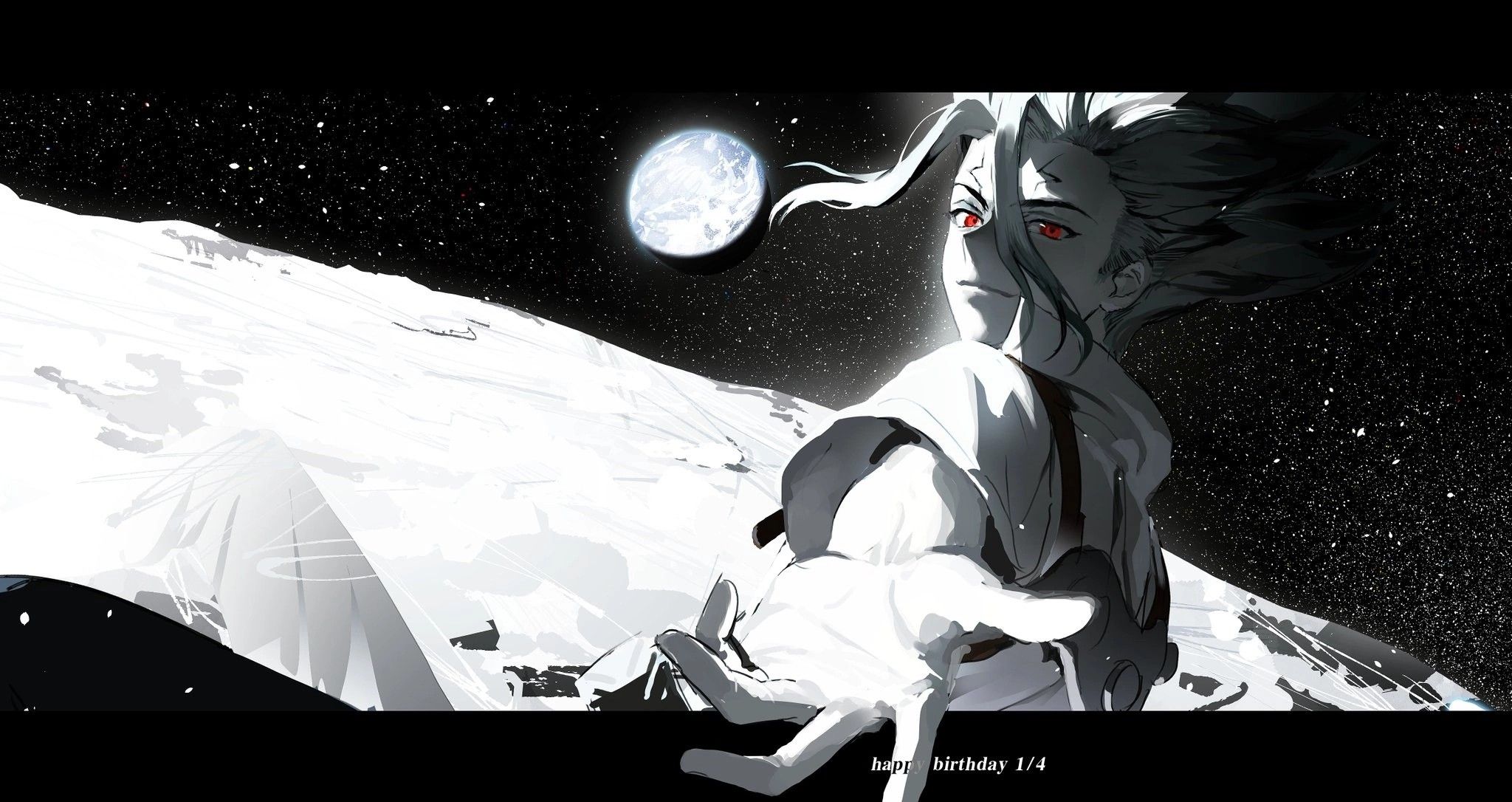
Why-Man is not just an antagonist lurking in the shadows; it is an ideological antithesis to everything Senku represents. Where Senku views science as an egalitarian instrument of liberation meant to lift every individual out of suffering, Why-Man used hyper-advanced technology to freeze human consciousness for millennia, halting evolution in its tracks. The decision to place Why-Man on the surface of the Moon turns the celestial body into a monument of humanity’s deepest trauma. Facing Why-Man is not simply a matter of landing an explosive punch on an overpowering villain; it is an intellectual and philosophical tribunal. The final showdown demands that Senku, Chrome, and Ryusui look their tormentor in the eye and demand answers for thousands of years of lost history.
Character Psychology: The Weight of Humanity on Senku’s Shoulders
Beneath the exuberant catchphrases and mathematical flexes, Dr. STONE: Science Future places an unprecedented psychological burden on its green-haired protagonist. Senku Ishigami has consistently masked deep emotional vulnerability behind calculating pragmatism. However, as the lunar launch draws near, the ghosts of the past inevitably catch up with the present. The rocket mission is not solely an expedition to save the future; it is the realization of a promise made across millennia to his adoptive father, Byakuya Ishigami.
Byakuya and the astronauts of the International Space Station sacrificed everything to leave behind the raw materials, the platinum, and the record disc that enabled Senku’s survival in the first place. The final season poignantly reframes Senku’s space mission as the completion of an intergenerational relay race. Furthermore, the selection of the lunar crew introduces searing interpersonal tension. Space travel is notoriously unforgiving; every gram of weight matters, every breath of oxygen is tallied, and not everyone can board the capsule. The crew must be prepared for the reality that a lunar launch in a post-apocalyptic era offers zero safety nets. There is no mission control with supercomputers to calculate trajectory aborts. Every calculation rests solely on their own minds and a homemade computer.
TMS Entertainment’s Final Frontier: Visualizing Hard Sci-Fi in Motion
Translating Boichi’s peerless manga art to animation has always been a gargantuan task. Boichi’s signature style—marked by hyper-detailed mechanical schematics, expressive anatomical distortions, and kinetic linework—demands the absolute best from TMS Entertainment. In Science Future, the animation studio faces its ultimate technical trial: animating the launch dynamics of a deep-space rocket and the eerie, low-gravity landscapes of the Moon.
The previous seasons proved that TMS understands how to make theoretical science visually intoxicating. Sequences detailing the synthesis of chemical compounds or the assembly of integrated circuits were directed with the rhythm and dynamism of high-stakes battle shonen. For the final season, the visual language expands into the cosmos. Fans are treated to meticulously storyboarded sequences capturing atmospheric re-entry, telemetry gauges ticking down to zero, and the vast, suffocating silence of lunar craters. Paired with a cinematic orchestral score that blends tribal percussion with soaring electronic synth, the audiovisual presentation in Science Future aims to deliver the cinematic weight of Interstellar through the vibrant lens of Japanese animation.
A Climax Unbound by Traditional Shonen Tropes
The anticipation surrounding Dr. STONE: Science Future is palpable precisely because it dares to conclude on its own terms. While most seasonal shonen culminate in escalating beam clashes and power-scaling debates, Dr. STONE resolves its overarching conflict through communication, rational deduction, and technological parity. It reminds the audience that the universe is governed by physical laws that do not bend for heroes or villains—and that understanding those laws is humanity’s greatest gift.
As Senku preps his thrusters and sets his sights on the lunar horizon, Science Future stands poised to solidify the franchise’s legacy as an enduring masterwork of rationalist optimism. The question is no longer whether humanity can survive the stone age, but whether humanity can reclaim the stars without losing its soul in the process.
How do you think the Kingdom of Science will handle the final revelation behind Why-Man? Will Senku’s rationalism be enough to overcome the architects of petrification? Join the conversation in the comments below and stay locked to Wibux.com for exhaustive episode breakdowns, technical deep-dives, and seasonal anime analysis!