

When Riichiro Inagaki and Boichi first unleashed Dr. STONE onto the pages of Weekly Shonen Jump in 2017, the premise felt almost delightfully quaint: a leek-haired genius uses practical chemistry and middle school physics to rebuild civilization from the dirt up. It was a survivalist sandbox, an educational comedy, and an earnest love letter to human trial and error. Yet, as the franchise gears up for its fourth and final television outing, Dr. STONE: Science Future, that modest sandbox has officially expanded into the cosmos. What started with terraforming clay pots and calcium carbonate has escalated into an interstellar countdown, framing an audacious, three-man lunar mission to confront the architects of humanity’s 3,700-year petrification.
Produced once again by TMS Entertainment, Science Future isn’t just another seasonal victory lap. It represents the culmination of modern shonen’s most unique ideological experiment: a battle shonen where the ultimate weapon is not an esoteric martial art or cursed genetic lineage, but the hard-fought lineage of human engineering. As Senku Ishigami sets his sights on the Moon, the stakes have shifted from localized survival to a high-concept collision between cosmic existentialism and scientific optimism.
The Audacity of Apollo: Rebuilding an Aerospace Industry from Zero
To fully appreciate the narrative scale of Dr. STONE: Science Future, one must contextualize the sheer logistical absurdity of Senku’s endgame. In the real world, the Apollo program required the collective efforts of roughly 400,000 scientists, engineers, and technicians, fueled by the GDP of the world’s wealthiest superpower. In Senku’s world, the Earth has been stripped bare of its industrial infrastructure, forcing the Kingdom of Science to construct an aerospace supply chain literally from scratch.
From Local Survival to Global Industrialization
The final season moves past the isolated battles of the Stone Wars and the maritime exploration of the Age of Exploration. Instead, it leans aggressively into the geopolitical and economic orchestration required for spaceflight. The narrative transforms into an exhilarating, fast-paced logistics simulator. Senku and his newly integrated allies—most notably former adversary Dr. Xeno—must establish specialized manufacturing hubs across the globe: Corn City for provisions, Superalloy City for aerospace metallurgy, and Math City to compute trajectory calculations that would normally melt a modern supercomputer.
This global cooperative phase underscores the thematic heartbeat of Inagaki’s writing. Science is rarely the triumph of a lone, isolated genius; it is a relay race across generations and borders. By forcing former enemies, disparate tribes, and revived modernists to synchronize their labors toward a single Saturn V-style launch vehicle, Dr. STONE mirrors the real-world miracle of international aerospace engineering with infectious, theatrical flair.
Decrypting Why-Man: The Horror at 12.8 Gigahertz
While the logistics of rocketry provide the narrative engine, the mystery of Why-Man provides its creeping tension. From the moment that eerie, synthesized Morse code transmission hijacked the Kingdom of Science’s crude radio waves—repeating the ominous, metallic query “WHY” at an impossible 12.8 gigahertz—Dr. STONE pivoted from cozy post-apocalyptic optimism into genuine cosmic dread.
Why-Man is not simply an antagonistic warlord like Tsukasa or a ruthless pragmatist like Ibara. Why-Man is an existential riddle perched atop the lunar surface, possessing access to the Medusa devices—the very technology that weaponized light to freeze organic life across the globe. For seasons, this entity has loomed in the background like a malevolent satellite, observing humanity’s slow resurgence with chilling indifference.
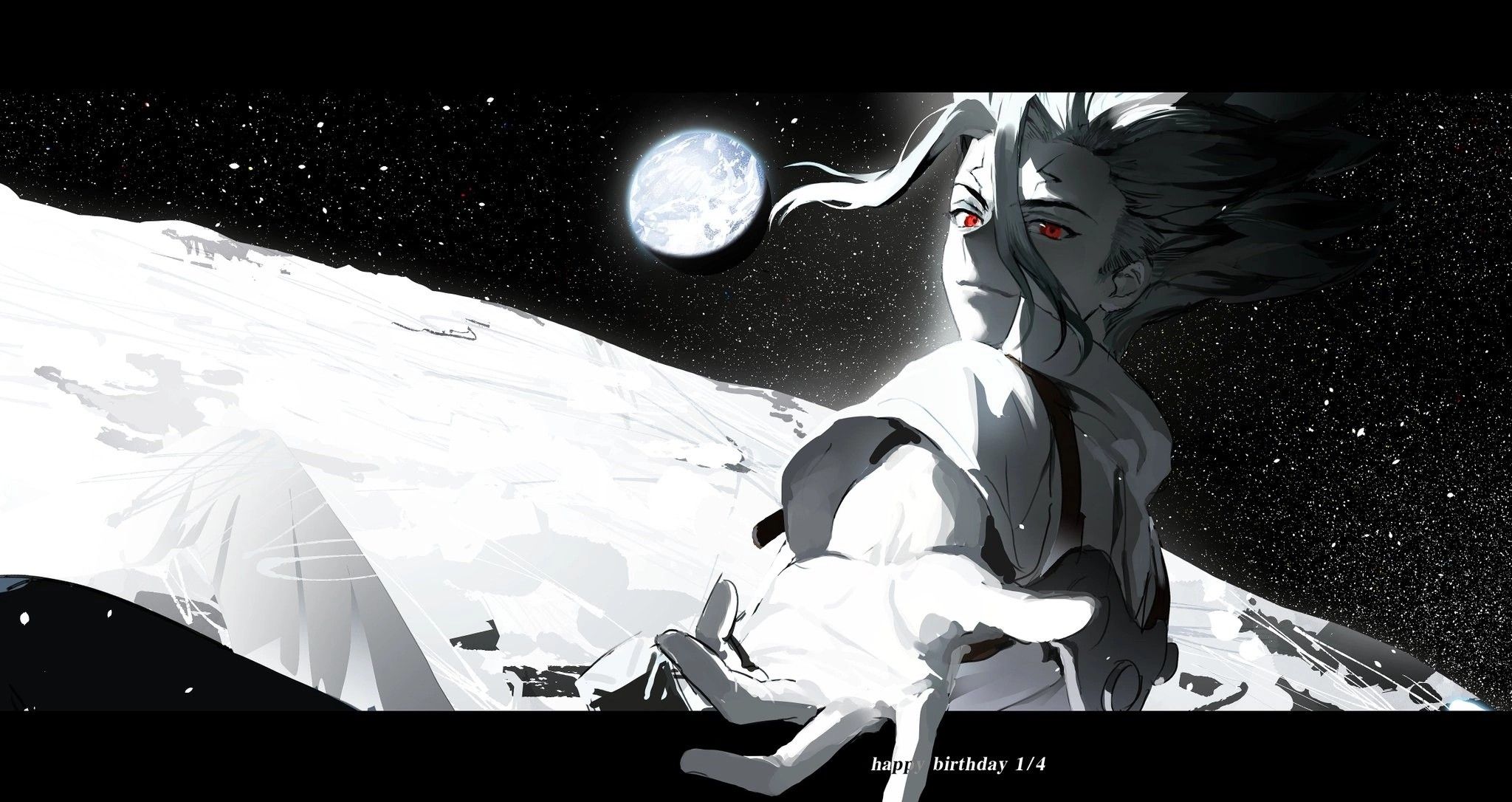
The confrontation awaiting viewers on the Moon is not a traditional brawl of fists and kinetic superpowers. Instead, it is an ideological debate disguised as a sci-fi thriller. What is the Medusa device? Is Why-Man an artificial intelligence running an ancient, corrupt program, an extraterrestrial entity observing Earth through a petrifying petri dish, or the tragic remnants of a rogue human experiment gone horribly right? Science Future must walk a delicate narrative tightrope, transitioning from hard-science celebration into speculative sci-fi without betraying the grounded mechanical logic that defines the series.
Engineering the Climax: TMS Entertainment’s Production Pedigree
Bringing Boichi’s hyper-detailed, kinetic manga panels to life has always been a formidable task, but the lunar sequence demands an unprecedented level of visual fidelity. Studio TMS Entertainment, alongside director Shuhei Matsushita, faces the challenge of animating the vacuum of space—a setting where the laws of friction, sound, and lighting fundamentally invert the dynamic language of traditional shonen action.
The franchise has consistently excelled due to its rigorous technical consultation with science writer Kurare. That consultation becomes critical during the final season. Modern anime audiences are notoriously eagle-eyed regarding the mechanics of orbital entry, staging separation, zero-gravity physics, and lunar surface navigation. Early visual teasers and production leaks hint that TMS is investing heavily in hybrid 2D/3D integration to render the intricate interior of the spacecraft and the unforgiving, monochrome expanses of the Moon.
The pacing will also dictate the anime’s legacy. With the manga concluding at Chapter 232, Science Future has a dense amount of technical exposition and emotional payoff to condense. Splitting the season across multiple cours ensures that the grueling preparation phases do not get truncated in favor of a rushed moonwalk, allowing the narrative the breathing room needed to earn every single metric ton of rocket thrust.
The Psychology of Senku Ishigami: Science as Compassion
At the center of this interstellar offensive stands Senku Ishigami, a protagonist who fundamentally subverts the archetypes of modern anime. Where peers like Izuku Midoriya or Tanjiro Kamado rely on sheer emotional endurance and somatic sacrifice, Senku’s superpower has always been his unyielding rationality—a rationalism that is, paradoxically, rooted in profound human empathy.
Senku’s journey to the Moon is deeply personal. It is the fulfillment of a childhood vow forged through stargazing with his adoptive father, Byakuya Ishigami, whose own sacrifice aboard the International Space Station laid the physical and emotional foundation for humanity’s resurrection. The Moon represents the point of intersection between Byakuya’s legacy and Senku’s destiny. When Senku dons an EVA suit, he isn’t marching to war to conquer an enemy; he is stepping into the void to rescue humanity from the paralysis of fear and stagnation.
This dynamic reframes the entire concept of the “final boss.” In Senku’s worldview, there are no villains that science cannot eventually understand, deconstruct, and redeem. The showdown with Why-Man is a testament to the belief that curiosity will always triumph over hostility, and that the universe’s darkest mysteries are merely equations waiting to be solved.
The Countdown to Anime Immortality
As Dr. STONE: Science Future prepares for launch, the series stands on the precipice of joining the elite pantheon of complete, uncompromised shonen adaptations. In an industry increasingly plagued by indefinite production hiatuses, rushed anime-original conclusions, and studio turnover, seeing Senku’s journey through from the first spark of a campfire to the cold vacuum of space is nothing short of miraculous.
Inagaki and Boichi crafted a modern myth for an era frequently paralyzed by cynicism, reminding audiences that progress is not a straight line, but an agonizing, beautiful climb up a mountain of failed experiments. When the Kingdom of Science finally ignites its boosters and sets its trajectory for the lunar dust, millions of fans will be strapped into the passenger seat, ready to bear witness to humanity’s greatest triumph.
Are you prepared for the Kingdom of Science’s final voyage? What are your wildest theories regarding the true identity of Why-Man? Sound off in the comments below, and stay tuned to Wibux.com for exhaustive episode breakdowns, science explainers, and exclusive animation insights.