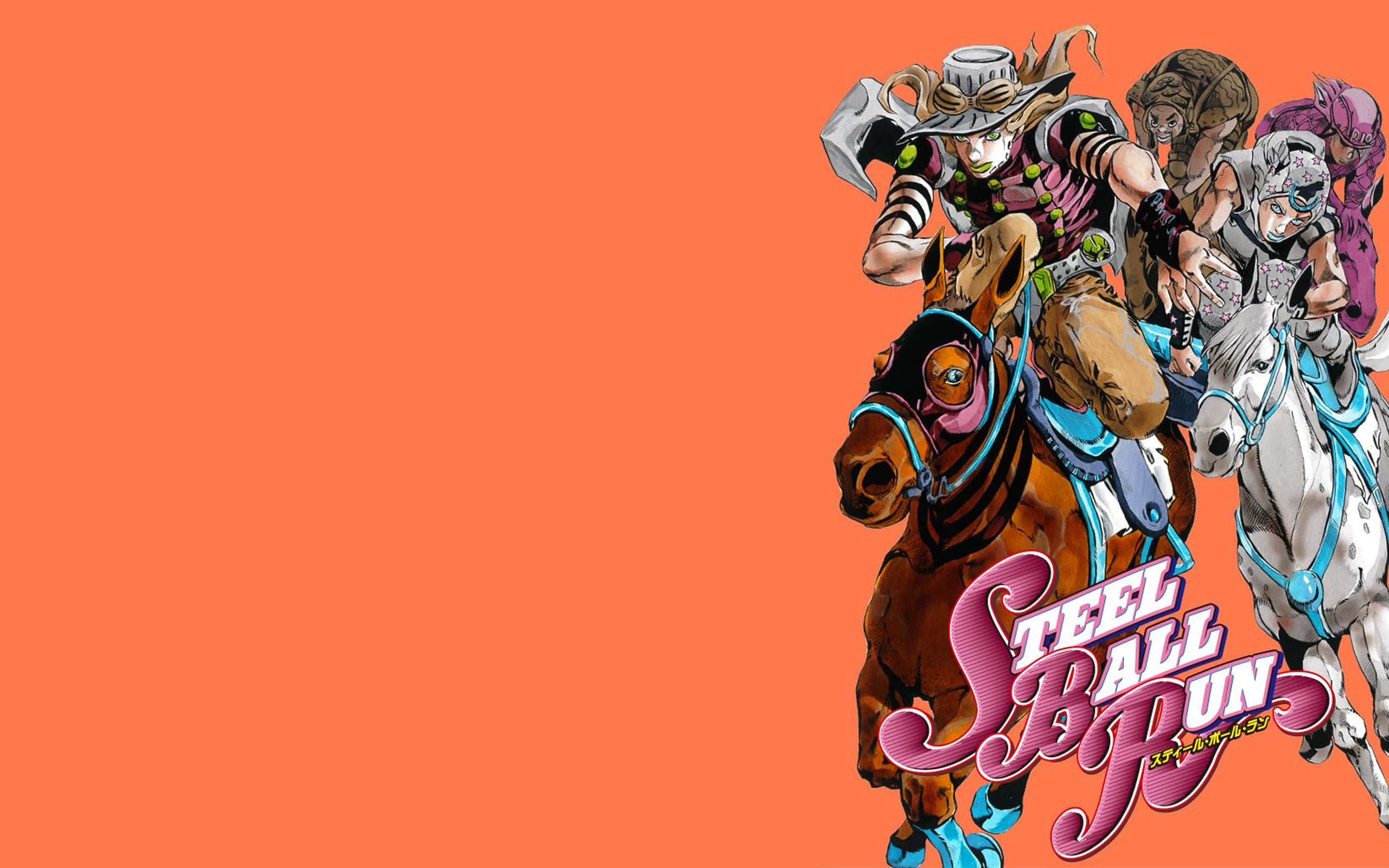
Ever since the melancholic, universe-resetting chords of Stone Ocean brought Hirohiko Araki’s multi-generational saga to an emotional close, the global anime community has been locked in an obsessive, collective vigil. For over a decade, anime-only viewers watched the Joestar bloodline war against DIO’s enduring curse, while manga connoisseurs smiled knowingly, whispering about the promised land that lay just beyond the horizon: Part 7, Steel Ball Run. Long regarded in critical circles not merely as Araki’s crowning artistic achievement, but as one of the greatest manga runs in the history of the medium, the adaptation of this trans-continental epic represents both the ultimate ambition and the most daunting technical mountain David Production has ever faced.
The Seinen Rebirth: Why Steel Ball Run Transcends the Shonen Formula
To understand the unprecedented fervor surrounding Steel Ball Run, one must grasp its foundational shift in creative DNA. Launched initially in Weekly Shonen Jump in 2004 before transitioning to the monthly seinen magazine Ultra Jump, the story liberated Hirohiko Araki from the punishing deadlines and demographic constraints of mainstream shonen. The shift was transformative. Unshackled from editorial guardrails, Araki pivoted from juvenile power-scaling to a gritty, historically textured American frontier epic set in 1890, saturated with moral ambiguity, intense violence, and psychological realism.
The premise itself is brilliant in its historical grandeur: an eccentric eccentric promoter orchestrates a grueling, 6,000-kilometer cross-country horse race from San Diego to New York City, promising a staggering fifty-million-dollar bounty. Yet underneath this dust-caked Western veneer lies an esoteric geopolitical conspiracy revolving around the pursuit of miraculous Holy Relics. By rebooting his continuity, Araki stripped away decades of accumulated lore baggage, grounding the narrative in survivalism, treacherous weather, scarce resources, and cutthroat opportunism.
Johnny Joestar and Gyro Zeppeli: A Masterclass in Character Deconstruction
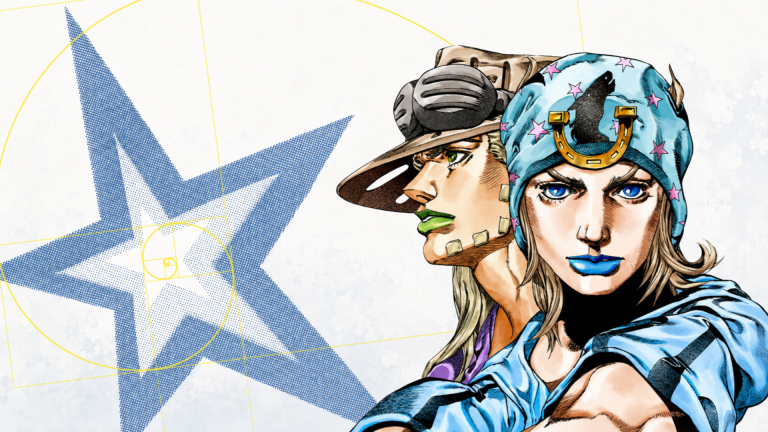
At the center of this bloodstained expedition is the most layered, emotionally resonant dual-protagonist dynamic Araki has ever penned. Rather than the righteous, larger-than-life chivalry of Jonathan or the effortless swagger of Jotaro, Part 7 introduces Johnny Joestar—a former horse-racing prodigy who lost his career, his family’s love, and the use of his legs due to his own blinding arrogance and petty hedonism.
Dark Determination vs. Neapolitan Stoicism
Johnny is fundamentally an anti-hero. Paralyzed, cynical, and driven by a desperate, borderline-feral desire to regain his mobility, he possesses what the story explicitly defines as “dark determination”—the terrifying willingness to kill without hesitation to achieve his goals. Araki does not soften Johnny’s flaws; instead, he crafts a profoundly human portrait of trauma, depression, and gradual redemption.
Serving as his moral counterweight and spiritual mentor is Gyro Zeppeli, a disgraced executioner from the Kingdom of Naples entering the race to secure an amnesty for an innocent child condemned to death. Gyro is flamboyant, superstitious, and fiercely honorable, masking deep existential guilt beneath nonsensical jokes about pizza mozzarella and steel teeth engraved with “GO! GO! ZEPPELI.” Their evolving partnership—built over campfires, shared coffee, and brush-with-death gunfights—is the emotional anchor of the entire narrative. Through Gyro, Johnny does not simply learn to walk; he learns how to live again.
The Spin Mechanics: Elevating the Stand Power System
While Stands remain a fixture of Part 7, Araki recalibrates the franchise’s supernatural combat by introducing The Spin, an ancient Neapolitan martial art grounded in physics, geometry, and the mystical properties of the Golden Ratio. Unlike Hamon (Ripple), which felt largely elemental, the Spin utilizes rotational energy to bypass physical defense, distort anatomy, and warp spatial dimensions.
This paradigm shift turns combat into an intellectual battleground. Stands in Steel Ball Run—such as Johnny’s evolving Tusk, which mirrors his psychological maturation through four distinct “Acts,” or the deadly temporal shifts of Funny Valentine’s Dirty Deeds Done Dirt Cheap (D4C)—are inextricably tied to the environment. Battles unfold across wind-swept prairies, frozen straits, and barren deserts. Stand abilities no longer manifest merely as punch-ghost brawlers; they are lethal, tactical anomalies where terrain, wind velocity, and saddle momentum dictate life or death.
The Technical Everest: David Production’s Equestrian Challenge
If the creative merits of Steel Ball Run are beyond debate, the production logistics behind its anime adaptation are an industry-wide nightmare. The open secret within anime production circles is simple: horses are the single most difficult subject to animate in 2D.
Four-legged quadruped locomotion demands an intricate understanding of skeletal kinetics, shifting muscle groups, and perspective foreshortening. In Steel Ball Run, horses are not incidental background props; they are principal characters. Slow Dancer and Valkyrie are present in virtually every sequence, galloping at breakneck speeds while their riders fire revolvers, unleash Spin spheres, and engage in high-speed Stand skirmishes.
David Production, which has faithfully adapted Parts 1 through 6 with stylistic brilliance, faces a pivotal fork in the road:
1. The Pure 2D Route: Hand-animating hundreds of distinct equestrian race sequences is commercially inviable and would break the scheduling pipeline of any modern animation studio without years of pre-production and an unprecedented budget.
2. The Hybrid 3D Pipeline: The far more realistic scenario involves utilizing cel-shaded CGI models for the horses—and possibly riders during distant action sequences—blended with hyper-detailed 2D close-ups. Studios like Orange (Trigun Stampede) have proved that expressive, stylized 3D can match the kinetic energy of top-tier 2D, but David Production must ensure that digital assets do not disrupt Araki’s distinct heavy cross-hatching, high-contrast ink lines, and psychedelic color palettes.
The Cultural Hunger and What Comes Next
The appetite for a Steel Ball Run anime announcement has reached critical mass across social platforms, convention floors, and animation forums. Fans who felt somewhat alienated by the unceremonious, batch-release distribution of Stone Ocean on Netflix are vocally advocating for a prestige treatment: high production values, a return to traditional weekly episodic releases to rebuild watercooler culture, and perhaps even a multi-cour, seasonal rollout that respects the sheer magnitude of the journey.
There is also the matter of its iconic antagonist, 23rd President of the United States Funny Valentine, whose twisted, hyper-nationalist worldview (“taking the first napkin”) presents a narrative sophistication rarely seen in serialized anime. In a medium often dominated by repetitive isekai power-trips and well-worn battle tropes, Part 7 arrives as an adult, literary tour de force masquerading as a wild-west supernatural sprint.
David Production has taken a conspicuous pause since the culmination of the original universe, and that silence should be read not as hesitation, but as calculated reverence. You do not rush a masterwork. When the starter pistol finally fires and Johnny Joestar’s stirrups click into place on screen, the anime industry won’t just be watching another seasonal release—it will be witnessing the arrival of a modern epic. Ready your saddles.
Which moment from the trans-American race are you most desperate to see animated—the silent suspense of the Sugar Mountain arc, or the explosive madness of D4C? Sound off in the comments below!