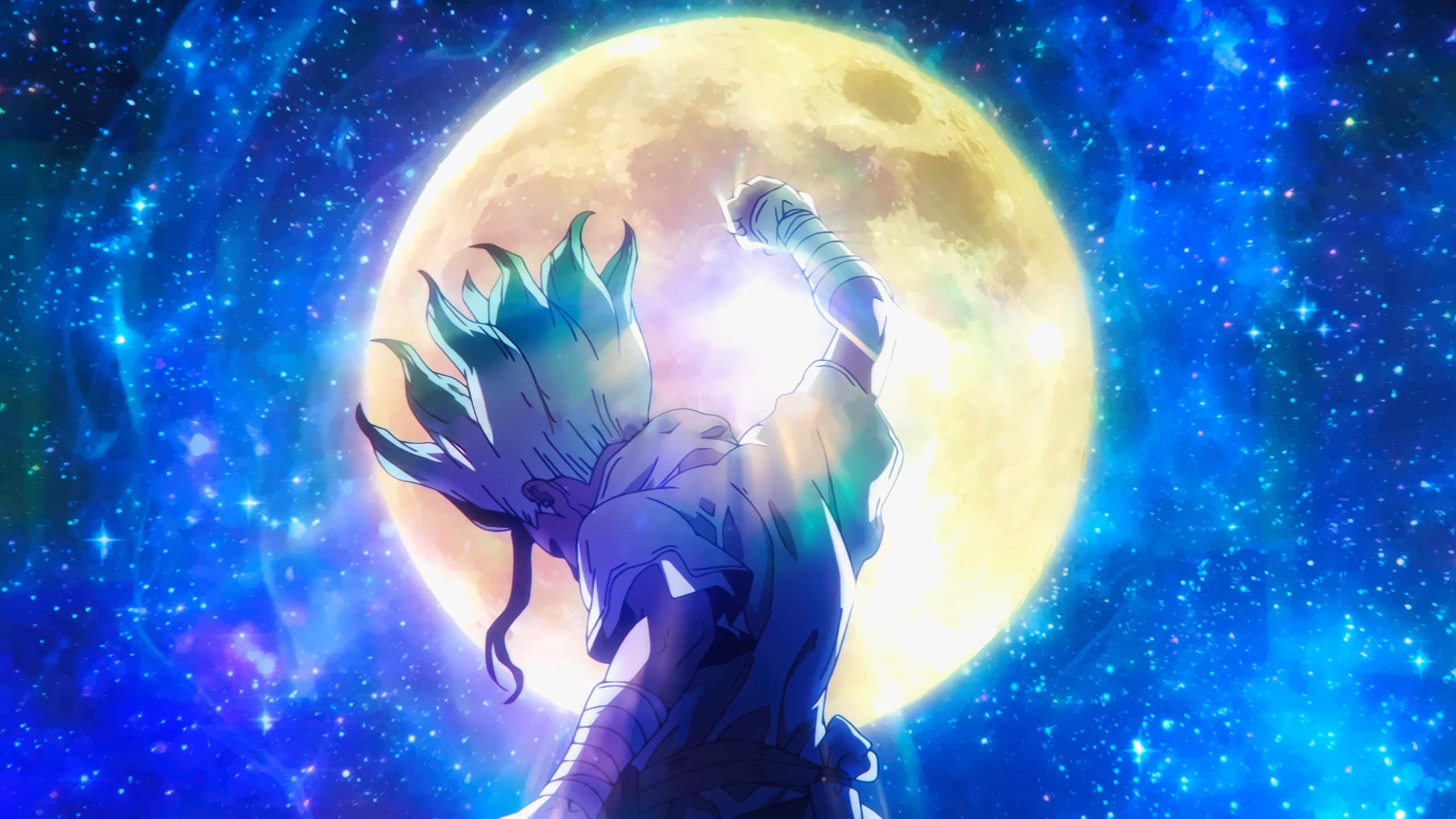
When Senku Ishigami first woke up in the year 5738, scraping together nitric acid and calcium carbonate from bat guano and seashells, few could have anticipated the sheer scale of the trajectory Riichiro Inagaki and Boichi were plotting. Over three critically acclaimed seasons, Dr. STONE evolved from an underdog edutainment survival yarn into an exhilarating, intercontinental tour de force. Now, with the official announcement of its fourth and final outing—subtitled Dr. STONE: Science Future—the Kingdom of Science stands on the precipice of its magnum opus: breaking through the Earth’s atmosphere, landing on the Moon, and coming face-to-face with the architect of humanity’s 3,700-year slumber, the enigmatic entity known only as Why-Man.
For longtime fans and manga readers alike, Science Future is not merely another seasonal renewal; it represents a triumphant, high-stakes capstone to one of the most uniquely optimistic stories in modern Weekly Shonen Jump history. As TMS Entertainment gears up to animate this colossal final journey, the narrative stakes have never been more terrifying or mathematically exhilarating.
The Blueprint to the Stars: From Stone Age Dirt to Apollo-Grade Rocketry
The thematic engine of Dr. STONE has always been its audacious premise: science is not a solitary magic, but an iterative, intergenerational relay race. In Science Future, this philosophy reaches its absolute zenith. Building an orbital-class, lunar-landing-capable rocket is a logistical nightmare that pushed real-world Cold War superpowers to their economic breaking points; executing it in a post-apocalyptic, de-industrialized world borders on mythological absurdity.
Viewers can expect the pacing to shift into hyperdrive as the Kingdom of Science orchestrates a truly global resource network. Rebuilding civilization’s supply chains requires everything from securing aluminum deposits and rubber plantations to establishing precision manufacturing factories capable of churning out functional integrated circuits. Senku’s chalkboard will transform from rudimentary chemical reaction diagrams into full-fledged orbital mechanics, guidance computer schematics, and aerospace thermodynamics.
What makes this final logistical sprint so compelling is the contrast between primal nature and high technology. Watching characters who were hunting boars with stone spears seasons ago suddenly assemble guidance computers by hand crystallizes the series’ core emotional thesis: human curiosity and collective labor can conquer any technological chasm, given enough patience and 10 billion percent effort.
The Ghost in the Radio: Demystifying Why-Man
Ever since that spine-chilling Morse code broadcast cracked through the Kingdom of Science’s crude communication array—endlessly, rhythmically repeating the English word “WHY”—Why-Man has lingered as an omnipotent, specter-like antagonist. Unlike the ideological warlords Senku has faced, such as Tsukasa Shishio’s brute survivalist darwinism or Hyoga’s twisted meritocracy, Why-Man represents an existential cosmic horror.
The Riddle of the Medusa Devices
The petrification device, colloquialized as the “Medusa,” has long defied Senku’s strict reliance on real-world physics. It operates at the intersection of nanotechnology, bio-energetics, and impossible thermodynamics, offering complete biological stasis, cellular regeneration upon de-petrification, and total planetary paralysis at the broadcast of a single vocal command. In Science Future, the narrative must finally reconcile this near-magical artifact with rigorous scientific logic.
Why-Man is not simply a cackling villain hiding in a crater; the entity is the embodiment of a philosophical paradox. Did Why-Man petrify humanity out of malice, or as an act of twisted cosmic mercy to halt anthropogenic extinction? The forthcoming confrontation on the dusty plains of the Moon is primed to be less of a traditional shonen fistfight and more of an ideological, battle-of-wits tribunal regarding the worth, destiny, and evolutionary legitimacy of humanity.
TMS Entertainment’s Final Frontier: Production and Visual Ambition
Adapting Boichi’s blisteringly detailed, hyper-kinetic manga art has always been a Herculean task, but the upcoming lunar arc demands an entirely different tier of visual spectacle. TMS Entertainment, which has faithfully stewarded the anime adaptation since its 2019 debut, faces a unique slate of technical challenges as the setting moves from lush, green terra-firma into the stark, claustrophobic vacuum of space.
The Technical Leap into Microgravity
Directing zero-gravity sequences, rocket separation mechanics, and the eerie, light-drenched desolation of the lunar surface requires seamless integration of 2D character expression and 3D mechanical rendering. Boichi’s artwork during the lunar mission leaned heavily into photorealistic mechanical blueprints and jaw-dropping lunar landscapes, juxtaposed against character faces contorted by gravitational force and raw terror. TMS Entertainment must ensure that the weightlessness of space carries the appropriate physical momentum and emotional gravitas without succumbing to flat, floaty CGI shortcuts.
Furthermore, composer Tatsuya Kato and Hiroaki Tsutsumi’s orchestral-folk-electronic hybrid soundtrack will need to expand into atmospheric, space-age territory. The rhythmic acoustic guitars and triumphant brass that defined the agrarian and nautical arcs must now make room for cold synths, ethereal vocalizations, and the deafening silence of an airless void.
Three Astronauts, One World: Character Psychology on the Brink
The journey to the Moon fundamentally relies on a suicide mission ethos. With fuel, payload, and computational weight limited down to the milligram, the mission cannot transport an army. The composition of the lunar crew stands as one of the narrative’s tightest psychological pressure cookers, demanding a trifecta of unparalleled intellect, peerless physical lethality, and indomitable courage.
Senku Ishigami, a boy driven exclusively by rational deduction, faces his greatest emotional reckoning. For thousands of years of subjective consciousness, Senku counted seconds to keep his mind from fraying. Now, standing where his adoptive father Byakuya Ishigami looked down from the International Space Station, Senku’s scientific journey becomes deeply personal. It is the closure of a familial promise etched across four millennia.
Beside him, key figures like Ryusui Nanami—the man whose insatiable “greed” has driven civilization’s economic expansion—and the elite combatants tasked with subduing whatever waits on the lunar surface must confront their mortality. The psychological dread of drifting into deep space with zero chance of immediate rescue grounds the narrative, transforming shonen heroics into raw, human perseverance.
The Anti-Cynicism Anthem: Why ‘Science Future’ Matters
In a contemporary anime landscape largely dominated by grimdark fantasy, existential trauma, and hyper-violent deconstructions—where catastrophic Shibuya-style massacres and body-horror devils rule the discourse—Dr. STONE is a vital, unapologetic breath of radical optimism. It does not treat human history as an irredeemable plague, but as a messy, beautiful tapestry of collective problem-solving.
Science Future is poised to remind the community why we fell in love with storytelling in the first place. There are no cursed energies, no demonic bloodlines, and no chosen-one prophecies here. The ultimate power in Dr. STONE is, and has always been, the scientific method: observation, hypothesis, trial, error, and relentless progress.
The Final Countdown Begins
As Dr. STONE: Science Future prepares to ignite its thrusters, the anime community prepares to bid farewell to one of the most uniquely educational, consistently thrilling shonen masterpieces of the modern era. The road from making a crude stone axe to walking on the lunar regolith has been paved with sweat, unyielding resilience, and the sheer audacity of human ambition. The question remains: when the dust clears on the lunar surface, will Senku’s science be enough to silence Why-Man’s transmission forever?
Are you prepared for the final launch, or do you think Why-Man’s true identity will break the Kingdom of Science? Sound off in the comments below and let us know your wildest theories on how TMS Entertainment will bring this legendary saga to a close!