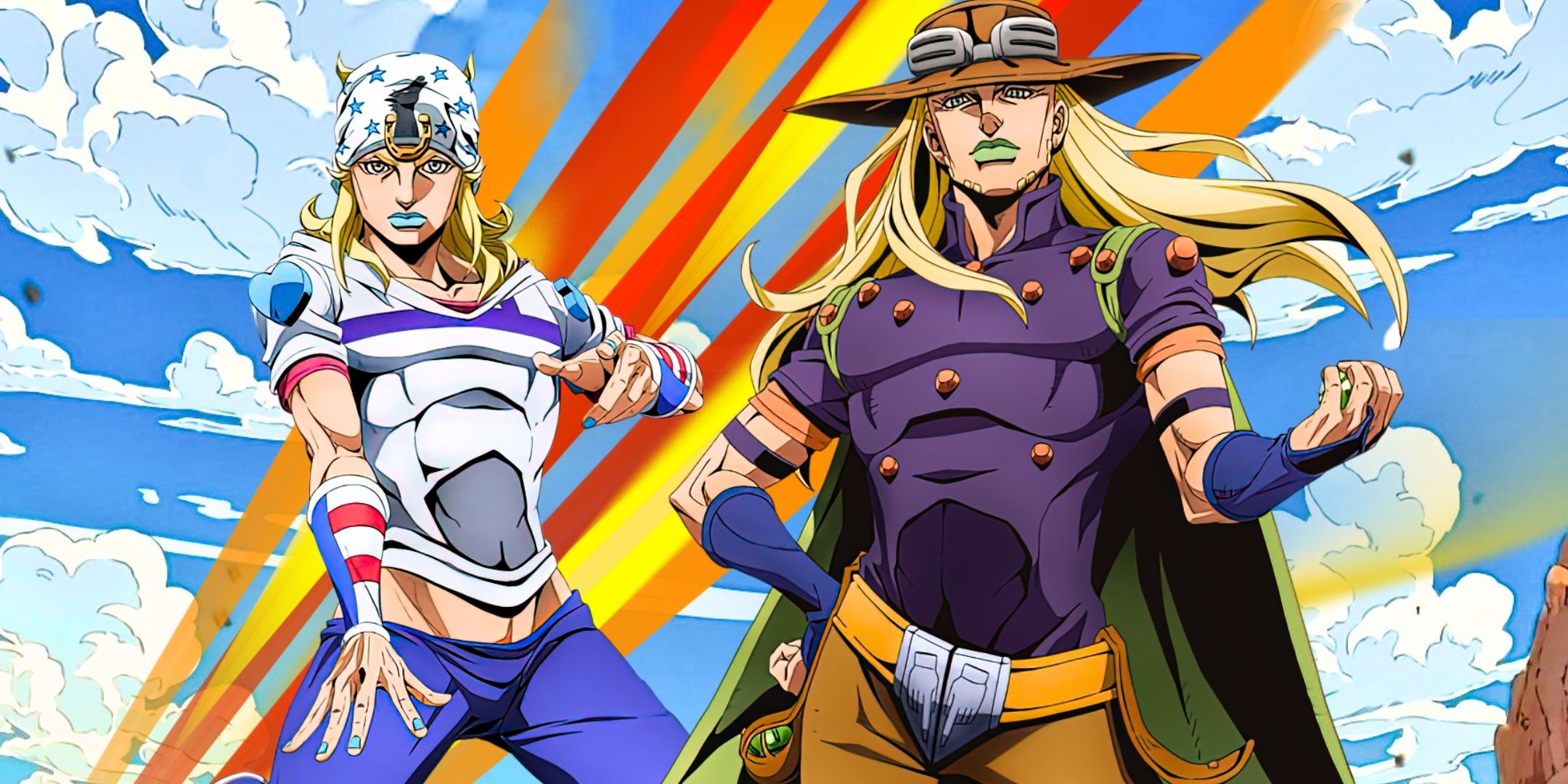
Ever since the melancholic, universe-resetting notes of the Stone Ocean finale faded into the anime ether, the global fandom of Hirohiko Araki’s generational saga has fixed its gaze upon a single, dust-swept horizon: the starting line of the 1890 trans-American equestrian race. For years, the whisper alone was enough to send community forums into a frenzy. Now, as speculative chatter around David Production’s production pipeline swells from quiet murmur to deafening roar, the prospect of an anime adaptation of JoJo’s Bizarre Adventure Part 7: Steel Ball Run represents far more than just another seasonal renewal. It is the impending coronation of what critics and readers universally revere as Araki’s undisputed magnum opus.
Serialized across seven grueling, transformative years, Steel Ball Run did not merely reboot the franchise into an alternate continuity; it fundamentally restructured its creative DNA. Bridging the gap between the audacious camp of classic JoJo and the cerebral, morally ambiguous weight of mature seinen fiction, Part 7 stands as a towering achievement in modern Japanese sequential art. Adapting its sprawling 24 volumes, however, poses the most formidable artistic and technical gauntlet David Production has ever faced.
The Seinen Shift: Araki’s Rebirth on the American Frontier
To understand the electric buzz surrounding Steel Ball Run, one must first appreciate the historic turning point it occupies in Araki’s career. Beginning serialization in Weekly Shonen Jump in 2004 under the unadorned title Steel Ball Run—initially omitting the “JoJo” prefix—the series soon migrated to the monthly pages of Ultra Jump. That logistical pivot unlocked an unprecedented level of creative liberty. Unshackled from weekly deadlines and shonen editorial constraints, Araki slowed his pacing, deepened his draftsmanship, and indulged in haunting existential thematic depths.
The canvas expanded from claustrophobic prisons and city streets to an immense, unforgiving wilderness: 3,700 grueling miles stretching from the Pacific sands of San Diego to the bustling ports of New York City. The contest, an audacious cross-country horse race conceived by eccentric promoter Steven Steel, offered a staggering $50 million purse. Yet, beneath the sun-baked dust and spectacle lies a picaresque journey into greed, geopolitical conspiracy, and divine intervention. The Western aesthetic is not a cosmetic skin—it is the thematic engine of an America at the crossroads of myth, industrialization, and ruthless ambition.
Paraplegia, Pride, and the Golden Ratio: Deconstructing the Duo
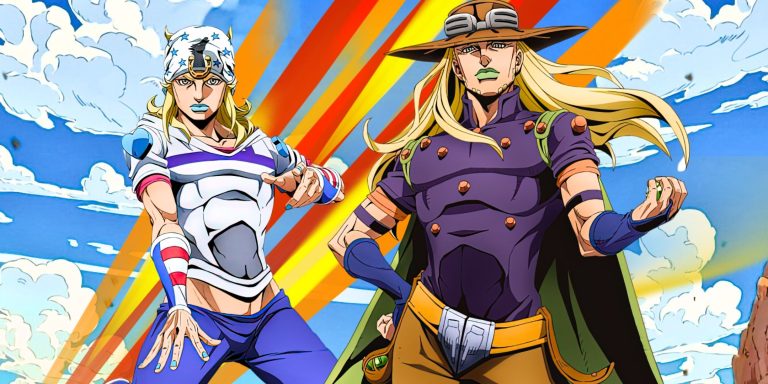
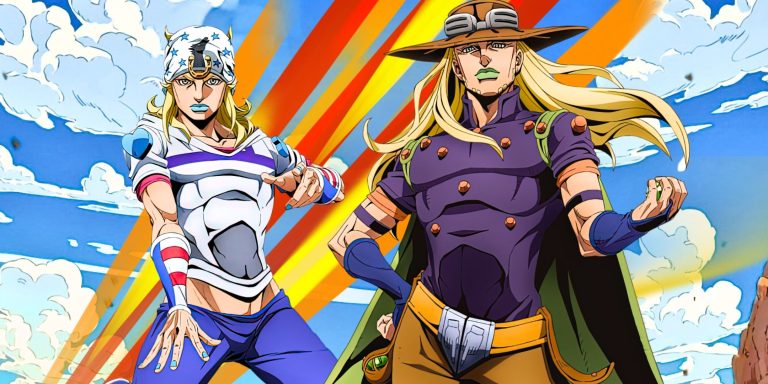
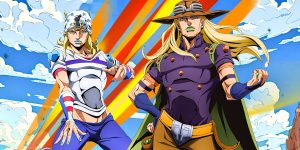
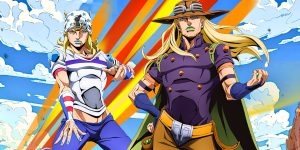
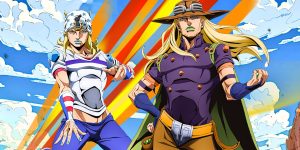
At the beating heart of Steel Ball Run is a relationship that subverts decades of battle-manga brotherhood. Previous JoJo entries featured charismatic saviors and noble protectors, but Johnny Joestar and Gyro Zeppeli arrive at the starting gate as broken, self-interested outcasts seeking redemption rather than righteousness.
Johnny Joestar’s Dark Determination
Johnny Joestar is not Jonathan Joestar reincarnated as a saintly gentleman. He is a fallen prodigy, a former horse-racing prodigy whose reckless vanity cost him the use of his legs and his societal standing. Paraplegic, bitter, and cast out by his family, Johnny enters the race not for gold or glory, but because the supernatural kinetic energy of Gyro Zeppeli’s Steel Balls causes his lifeless legs to twitch for a fraction of a second. Johnny’s internal journey is defined by what Araki famously terms “dark determination”—an unflinching, sometimes terrifying willingness to sacrifice his soul, his morals, and his companions simply to cross from “negative into zero.” His character arc remains the most complex psychological study in the entire franchise.
Gyro Zeppeli and the Burden of the Executioner
Operating as Johnny’s foil and mentor is Gyro Zeppeli, a disgraced officer from the Kingdom of Naples whose absurd outward persona—graced with steel-plated teeth bearing “GO! GO! ZEPPELI” and a fondness for improvising nonsensical songs about pizza mozzarella—masks an agonizing moral dilemma. Gyro participates in the deadly race to win amnesty for an innocent child condemned to state execution back home. He carries the tragic hereditary mantle of the Zeppeli family: a lineage bound to sacrifice, doomed to tutor a Joestar through blood, sweat, and profound philosophical enlightenment.
The Spin vs. Stands: An Intellectual Evolution
Rather than defaulting to the traditional “punch-ghost” Stands that dominated Parts 3 through 6, Steel Ball Run introduces the Spin—an ancient Neapolitan executioner technique rooted in the mathematical perfection of the Golden Spiral and the Fibonacci sequence. By manipulating kinetic rotation through spheroids, practitioners bypass dimensional barriers, bend physical reality, and unlock anatomical wonders. Stands do eventually manifest—most notably Johnny’s evolving Tusk—but they function as spiritual extensions of this geometric art form rather than straightforward combat summons. It is a cerebral, intricate combat philosophy that demands razor-sharp visual direction to communicate on screen.
The Technical Gauntlet: Animating the Equestrian Nightmare
If the narrative pedigree of Steel Ball Run is practically bulletproof, the central question keeping animators and studio executives awake at night is terrifyingly mundane: the horses.
In the global animation industry, the horse is notorious as the ultimate animator-killer. Equine biomechanics—the precise firing of muscles, the articulation of four independently flexing legs, the shifting weight of hooves striking earth—require extraordinary anatomical mastery. A single galloping horse in full perspective can bring a senior 2D key animator to their knees. In Steel Ball Run, entire packs of hundreds of thoroughbreds, wild mustangs, and stampeding herds are depicted galloping simultaneously across sprawling deserts, navigating blizzards, and engaged in dynamic close-quarters combat.
David Production, celebrated for their stylized line-hatching, flamboyant color shifts, and tactile sound-effect typography, faces an unprecedented technological crossroads. A purely hand-drawn 2D production of Steel Ball Run would either balloon the budget into catastrophic territory or break the studio’s scheduling backbone. Conversely, overly synthetic 3DCG models could shatter the handcrafted, Renaissance-inspired linework that makes Araki’s manga pages look like museum tapestries.
Industry insiders speculate that David Production will likely deploy a sophisticated hybrid pipeline, combining heavily customized cel-shaded 3D assets for background racing formations with painstakingly drawn, expressive 2D character-and-steed focus shots during pivotal duels. Mastering this delicate visual alchemy is the single greatest hurdle separating Steel Ball Run from anime immortality.
The Holy Corpse and Geopolitical Madness
Beyond the technical obstacles lies a narrative scope far grander than a simple sports duel. As the racers cross the midwestern plains, the contest reveals itself as an elaborate geopolitical conspiracy orchestrated by the 23rd President of the United States, Funny Valentine. Armed with the dimensional-hopping Stand Dirty Deeds Done Dirt Cheap (D4C) and driven by an uncompromising, terrifying brand of imperial patriotism, Valentine seeks to gather the scattered mummified relics of the Holy Corpse—widely implied to be Jesus Christ Himself.
This intersection of historical fiction, esoteric Christian mysticism, and frontier folklore gives Part 7 its distinct, magnetic flavor. The clash between Johnny’s deeply personal search for self-worth and Valentine’s utilitarian vision for American dominion elevates the climax beyond a standard martial contest into an operatic confrontation of absolute philosophical wills.
When Will the Starting Pistol Fire?
Following David Production’s recent heavy workloads—ranging from the high-octane spectacle of Fire Force to the lavish retro reboot of Urusei Yatsura—the timeline for Steel Ball Run remains tightly guarded. Yet, within the anime ecosystem, the sense of inevitability is absolute. No studio walks away from the crown jewel of modern manga, especially after successfully translating six continuous generations of Joestar history with unmatched fidelity.
When the starting pistol finally echoes across the sands of San Diego Beach, it will herald the arrival of an anime that challenges every aesthetic and thematic standard the medium holds dear. The road ahead is brutal, unforgiving, and laden with immense technical peril—but for Johnny, Gyro, and millions of devoted fans worldwide, the prize waiting at the finish line is nothing short of legendary.
What are your biggest hopes and fears for David Production’s adaptation of Steel Ball Run? Will they crack the equestrian animation code, or should they rely heavily on cutting-edge 3D hybrids? Let us know your thoughts in the comments below!