
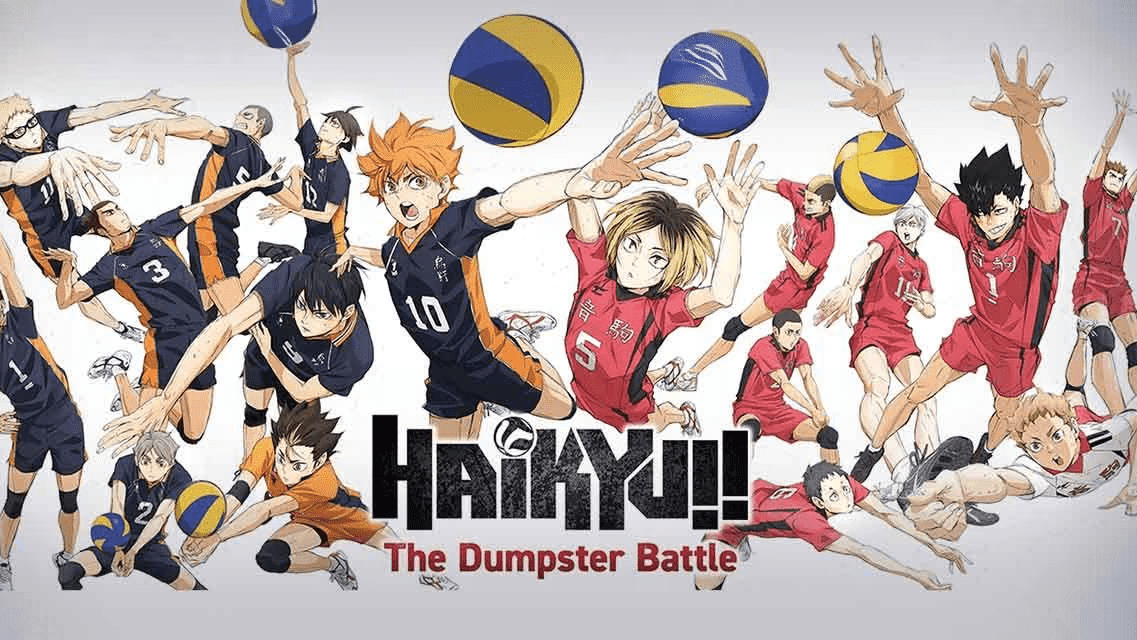
When the final whistle blew during the domestic theatrical run of Haikyu!! The Dumpster Battle, it didn’t just cap off an astounding 11-billion-yen domestic box office blitz; it crystallized a decade of sports anime evolution. Now that the cinematic spectacle has finally touched down on global streaming platforms, millions of international fans are experiencing what Japanese audiences wept over in early 2024: an 85-minute masterclass in athletic poetry, kinetic direction, and emotional catharsis. The long-promised “Battle at the Garbage Dump” between Karasuno High and Nekoma High is not simply another tournament round in the Spring National Tournament—it is the ideological, structural, and narrative zenith of Haruichi Furudate’s magnum opus.
The Anti-Rivalry: Subverting Shonen Conflict Through Mutual Elevation
In standard shonen architecture, rivalries are historically built on resentment, ideological antagonism, or existential opposition. From the blood-soaked grudges of Naruto to the bitter ego clashes of Blue Lock, sports and battle manga traditionally teach us that opponents must be crushed for the protagonist to validate their existence. Haikyu!! fundamentally rejects this zero-sum cynicism. Karasuno and Nekoma do not play to destroy each other; they play to bring each other fully to life.
The roots of this clash run half a century deep, inherited from former coaches Ikkei Ukai and Yasufumi Nekomata. For decades, the Crows and the Cats traded practice matches on suburban gym floors, endlessly chasing the phantom dream of a clash on the grandest stage: the orange court of Tokyo’s Metropolitan Gymnasium. By framing this third-round encounter as the “match with no second chances,” director Susumu Mitsunaka imbues every single point with existential urgency. There are no training camps tomorrow, no post-game scrimmage sets to run. For the seniors—Daichi, Sugawara, Asahi, Kuroo, Yaku, and Kai—the court is a finite space shrinking with every serve.
A Contrast of Philosophies: Flight Versus Circulation
What makes the Karasuno vs. Nekoma dynamic sports anime perfection is the elemental symmetry of their volleyball identities. Karasuno represents erratic, untamable momentum—a murder of crows that constantly dives, misses, reinvents itself, and takes to the skies with synchronized attacks and erratic tempos. Nekoma is systemic, patient, and biological. They are the blood vessels, the spine, the creeping feline that refuses to let the ball touch the hardwood.
Watching these two styles collide is not an exercise in brute force, but an intricate anatomical examination. Karasuno swings their sledgehammer; Nekoma simply shifts the angle of impact, absorbing the kinetic shock and funneling it right back across the net until their opponent suffocates on their own exhaustion.
The Psychological Chess Match: Kenma Kozume’s Birdcage
At the beating, algorithmic heart of The Dumpster Battle is the psychological war waged between Nekoma’s quiet setter, Kenma Kozume, and Karasuno’s hyperactive decoy, Shoyo Hinata. Kenma has never cared about volleyball; to him, it is an exhausting, sweat-drenched sensory overload that pales in comparison to his handheld RPGs. Hinata, conversely, is the living avatar of pure, unadulterated athletic passion.
Kenma doesn’t try to outjump Hinata; he computes him. In one of the film’s most chilling and brilliant narrative sequences, Kenma systematically robs Hinata of his kinetic playground. Through microscopic adjustments in serve placement and floor defense, Nekoma cages Hinata’s run-up, taking away the wide, sweeping approach that allows him to fly. The film visualizes this not as standard sports strategy, but as psychological entrapment: Hinata finds himself trapped inside an actual birdcage, his wings clipped, grounded on an open floor with nowhere to jump.
Yet, the genius of Furudate’s characterization—and Mitsunaka’s adaptation—is that Hinata’s eventual breakthrough does not humiliate Kenma. When Hinata unleashes the sky-scraping “open toss” jump that finally breaks the cage, Kenma doesn’t recoil in horror. Instead, his eyes dilate. The game has forced the gamer to care. The agonizing, breathless rally that follows culminates not in an epic, reality-bending super-spike, but in the most mundane, human mistake imaginable: a ball slipping through sweat-slicked fingers. It is a moment of profound vulnerability where Kenma looks up at Kuroo, gasping for air, and utters the words fans waited ten years to hear: “Kuroo… thanks for teaching me how to play volleyball. It’s fun.”
Production I.G’s Kinetic Triumph: Inside the Sweating Mind of an Athlete
To compress over thirty manga chapters into an 85-minute feature film was a risky creative gamble that initially provoked anxiety across the fandom. Would the cuts be too deep? Would the secondary characters lose their spotlight? While some character vignettes were inevitably trimmed, Production I.G answered these concerns with what can only be described as a visual masterstroke.
The film’s climactic rally abandons traditional third-person spectator cinematography and pulls the audience directly into Kenma Kozume’s skull. Utilizing a dizzying, handheld-style first-person perspective (POV), the camera sways, tilts, and pants. The frame blurs with sweat and visual fatigue; the audio drops into an underwater muffled hum, dominated entirely by Kenma’s ragged breathing and the harsh rubber squeak of sneakers on polished wood. We feel the weight of the ball, the paralyzing dread of tired knees, and the lightning-fast panic of reading a hitter’s shoulder rotation in real-time.
This is not merely hyper-detailed animation; it is an empathetic bridge. By rendering the final moments through the sensory overload of an introverted strategist pushed beyond his biological limits, Production I.G elevates a high school volleyball match into an intimate, claustrophobic psychological opera.
The Mentorship Paradox: Kuroo and Tsukishima’s Full Circle
Beneath the Kenma-Hinata spotlight lies the equally moving, generational dialogue between Tetsuro Kuroo and Kei Tsukishima. The Tokyo Training Camp arc in season two spent dozens of episodes framing Kuroo not as Karasuno’s adversary, but as Tsukishima’s voluntary mentor. Kuroo taught Karasuno’s stoic middle blocker the nuance of lead-blocking, the psychological terror of funneling, and the intellectual satisfaction of reading an offensive play before it unfolds.
In The Dumpster Battle, that seed bears full fruit. Tsukishima uses Kuroo’s own philosophy to deny Nekoma’s spikers at the net, even offering his rival a cheeky, knowing smirk. There is an unspoken tragedy inherent to this dynamic: to honor the senior who mentored you, you must extinguish his final high school dream. When Kuroo’s high school career dissolves with the final point, there is no anger—only the immense, quiet pride of an older brother watching his apprentice surpass him.
The Cultural Verdict: Why The Dumpster Battle Sets the Standard
As The Dumpster Battle circulates globally through home streaming, its reception cements what critics have long argued: Haikyu!! is the gold standard of contemporary sports media because it honors the reality of human limitation. There are no magical powers here, no manufactured villains to despise, and no easy answers. Both teams left everything on the floor, yet one team had to lose.
By focusing so sharply on the ephemeral nature of high school athletics—the haunting realization that childhood ends on a gymnasium floor surrounded by weeping teammates—the film transcends the niche boundaries of sports anime. It captures that rare, fleeting lightning in a bottle: the joy of doing something utterly meaningless with people who mean everything to you.
Now that Karasuno has clawed their way out of the garbage dump and into the quarterfinals against Kamomedai, the stakes have officially turned terminal. If The Dumpster Battle proved anything, it’s that when Production I.G and Haruichi Furudate lock eyes across the net, the result is nothing short of absolute brilliance.
Did the cinematic pacing do justice to the manga’s iconic Garbage Dump showdown, or did you miss the breathing room of a full television season? Jump into the comments below and tell us your favorite rally from the film!