In the breathless wake of Stone Ocean’s cataclysmic finale, the global anime community found itself staring into an unprecedented void. For over a decade, David Production marched relentlessly through the multi-generational tapestry of the Joestar bloodline, adapting Hirohiko Araki’s bizarre universe with unmatched stylistic devotion. Yet, as the dust settled over the reset universe, every whisper, forum post, and speculative leak coalesced into a singular, sacred question: When does the race begin? We are, of course, talking about JoJo’s Bizarre Adventure: Steel Ball Run. Consistently ranked second only to Kentaro Miura’s Berserk on global manga leaderboards, Part 7 is not merely the next installment in a venerable franchise; it is widely considered Araki’s magnum opus—a hyper-literate, mechanically daring reinvention of Western frontier mythology that looms over modern animation like an untouchable colossus.
The Shift to Ultra Jump: Araki’s Reinvention of the Mythos
To understand the sheer magnitude of the anticipation surrounding Steel Ball Run, one must appreciate the artistic crucible from which it was forged. When the series debuted in Weekly Shonen Jump in 2004, it was initially uncoupled from the JoJo moniker, framed as a standalone cross-country horse race through late 19th-century America. However, the true seismic shift occurred when Araki migrated the series to the monthly seinen imprint Ultra Jump in 2005. Freed from the draconian deadlines and demographic sanitization of weekly shonen publication, Araki unleashed a creative renaissance.
The pacing transformed. The panel layouts abandoned standard action geometry in favor of sprawling, painterly spreads reminiscent of American realism and classic Italian fashion editorials. Araki’s thematic palette darkened, trading straightforward punch-ghost skirmishes for intricate games of survival, theological philosophy, and visceral anatomical body horror. Steel Ball Run took the foundational ethos of the series—the triumph of the human spirit against insurmountable destiny—and filtered it through a sun-bleached, dusty lens of moral ambiguity, creating an epic that rivals the great frontier epics of Cormac McCarthy and Sergio Leone.
Johnny Joestar and Gyro Zeppeli: Deconstructing Brotherhood and the Spin
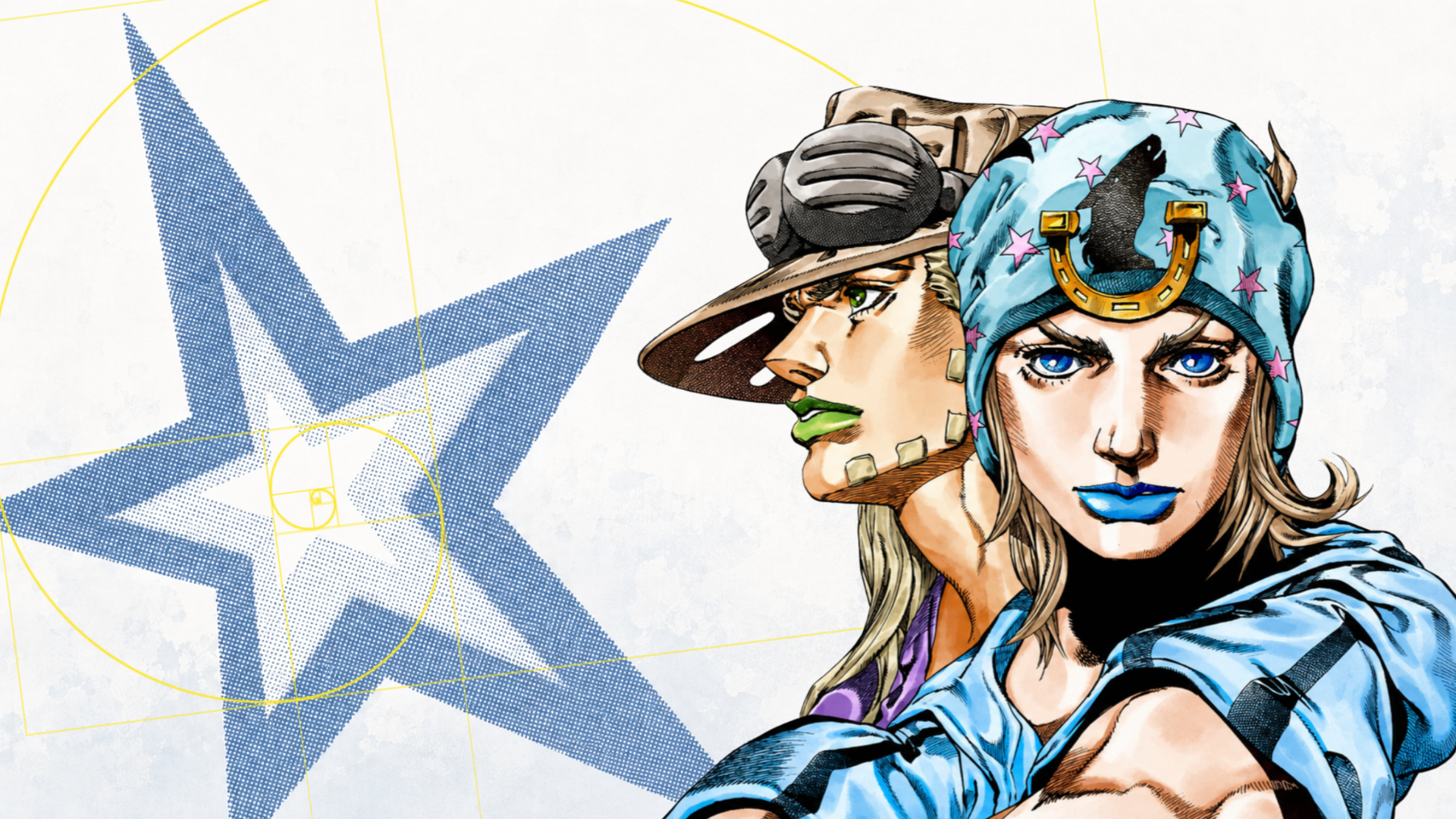
At the beating heart of this sprawling 6,000-kilometer sprint across the North American continent lies the greatest dual-protagonist dynamic Araki has ever penned. Rather than the archetypal noble heroes of JoJo’s past, Steel Ball Run anchors itself in the fractured psyches of two men desperately chasing redemption.
Johnny Joestar: The Dark Determination of a Fallen Prodigy
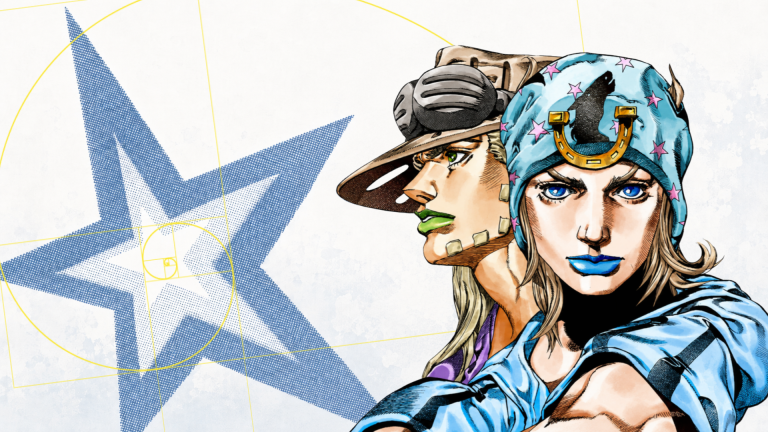
Johnny Joestar is not Jonathan Joestar, despite the lineage of his moniker. Paralyzed from the waist down following an act of hubristic arrogance in his youth, Johnny begins his narrative journey as a bitter, washed-up jockey stripped of his dignity and purpose. What makes Johnny captivating—and radically distinct from typical anime protagonists—is his unabashed moral rot. He is possessed by what Araki explicitly labels a “dark determination”: a cold, merciless fixation that burns in his eyes whenever his survival or goals are challenged. Johnny is not racing across America to save the world; he is racing because the mysterious spinning spheres of a Neapolitan executioner granted him the momentary ability to stand on his own two feet again. His trajectory is a raw, non-linear study of trauma, physical disability, and spiritual resurrection.
Gyro Zeppeli and the Mathematics of the Golden Spiral
Balancing Johnny’s brooding desperation is Gyro Zeppeli, a disgraced former royal executioner from the Kingdom of Naples armed with steel orbs, gold-plated grillz reading “GO! GO! ZEPPELI,” and an absurd penchant for terrible puns. Beneath his ostentatious theatricality lies a deeply principled ascetic bound to an impossible quest of imperial bureaucracy and compassionate rebellion.
Gyro is the vessel through which Araki introduces the Spin, a profound mechanical evolution that transcends the series’ traditional power systems. Expanding upon the respiration-based Hamon of Parts 1 and 2, the Spin is a supernatural martial discipline rooted in the mathematical perfection of the Fibonacci Sequence and the Golden Ratio. Watching the Spin clash with early 20th-century Stand evolution represents one of the most intellectually thrilling eras of Araki’s combat choreography, where kinetic momentum, spherical trajectory, and cellular rotation replace raw destructive power.
The Technical Crucible: Can David Production Animate the Herd?
For all the thematic grandeur of Part 7, an inescapable production paradox hangs over David Production: the horses. It is an industry-wide axiom that four-legged equestrian locomotion is the ultimate graveyard of 2D animation budgets. The intricate skeletal anatomy, continuous gait cycles, shifting musculature, and kinetic mane movement demand an astronomical number of keyframes that can bring even elite studios to their knees.
Steel Ball Run does not merely feature horses as background transportation; they are living, breathing secondary characters that engage in high-octane cavalry combat across plains, snowcapped mountain ranges, and dense swamps. The opening stages of the race feature hundreds of horses thundering simultaneously across the San Diego shoreline. How does a production pipeline reconcile this reality?
Industry insiders and veteran animators speculate that David Production must radically evolve its technical pipeline, likely pioneering a sophisticated hybrid approach:
- High-End Cel-Shaded CGI: Similar to the hyper-detailed 3D assets deployed by Orange (Trigun Stampede) or the complex naval machinery in modern mecha productions, David Production may rely on meticulously textured 3D horse models for wide-angle gallops and swarm shots.
- Hand-Drawn 2D Keying for Combat Climax: In tight, claustrophobic saddle fights where Johnny and Gyro deploy Stand abilities and the Spin, the production will inevitably require veteran key animators to hand-draw the musculature to preserve Araki’s trademark ink hatching and muscular contours.
- Auteur Sound and Color Design: The soundscapes of JoJo have always stood as masterpieces of audio design. Recreating the thunderous acoustic dissonance of steel spheres cutting through desert air, alongside dramatic palette shifts during high-noon shootouts, will be crucial to masking budgetary strain and elevating the kinetic drama.
The Corpse Parts and Moral Relativism: The Shadow of Funny Valentine
The race itself serves merely as an elaborate geopolitical smokescreen. The true narrative engine of Steel Ball Run is the race to recover the scattered mummified fragments of the Holy Corpse—implied heavily to be the physical remains of Jesus Christ—which bestow miraculous reality-bending abilities upon those who graft them into their flesh.
Enter the 23rd President of the United States, Funny Valentine. Valentine represents one of the most chillingly charismatic antagonists in modern fiction. Operating under a utilitarian ideology of pure, unadulterated patriotism, Valentine seeks the Corpse Parts to permanently divert all misfortune away from the United States and push it onto the rest of the world. His Stand, Dirty Deeds Done Dirt Cheap (D4C), enables him to traverse infinite parallel dimensions, swapping out mortal injuries with alternate versions of himself. The ideological collision between Valentine’s collectivist manifest destiny and Johnny Joestar’s hyper-individualist will to survive shatters conventional black-and-white morality, ensuring that the thematic stakes of the adaptation will spark fierce debate across contemporary pop-culture spheres.
The Final Frontier of the JoJo Zeitgeist
The road ahead for Steel Ball Run is daunting. Adapting a 24-volume monthly seinen with uncompromising technical demands is a monumentally risky commercial and artistic venture. Rumors continue to swirl regarding whether David Production might split the epic into multiple seasons, explore high-budget theatrical releases for early race stages, or completely overhaul their scheduling to prevent the production crises that plagued the latter half of Stone Ocean.
Yet, the cultural hunger for Part 7 is undeniable. It represents the pinnacle of Hirohiko Araki’s lifelong artistic odyssey—a work where historical revisionism, psychological depth, and supernatural surrealism achieve absolute equilibrium. When the starter pistol finally fires and the opening notes of the adaptation’s score reverberate across the desert sands, anime will bear witness to an event that could redefine the boundaries of the medium for the next generation.
Are you prepared to enter the race of the century? Do you believe David Production can pull off the horses without leaning too heavily on CGI, or should they take a multi-year hiatus to get it right? Sound off in the comments below, and let us know your dream voice cast for Johnny and Gyro!