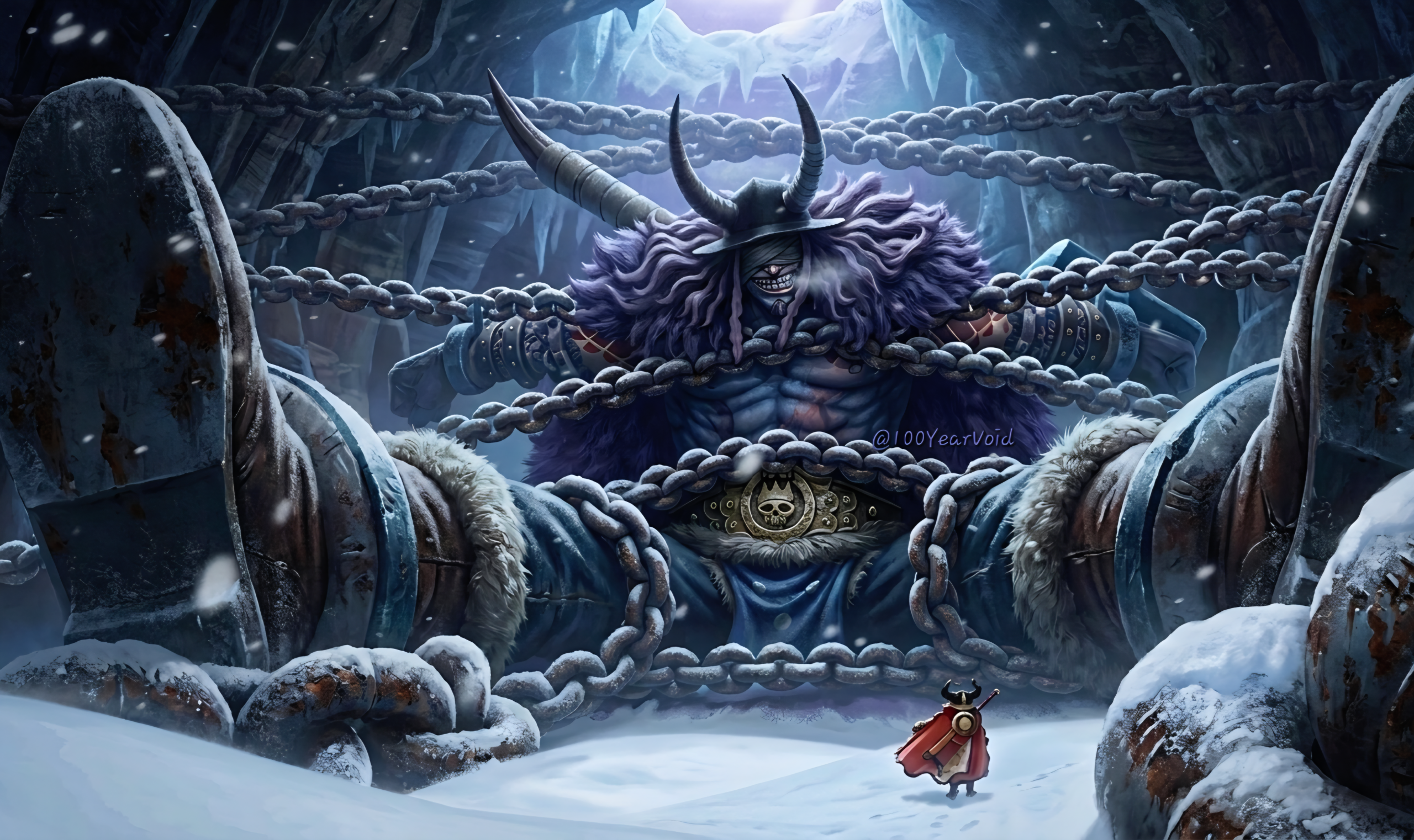
For more than a quarter of a century, Eiichiro Oda has transformed the concept of the manga milestone into a sacred event. From the epoch-defining declaration of the Grand Line in Chapter 100 to the mythic, paradigm-shattering transcendence of Chapter 1000, One Piece does not merely observe century markers—it detonates them. Now, as the narrative navigates the towering, sun-dappled canopy of Elbaf, the community’s collective gaze is fixed on the impending horizon: Chapter 1200. Following the seismic revelations of Egghead Island, where Dr. Vegapunk peeled back the veil on the world’s aquatic doom, the stage is set for a narrative cataclysm. The prevailing theory dominating theory-crafting circles is as terrifying as it is poetic: Chapter 1200 will expose the subterranean graveyard of the Void Century directly beneath the roots of Elbaf, culminating in the apocalyptic unshackling of Prince Loki.
The Anatomy of Milestone Chapters: Why 1200 Demands an Epochal Shattering
To understand the immense gravity weighing on the upcoming Chapter 1200, one must analyze Oda’s structural rhythm. Oda treats these hundredth chapters as thematic keystones. Chapter 1000 (“Straw Hat Luffy”) delivered emotional catharsis and generational succession on Onigashima’s rooftop; Chapter 1100 (“Thank You, Bonney”) contextualized Bartholomew Kuma’s tragic martyrdom, tying the emotional core of the series directly to the drums of liberation. By this trajectory, Chapter 1200 cannot simply be a transitional chapter of exposition. It must be an inflection point that permanently fractures the geopolitical board of the Final Saga.
The Narrative Crossroads of the Final Saga
Egghead established that the world is actively sinking into the sea, an engineered cataclysm orchestrated via the Mother Flame and the Ancient Weapon Uranus. The Straw Hats have arrived at Elbaf not merely to reunite with old friends or engage in romanticized Viking brawls, but to arm themselves with the ontological truth of their world. Elbaf is the final bastion untouched by the World Government’s cartographic censorship. If Chapter 1200 represents the structural climax of the arc’s first act, it will inevitably deliver the catalyst that propels the world into total, unavoidable war.
Beneath the Bark of Adam: The Subterranean Vault of the Void Century
For decades, environmental storytelling has been Oda’s sharpest narrative blade. The legendary Treasure Tree Adam, first named by Franky in Water 7, has long stood as an architectural miracle—its wood impervious to cannon fire and violent seas. Yet, lore scholars have constantly pointed to the cosmic mirror: the Sunlight Tree Eve, which transfers atmospheric light ten thousand meters beneath the ocean to Fish-Man Island. If Eve is the conduit of light and life, Adam is its terrestrial counterweight: the eternal sentinel anchoring the memories of a drowned world.
The Botanical Duality: Eve Above, Adam Below
The prevailing theory posits that beneath the colossal roots of Adam lies an ancient subterranean vault, sealed during the twilight of the Great War eight hundred years ago. Where Mary Geoise sits atop the Red Line as an artificial pantheon of tyranny, the true cradle of the Ancient Kingdom’s resistance may be woven directly into the foundational soil of the Giants. Speculation suggests that when the ocean levels rose by two hundred meters during the Void Century, it was not just topography that was buried—it was the industrial, weaponized heart of Joy Boy’s allied forces. What rests below Elbaf is not mere archeology; it is a decommissioned war zone waiting for a spark.
The Iron Giants and Joy Boy’s Unfinished Covenant
The emotional resonance of Emeth, the ancient automaton on Egghead, proved that the war machines of the Void Century operated on spiritual loyalty rather than cold logic. In Elbaf, the giants revere the Sun God with a cultural purity that borders on religious zeal. The subterranean caverns beneath the giant realm likely hold prototypes of these colossal, dial-infused dreadnoughts—ancient armaments forged in conjunction with ancient Birkans, Lunarians, and the royal bloodline of Elbaf. Chapter 1200 could unveil this subterranean armada, contextualizing Elbaf not just as a land of mighty warriors, but as the dormant hangar bay of the Ancient Alliance.
Prince Loki Unshackled: Divine Pariah or Apocalyptic Harbinger?
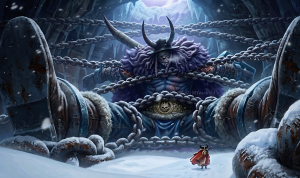
Every legendary arc possesses an emotional and psychological epicenter, and for Elbaf, that locus is Prince Loki. Introduced bound in colossal, sea-prism-draped chains, Loki represents a radical departure from the archetypal honorable giants audiences came to love through Dorry, Brogy, and Hajrudin. Branded a patricide who murdered King Harald for a “legendary” Devil Fruit, Loki is Oda’s narrative wild card—a figure whose outward malice masks an agonizing, deeply complex internal philosophy.
The Psychology of the Cursed Royal
Loki’s narrative design heavily reflects his Norse mythological namesake: the catalyst of Ragnarok, the trickster bound by the gods with the entrails of his own kin until the twilight of the cosmos. Yet, Oda rarely writes purely malicious monsters. If Loki killed King Harald, what was the impetus? A growing theoretical consensus argues that Harald, cowed by the mounting dread of the World Government or complicit in a Faustian bargain to protect Elbaf, sought to bury the kingdom’s true purpose. Loki’s patricide was not an act of manic ambition, but an agonizing, radical intervention to prevent Elbaf from bending the knee to the Celestial Dragons.
The Nature of the Legendary Akuma no Mi
The whispers surrounding Loki’s Devil Fruit suggest a power so volatile that even the iron-willed giants chose to bind him to the earth rather than execute him, lest the fruit cycle back into the wild. Whether it is an apocalyptic Mythical Zoan—such as the World Serpent Jormungandr or the dragon of death Nidhogg—or an elemental paramecia capable of fracturing the tectonic integrity of the world, Loki’s liberation in Chapter 1200 would signal the breakdown of all narrative equilibrium. The unbinding of Loki is not a standard prison break; it is the physical ignition of the promised Ragnarok.
The Convergence: Holy Knights, Red Hair Shanks, and the Imminent Ragnarok
The impending chaos of Chapter 1200 does not exist in an insular bubble. With Saint Jaygarcia Saturn erased from existence and the ruthless Saint Figarland Garling elevated to the Gorosei, the World Government has transitioned from reactive damage control to preemptive annihilation. The God’s Knights—the covert military vanguard of the World Nobles—are mobilising. Elbaf, housing the final Road Poneglyph and the lingering legacy of Nika, is their inevitable target.
Shanks as the Sovereign Warden
This dynamic permanently recalibrates our understanding of Red Hair Shanks. Shanks made Elbaf his territory not merely out of nostalgia, but out of grim custodianship. His previous confrontations in these waters—most notably the obliteration of the Kid Pirates—showcased an Emperor who has abandoned all patience. Shanks is the warden holding the threshold. He knows what lies beneath Adam’s roots; he understands what Loki represents. If Loki snaps his chains in Chapter 1200, it forces Shanks to reveal his hand: is the Red-Haired Emperor keeping the peace for the world’s sake, or preserving the matchstick until Monkey D. Luffy was finally ready to burn the system down?
The Cultural Pulse: Why the Fandom is Bracing for Chapter 1200
Across platforms like Reddit, Arlong Park, and X, the fandom’s collective anxiety is palpable. The transition from Egghead to Elbaf has altered the rhythm of serialized discussion. We are no longer debating whether the Straw Hats can survive the Navy; we are theorizing how the foundational physics and moral cosmology of the One Piece universe will survive the clash of gods. Chapter 1200 is widely viewed as the structural point of no return. Fans are anticipating a spread that juxtaposes Luffy’s Sun God manifestation against the unleashed, primal malice of Loki, framed against the exposed, biomechanical relics of a war forgotten by time.
The thematic beauty of One Piece has always laid in the intersection of liberation and legacy. If Chapter 1200 fulfills its thematic destiny, it will fundamentally redefine what freedom means in this world. It will assert that you cannot truly inherit the dawn until you confront the horrors buried in the dark.
What do you think lies within the deepest roots of Elbaf? Is Prince Loki a misunderstood anti-hero destined to ally with Luffy, or is his divine wrath a force that will plunge the world into the fires of Ragnarok? Sound off in the comments below, and let us know your wildest predictions for Chapter 1200!