Ever since the bittersweet, universe-resetting chords of Stone Ocean faded into anime history, the global JoJo’s Bizarre Adventure community has existed in a state of hyper-attuned anticipation. For over a decade, David Production has diligently carried Hirohiko Araki’s baroque vision from the cobblestone streets of Victorian England to the humid swamps of Florida. Yet, whispered among manga purists and anime-only converts alike is a singular, near-mythic truth: everything before was merely a prelude to the magnum opus. That magnum opus is Steel Ball Run.
Revered as a generational peak of visual storytelling, Part 7 does not merely continue Araki’s saga—it reinvents it from the dirt up. With chatter mounting around David Production’s current slate and industry rumblings pointing toward an inevitable production kickoff, the prospect of an adaptation has evolved from an enthusiastic pipe dream into one of the most creatively fraught, high-stakes anime announcements on the horizon.
The Trans-American Shift: How Part 7 Redefined Araki’s Canvas
To grasp the cultural pressure cooker surrounding a potential Steel Ball Run anime, one must first appreciate the manga’s seismic historical pivot. Serialized in 2004, the series initially debuted as a mystifying western titled simply Steel Ball Run, briefly detaching itself from the JoJo moniker before shifting from the breakneck deadlines of Weekly Shonen Jump to the monthly, mature sanctuary of Ultra Jump.
This demographic graduation changed everything. Liberated from traditional shonen editorial guardrails, Araki indulged in sprawling narrative horizons, psychological grit, and brutal physical vulnerability. The premise—a grueling, 3,700-mile transcontinental horseback race across late 19th-century America with a $50 million purse—offered a canvas unburdened by standard monster-of-the-week tropes. Here was an unforgiving landscape where dehydration, treacherous terrain, and territorial fauna were just as lethal as enemy Stand users. For David Production, adapting this means abandoning claustrophobic urban corridors in favor of vast, dust-swept prairies, snow-crested mountain ranges, and monumental sunrises.
Johnny Joestar and Gyro Zeppeli: Deconstructing the JoJo Archetype
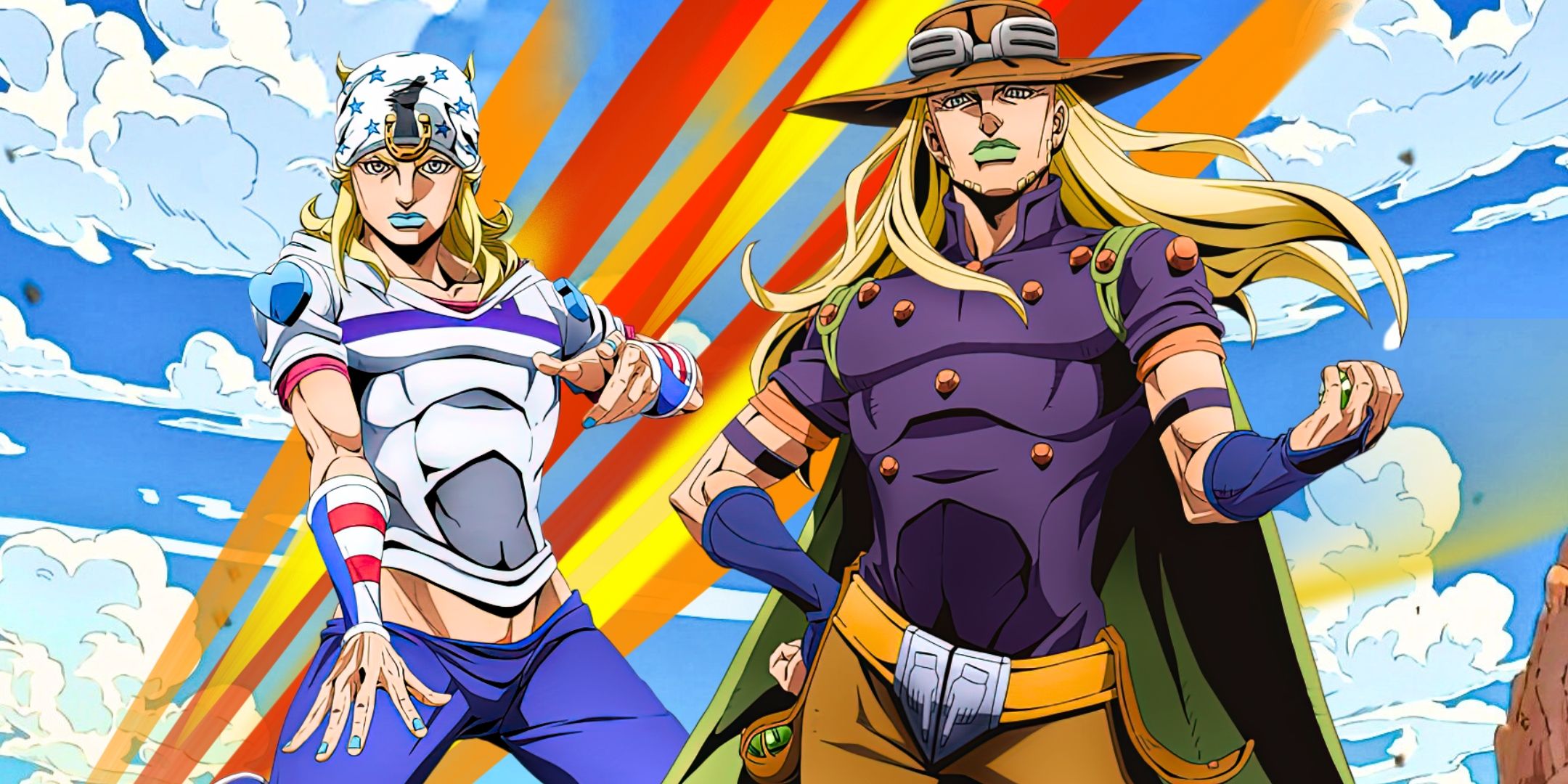
At the beating heart of Steel Ball Run is what many critics and readers consider the finest dual-protagonist dynamic in modern sequential art. Part 7 does away with the unyielding, righteous chivalry of early Joestars, introducing an emotional ecosystem anchored entirely by flawed, morally ambiguous wanderers.
The Fallen Prodigy: Johnny’s “Dark Determination”
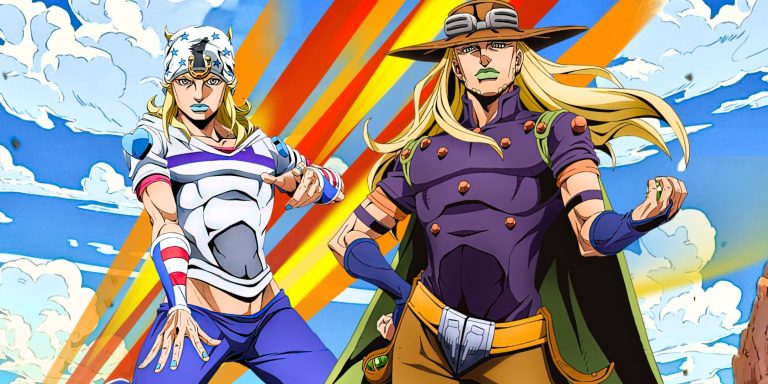
Johnny Joestar is not a hero in any conventional sense. A former equestrian wunderkind stripped of his prestige and the use of his legs due to sheer hubristic folly, Johnny begins the story as a cynical, hollowed-out paraplegic rotting on the margins of society. His initial motivation is neither altruistic nor grand; he enters the race solely because an accidental brush with Gyro Zeppeli’s weaponry causes his legs to twitch for a fraction of a second. Johnny possesses what Araki explicitly terms “dark determination”—an icy, remorseless drive to regain what he lost, regardless of who or what stands in his crosshairs. Witnessing his Stand, Tusk, evolve across four distinct Acts mirrors Johnny’s psychological metamorphosis from a desperate crawl to spiritual ascension.
The Golden Spin: Gyro’s Subversive Mentorship
Counterbalancing Johnny’s brooding desperation is Gyro Zeppeli, a disgraced Neapolitan executioner’s son with a grill emblazoned with “GO! GO! ZEPPELI” and a satchel of steel spheres. Gyro is flamboyant, erratic, and seemingly absurd—often interrupting high-stakes shootouts to share terrible dad jokes about days of the week. Yet behind the bravado lies an agonizing crisis of conscience: Gyro is racing to win an amnesty plea for an innocent child condemned to die on his homeland’s scaffold.
Furthermore, Gyro serves as the conduit for the series’ most celebrated technical power system: The Spin. Bypassing the solar-powered Hamon of early parts and elevating Stand mechanics, the Spin is a discipline rooted in Renaissance mathematics, rotational kinetic energy, and the perfection of the Golden Ratio. Watching David Production translate this intricate visual geometry into motion—where spinning spheres warp spatial dimensions and channel raw natural physics—promises to be a visual feast that pushes modern compositing to its absolute limits.
The Equestrian Nightmare: David Production’s Ultimate Technical Gauntlet
If fans are feverish with excitement, animators throughout Tokyo are likely sweating bullets. There is an open secret within the anime industry: horses are notoriously difficult to animate. Animating a single horse in hand-drawn 2D requires an elite command of quadrupedal skeletal mechanics, complex muscle deformation, and rapid foreshortening. Steel Ball Run features dozens of horses running at maximum gallop, crashing into one another, navigating rough topography, and sustaining supernatural Stand attacks simultaneously across hundreds of miles.
David Production stands at a profound stylistic crossroads that will dictate the project’s critical reception:
- The Hybrid 2D/3D Dilemma: To maintain visual continuity without incinerating production budgets, the studio will inevitably have to integrate 3D CGI models for background race sequences. The challenge lies in avoiding the stiff, uncanny-valley CGI that has historically plagued series like Berserk (2016), striving instead for the seamless integration seen in high-end studio productions like Chainsaw Man or Trigun Stampede.
- Pacing and Distribution Logistics: The release model will also be intensely scrutinized. The episodic momentum of Stone Ocean suffered immensely under Netflix’s batch-drop strategy, which dissipated weekly social media discourse. An epic of Part 7’s stature requires the communal, week-to-week watercooler intensity of a traditional television broadcast or a meticulously staggered streaming event.
The Ideological Frontier: Funny Valentine and the High Stakes of the Corpse
No exploration of the buzz surrounding Part 7 is complete without acknowledging its primary antagonist: the 23rd President of the United States, Funny Valentine. Far removed from the vampiric sadism of Dio Brando or the psychopathic isolation of Yoshikage Kira, Valentine is an avatar of extreme patriotic utilitariansm.
His quest to gather the scattered remnants of a holy corpse—implied to belong to Jesus Christ—is framed not by a desire for personal wealth, but by a radical conviction to ensure the United States claims the absolute moral and socioeconomic dominance of the world (“taking the first napkin”). Driven by his interdimensional Stand, Dirty Deeds Done Dirt Cheap (D4C), Valentine forces audiences into uncomfortable philosophical corners. The impending animated clash between Johnny’s desperate, selfish survivalism and Valentine’s fanatical, self-sacrificing nationalism represents the ideological peak of Araki’s writing career.
Ready, Set, Bang: The Horizon Awaits
Steel Ball Run is far more than just the next installment in a popular franchise; it is a monument to an auteur artist challenging his own boundaries 20 years into his career. It demands top-tier voice talent, an orchestral score that weaves rustic Morricone-esque brass with screaming prog-rock guitars, and an animation effort that respects the sacred weight of the source material.
As David Production navigates its production pipeline, the question is no longer if the race will begin, but how triumphantly it will cross the finish line. The fandom stands along the starting line, awaiting the starter pistol. When that gun finally goes off, the anime landscape will never be the same.
How do you think David Production should tackle the legendary horse animation hurdle—pure 2D or dynamic cel-shaded CG? Drop your theories and voice-cast picks in the comments below, and stay tuned to Wibux.com for all breaking updates on the JoJo frontier!