Ever since the cosmic, bittersweet strings of Stone Ocean faded into the ether, the global anime community has found itself caught in a persistent state of breathless anticipation. For over a decade, David Production has undertaken one of the most celebrated adaptation marathons in pop-culture history, transforming Hirohiko Araki’s genre-defying manga into a hyper-stylized audiovisual institution. Yet, all roads—and all bizarre detours—have inevitably led to this monumental precipice: JoJo’s Bizarre Adventure: Steel Ball Run. Widely heralded as Araki’s magnum opus and ranked consistently among the greatest manga series ever inked, Part 7 is not merely the next project on the docket; it represents David Production’s ultimate technical and narrative frontier.
A Clean Slate Across the Great Plains: The Seinen Rebirth
To grasp the sheer gravity of the Steel Ball Run discourse, one must understand its unique positioning in the broader JoJo canon. Following the universe-shattering climax of Part 6, Araki executed a daring creative pivot. Unshackled from the multi-generational baggage of the original Joestar lineage and freed from the weekly editorial churn of Weekly Shonen Jump by migrating to the monthly seinen pages of Ultra Jump, Araki delivered a sweeping, historical epic set across a mythic 1890s America.
The premise is deceptively accessible yet intoxicatingly ambitious: a trans-continental, cross-country equestrian race spanning from San Diego Beach to the heart of New York City, boasting a staggering fifty-million-dollar purse. However, what begins as an eccentric celebration of frontier Americana rapidly devolves into an occult espionage thriller centered on the pursuit of the mystical Holy Corpse. By recalibrating the series’ narrative scope, Araki crafted a tale that retains the tactical, razor-sharp absurdity of Stand battles while imbuing every chapter with psychological realism, existential philosophy, and cinematic grandeur that rivals golden-age westerns like Sergio Leone’s Once Upon a Time in the West.
The Dual Protagonist Dynamic: Dark Determination vs. Zeppeli Honor
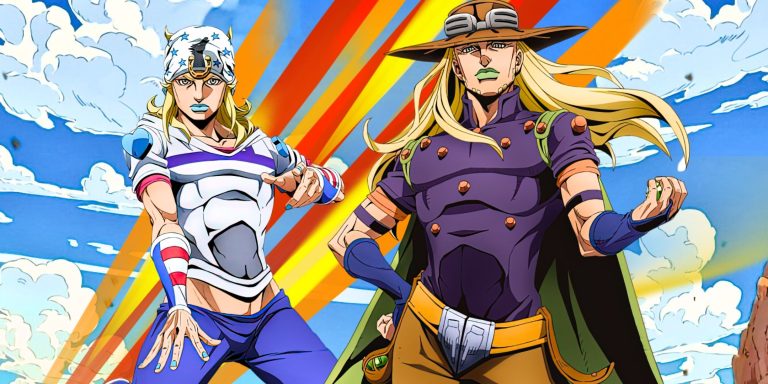
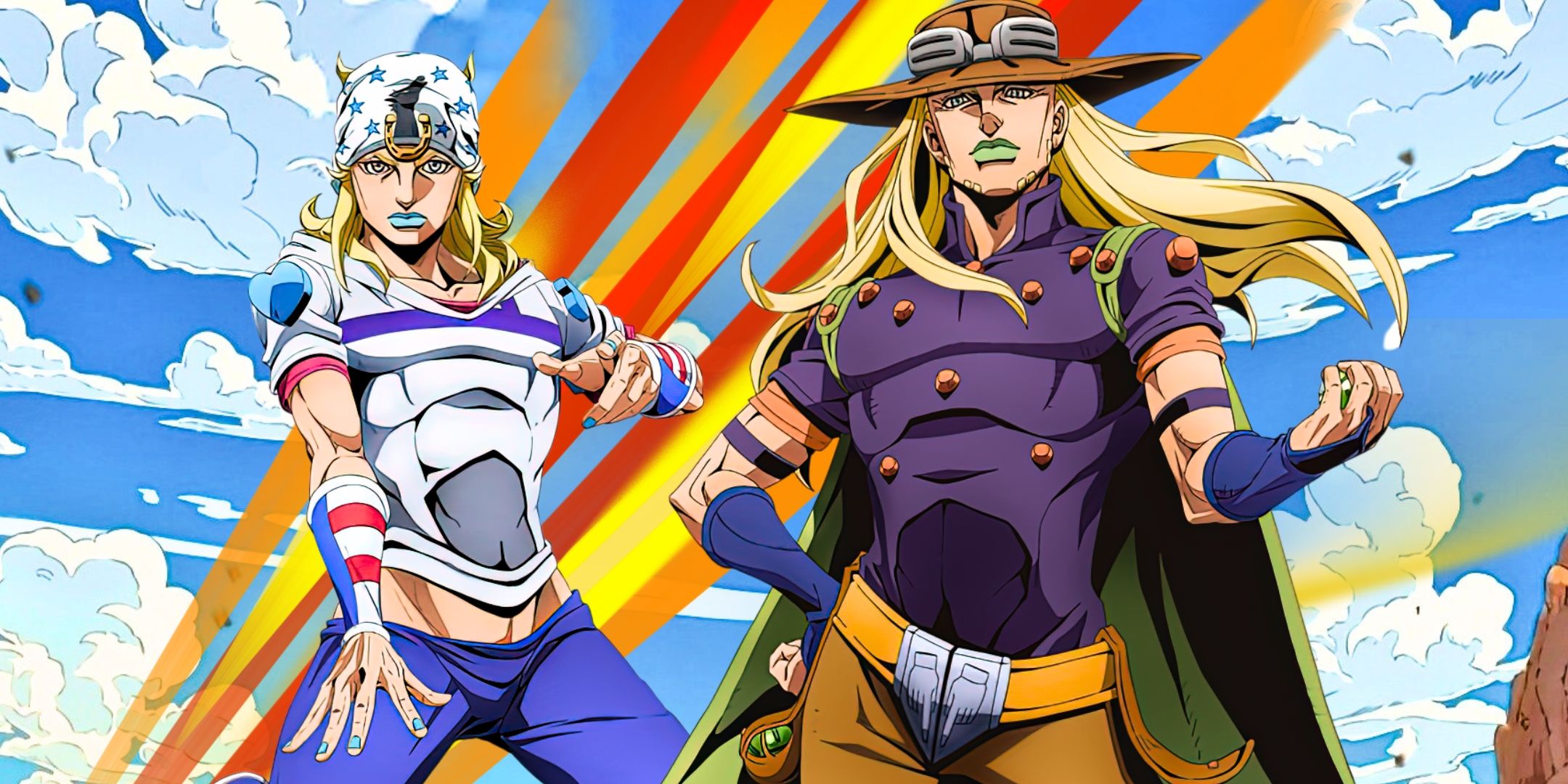
At the beating heart of Steel Ball Run lies arguably the most compelling, exquisitely realized character dynamic in modern sequential art: the relationship between Johnny Joestar and Gyro Zeppeli.
Johnny Joestar: The Fall and Rise of an Anti-Hero
Unlike the incorruptible chivalry of his namesake Jonathan Joestar, Johnny enters the narrative as a broken, cynical outcast. Paralyzed from the waist down due to his own arrogance and discarded by the equestrian elite, Johnny’s journey is not initially motivated by justice, valor, or altruism. It is propelled by raw, unapologetic desperation. Araki frequently paints Johnny with what the narrative terms “Dark Determination”—a chilling, black-flame gaze indicating a protagonist willing to kill and sacrifice everything merely to return his life from “negative to zero.” Watching Johnny claw his way back toward agency makes him one of the most humanized and fascinating protagonists in manga history.
Gyro Zeppeli: Comedy, Duty, and the Golden Rotation
Contrasting Johnny’s grim introspection is Gyro Zeppeli, a disgraced executioner from the Kingdom of Naples operating under the burden of moral duty. Armed with steel balls, eccentric verbal tics (“Nyo-ho!”), and ridiculous operatic songs about mozzarella cheese, Gyro subverts traditional mentorship archetypes. He is flawed, hot-headed, and proud, yet he possesses an innate, unwavering code of honor. As the duo traverses treacherous canyons and hostile plains, their dynamic evolves from transactional allies to soul-bound brothers in arms. Their campfire banter humanizes the sprawling epic, grounding supernatural horrors in authentic emotional resonance.
Beyond Stands: The Mathematical Mysticism of the Spin
Combat in Steel Ball Run represents the apex of Araki’s creative ingenuity. While Stands remain a staple—culminating in mind-bending abilities like Funny Valentine’s dimension-traversing Dirty Deeds Done Dirt Cheap (D4C)—Araki reintroduces a lineage-based martial art that directly mirrors the Hamon (Ripple) of Parts 1 and 2: the Spin.
Grounded in the Renaissance concept of the Golden Ratio (the Fibonacci sequence manifested in nature), the Spin transforms basic physics into devastating supernatural reality. From the physiological manipulation induced by Gyro’s spherical projectiles to Johnny’s progressive Stand evolution through the four acts of Tusk, combat becomes an intellectual exercise in spatial geometry and environmental mastery. The Spin is not simply an attack; it is an omnipresent cosmic truth woven into sunflower spirals, nautilus shells, and galloping horses. Translating this visual blend of sacred geometry and visceral kinetic impact will require David Production to fundamentally reimagine their legendary visual grammar.
The Equestrian Dilemma: David Production’s Technical Mount Everest
Despite the deafening fan fervor, the elephant in the room has always been the technical cost of realization. Or more accurately: the horse problem.
In the animation industry, horses are notorious pariahs. Their four-legged gait, shifting muscle anatomy, complex skeletal proportions, and hyper-kinetic movement patterns represent an animator’s worst logistical nightmare. A single horse sprint requires dozens of meticulously framed keyframes; Steel Ball Run features dozens of steeds galloping shoulder-to-shoulder amidst dust storms, swamp ambushes, and Stand clashes.
Rumors and production leaks have long speculated on how David Production will navigate this challenge. Hand-drawn 2D horses across a continuous 36-to-48-episode run are practically an economic impossibility in contemporary anime production. The prevailing industry consensus suggests the studio will inevitably leverage advanced 3D CGI models blended with 2D character cel-shading—a technique previously utilized by studios like MAPPA and Wit Studio during heavy cavalry sequences. The critical challenge, however, will be preserving the idiosyncratic, painterly weight of Araki’s modern art style without plunging into the uncanny valley. The metallic sheen of the steel balls, the shifting psychotropic palette, and the raw kinetic grit of the dust-blown American frontier demand nothing short of perfection.
The Verdict: A Monumental Era Awaits
The anticipation surrounding a potential JoJo’s Bizarre Adventure: Steel Ball Run adaptation is not manufactured hype; it is the culmination of decades of artistic evolution. When the starter pistol finally fires and the race across America officially begins, it will signal an unprecedented paradigm shift not just for David Production, but for the entire medium of televised anime. Part 7 is a tragedy, a triumph, and a love letter to the indomitable human spirit wrapped in blood-soaked dust and chromatic glory.
What are your biggest hopes for the Steel Ball Run adaptation? Do you trust David Production to nail the dreaded horse animation, and who is on your dream voice-cast list for Johnny and Gyro? Drop your theories and Stand predictions in the comments below!