

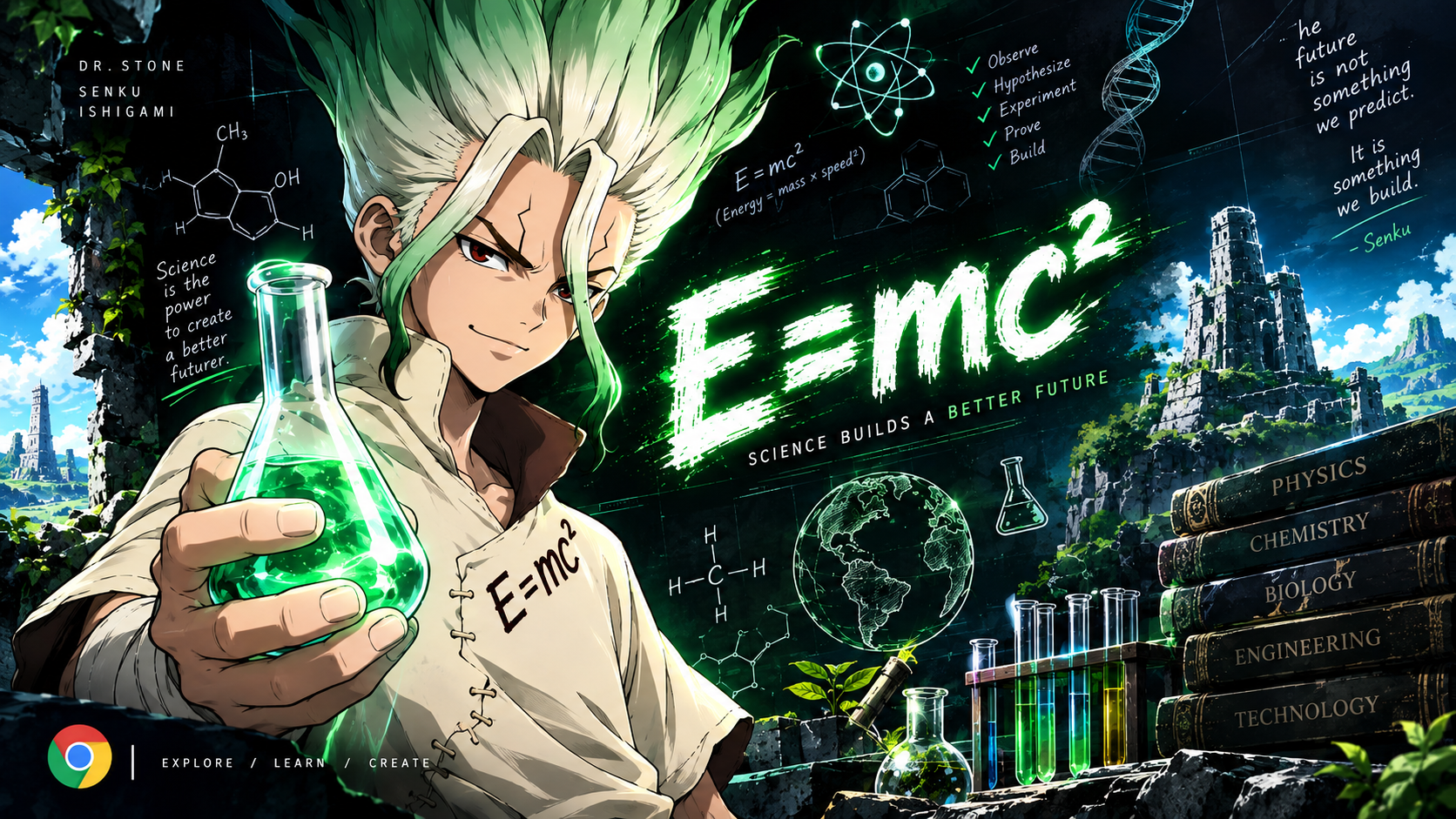
When Riichiro Inagaki and Boichi first introduced audiences to a leek-haired savant counting seconds inside an unbroken cocoon of limestone, few could have predicted that Dr. STONE would evolve from a quirky prehistoric survival tutorial into one of the most intellectually exhilarating space odysseys in modern anime. Shonen Jump has long built its legacy on blood-pumping martial arts tournaments, cursed energy showdowns, and generational bloodlines. Yet, Senku Ishigami flipped the paradigm entirely on its head: here was a protagonist who did not win through unyielding rage or divine destiny, but through the rigorous, patient, and collaborative application of the periodic table.
Now, with TMS Entertainment officially gearing up for Dr. STONE: Science Future—confirmed as the fourth and final season of the anime adaptation—the Kingdom of Science stands on the precipice of its most audacious undertaking yet. The journey from forging crude stone hand-axes to assembling a functional lunar rocket is the ultimate culmination of human resilience. As Senku and his comrades prepare to breach Earth’s atmosphere, the impending confrontation with the enigmatic entity known as Why-Man promises an apocalyptic, deeply philosophical climax that will redefine the franchise’s legacy forever.
The Long Road to Orbit: Engineering the Impossible in the Stone World
The premise of Dr. STONE: Science Future sounds almost absurd on paper: an agrarian, post-petrification society rebuilding thousands of years of human infrastructure in a matter of years, all to stage an Apollo-tier moon landing. However, the brilliance of Inagaki’s writing lies in its meticulous, step-by-step logic. The anime has spent three seasons laying the logistical groundwork for this exact moment. Viewers have watched Senku move from distilling alcohol and sulfuric acid in Season 1, to mastering steam engines and radio frequencies in Stone Wars, to navigating the treacherous open seas and mapping ocean currents in New World.
The narrative stakes of Science Future demand a dramatic expansion of scale. The production of a spacefaring vessel requires a staggering global supply chain: high-grade aluminum, synthesized petrochemicals, vulcanized rubber, precision microchips, and untold megawatts of power. Senku’s ambition is no longer confined to a single laboratory camp in Japan; it has evolved into a continent-spanning industrial renaissance. This isn’t merely an expedition—it is the triumphant resurrection of human civilization’s collective knowledge, crystallized into a gleaming multi-stage rocket.
The Generational Bridge: Byakuya’s Dream and Senku’s Reality
What elevates this scientific sprint from a dry engineering montage into pure, tear-jerking emotional poetry is the haunting, ever-present specter of Byakuya Ishigami. The foundational tragic irony of Dr. STONE has always been the temporal gulf separating father and son. Byakuya looked down from the International Space Station as the Earth turned to stone, spending the rest of his life laying the breadcrumbs of platinum and folk tales that would eventually allow Senku to thrive thousands of years later.
For Senku to breach the stratosphere is not merely a tactical maneuver to neutralize a global threat; it is the ultimate fulfillment of a filial and spiritual debt. The thematic resonance of a rocket blasting through the clouds—carrying the adopted son of an astronaut into the silent expanse where his father spent his final moments looking at home—serves as the beating emotional heart of this grand finale.
Unmasking Why-Man: The Cosmic Horror Lurking on the Moon
While the mechanical marvel of the rocket build drives the plot forward, the existential tension of Science Future rests entirely on the lunar surface. Ever since the Kingdom of Science powered up their first crude vacuum-tube radio receiver, the haunting, synthetic transmission repeating “WHY” in Morse code has lingered like a death sentence over the narrative. The escalation peaked when the mysterious voice mimicked Senku’s exact cadence, attempting to detonate the petrification device across the entire globe once again.
Why-Man represents the antithesis of everything Senku holds dear. Where the Kingdom of Science represents transparent cooperation, discovery, and the relentless celebration of human vitality, Why-Man represents absolute isolation, opaque intent, and a horrifying willingness to reduce conscious life to inert mineral statuary. The moon is no longer just a romantic destination; it is an interrogation room suspended in the blackness of the cosmos.
The impending encounter flips the script on traditional battle shonen encounters. Senku cannot simply overpower Why-Man with raw brute force; he must deduce the entity’s origins, understand its biological or synthetic parameters, and formulate an airtight logical rebuttal to its motives. Is the petrification a deliberate cosmic execution? A miscalculated gift of biological immortality? Or the automated remnants of an incomprehensible ancient technology? Science Future must walk a razor-thin narrative tightrope to deliver answers that satisfy years of speculative theories without discarding the series’ grounded scientific roots.
Psychological Crucible: The Lunar Triumvirate
A mission to the Moon under post-apocalyptic conditions allows for virtually zero margin of error. The anime’s narrative trajectory pushes the cast into an agonizing strategic bottle: the rocket can only support a skeleton crew of three specialists. The psychological depth of Dr. STONE shines brightest when forcing radically different worldviews into claustrophobic operational environments.
The dynamic between the selected crew members represents a distillation of humanity’s finest survival assets:
1. The Intellect (Senku Ishigami): The unwavering mind who calculates orbital trajectories and system contingencies in real time, armed with pure scientific dogma.
2. The Pilot (Ryusui Nanami): The embodiment of human desire and instinct, whose greed for the horizon translates into peerless vehicular intuition.
3. The Vanguard (Tsukasa Shishio / Kohaku): The ultimate physical deterrent, brought along to neutralize whatever lethal kinetic threats await in the lunar dust.
Tsukasa’s presence in this endgame sequence is particularly striking. The man who once declared war on modern civilization—shattering statues of corrupt adults in a bid to construct a primitive paradise—is now tasked with riding the pinnacle of human industrial technology into the stars to protect the very civilization he once sought to abort. This evolution encapsulates Inagaki’s overarching thesis: human progress is not an inherent sickness to be purged, but an untamable, beautiful flame that can redeem even its fiercest critics.
TMS Entertainment’s Final Stand: Pacing and Production Pedigree
Adapting the final stretch of Riichiro Inagaki and Boichi’s 232-chapter manga is no modest task for TMS Entertainment. Boichi’s kinetic, hyper-detailed linework—particularly when rendering intricate aerospace schematics, sprawling macro-factories, and sweeping lunar horizons—places an immense technical demand on the animation staff. The studio’s decision to structure Science Future across split cours provides much-needed breathing room, ensuring that neither the dizzying technical montages nor the contemplative emotional crescendos are sacrificed for the sake of runtime.
Director Shuhei Matsushita, who took over the reins during Ryusui and New World, has demonstrated a nuanced understanding of the series’ pacing. The soundtrack by Tatsuya Kato, Hiroaki Tsutsumi, and Yuki Kanesaka will undoubtedly do the heavy lifting once more, shifting from acoustic folk instruments to brass-heavy orchestral bombast and eerie, synth-driven cosmic ambient scores as humanity crosses the threshold into the void.
The Ultimate Triumph of Human Curiosity
In a medium currently saturated with cynical anti-heroes, grimdark multiverses, and apocalyptic decay, Dr. STONE has spent five years functioning as a monument to radical, unflinching optimism. It posits that human beings are fundamentally wondrous creatures—not because we are invincible or morally flawless, but because when pushed to the absolute edge of extinction, we choose to measure, build, learn, and reach upward.
When the ignition engines roar to life in Dr. STONE: Science Future, it won’t just be Senku leaving the atmosphere. It will be the collective triumph of thousands of generations of human striving, soaring into the dark to stare down our silencers. Ten billion percent, this is a finale no anime fan can afford to miss.
Are you emotionally ready to watch Senku make history on the Moon, or are your theories about Why-Man’s identity keeping you awake at night? Drop your hottest predictions in the comments below, and let’s debate the future of the Kingdom of Science!