
For more than a decade, an unspoken covenant has existed among the global anime fandom: no matter how magnificent the adaptation of Hirohiko Araki’s multi-generational saga became, everything prior was merely a prologue. From the Victorian gothic horror of Phantom Blood to the dimensional cataclysm that capped off Stone Ocean, David Production has spent twelve years painstakingly cataloging the eccentricities, heartbreaks, and kinetic sound effects of the Joestar bloodline. Yet, hovering over every studio milestone is the specter of a singular, monolithic achievement. We have officially reached the event horizon of JoJo’s Bizarre Adventure: Steel Ball Run.
Widely regarded as Araki’s undisputed magnum opus and routinely sitting alongside Berserk atop critical manga rankings, Steel Ball Run is not just the next chapter in the franchise—it is a total reinvention. Transporting audiences to an alternate 1890 where the world’s most cutthroat competitors embark on a 6,000-kilometer cross-country trek from San Diego to New York City, Part 7 reimagines the core philosophy of JoJo. As online forums vibrate with rumors, domain registrations, and speculative production timelines, the industry is bracing for what could be the most technically demanding and conceptually ambitious television anime of the decade.
The Seinen Shift: Why Steel Ball Run Stands as Araki’s Magnum Opus
To understand the sheer weight of the buzz surrounding Steel Ball Run, one must examine its historical turning point within Shueisha’s editorial machine. Originating in 2004 in Weekly Shonen Jump before migrating to the monthly pages of Ultra Jump, the series shed the lingering shackles of traditional shonen restrictions. Araki was no longer constrained by youth-oriented censorship or grueling weekly deadlines; instead, he was granted the real estate to explore moral rot, historical revisionism, and psychological grit with surgical precision.
The race itself—the eponymous Steel Ball Run—is a dazzling cover. Ostensibly organized by eccentric promoter Steven Steel for a staggering $50 million grand prize, the trans-American journey swiftly unspools into a clandestine occult proxy war orchestrated by President Funny Valentine to assemble the mummified relics of the Saint’s Corpse. Here, Araki seamlessly weaves American frontier mythos with divine providence. It is a work where manifest destiny is literalized into an existential race, pitting opportunistic outlaws, disgraced aristocrats, and international terrorists against one another across blistering deserts, snow-choked passes, and eerie ghost towns.
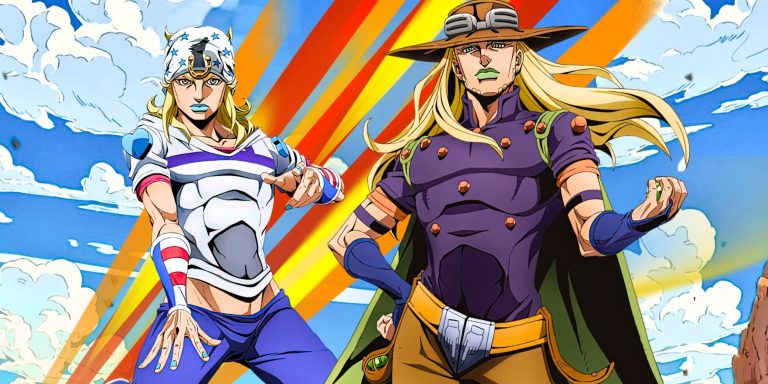
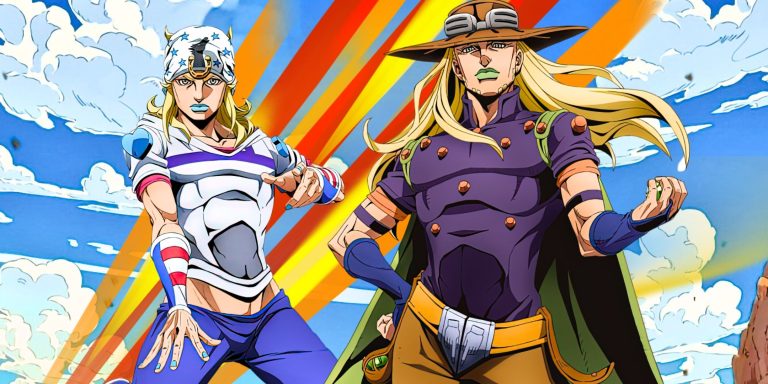
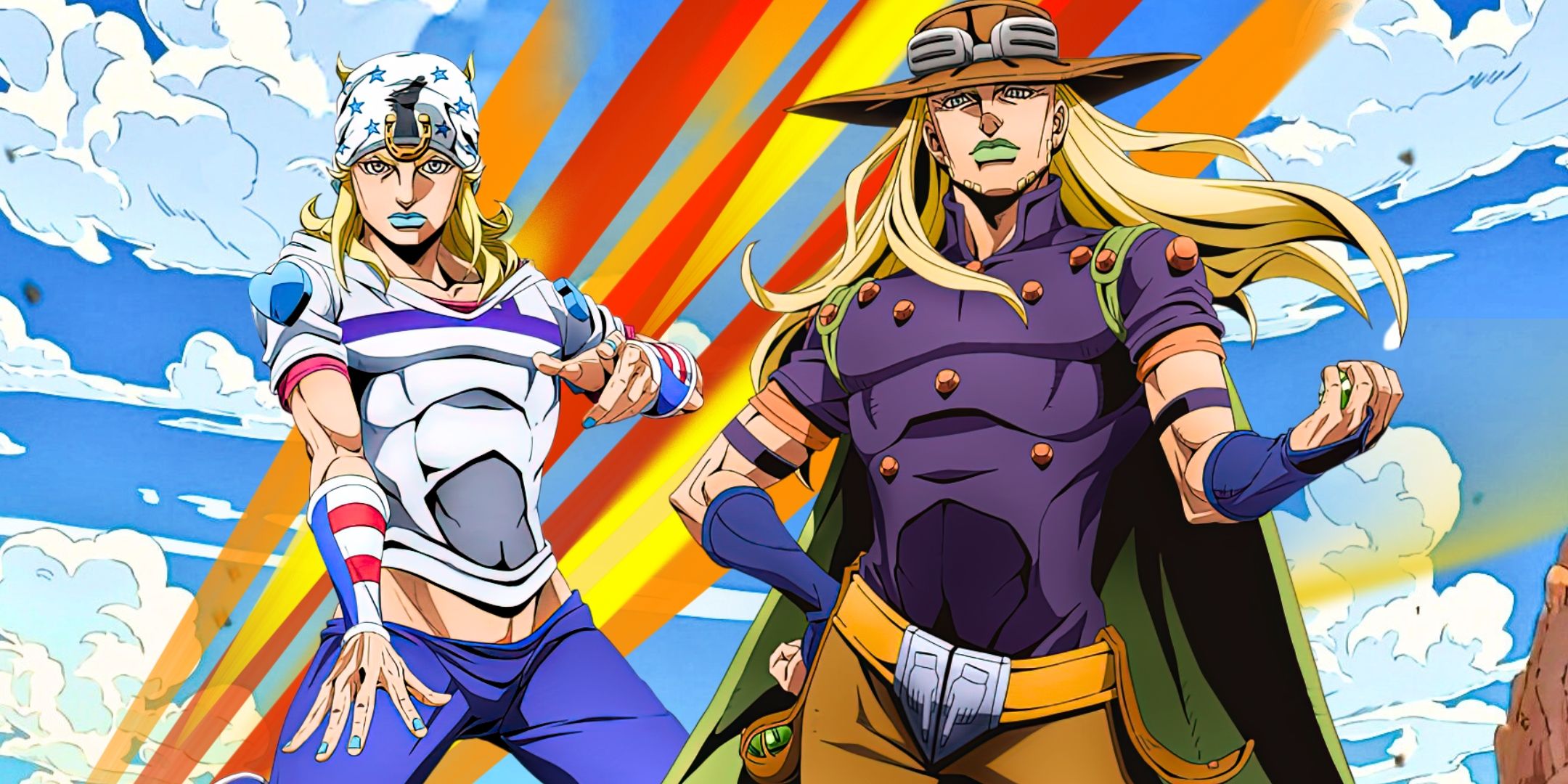
Johnny Joestar and Gyro Zeppeli: The Architecture of Araki’s Best Duo
At the beating heart of this sprawling supernatural Western is the complex dynamic between two outcasts whose emotional resonance outstrips any previous JoJo-Zeppeli pairing.
Johnny Joestar: The Fallen Prodigy and His Dark Determination
In Johnny Joestar, Araki subverted every archetype of the noble shonen protagonist. Paralyzed from the waist down due to his own youthful arrogance and abandoned by high society, Johnny enters the narrative not as a beacon of justice, but as a bitter, self-pitying shell of a former equestrian prodigy. His journey is distinctly unheroic in its origins; he pursues Gyro Zeppeli not out of altruism, but because an encounter with Gyro’s mysterious weapon momentarily causes his paralyzed legs to twitch. Johnny’s subsequent growth across the narrative is terrifyingly authentic. His evolution through his Stand, Tusk (evolving across four distinct ACTs), directly mirrors his psychological descent into what the narrative famously labels as “dark determination”—the ruthless, unflinching willingness to kill or sacrifice anything simply to reach “zero,” to reclaim the humanity he lost.
Gyro Zeppeli and the Miracle of the Spin
Serving as Johnny’s mentor, companion, and philosophical foil is Gyro Zeppeli, a disgraced executioner’s son from the Kingdom of Naples. Hidden beneath his grill-toothed smile, eccentric musical compositions about Italian food, and abrasive swagger is an overwhelming burden of conscience: Gyro has entered the lethal race solely to secure an amnesty pardon for an innocent child condemned to death back home.
Rather than relying immediately on Stand abilities, Gyro introduces the narrative to the Spin—Araki’s mathematically grounded, evolutionary successor to Hamon. Derived from the Fibonacci sequence and the Golden Ratio found throughout the natural world, the Spin turns steel spheres into devastating instruments of kinetic torque. The technical sophistication of the Spin not only provides breathtaking visual choreography on the page, but grounds Johnny and Gyro’s interactions in an exchange of genuine pedagogical trust. Their late-night campfires, absurd running gags, and shared philosophical breakthroughs create an emotional anchor that makes the high-stakes gunfights deeply personal.
The Technical Crucible: Can David Production Tame the Horses?
While narrative hype runs white-hot, the production realities facing David Production are staggering. If Steel Ball Run has not yet hit screens, it is because it poses an animation nightmare that strikes terror into even the most veteran layout directors: equestrian mechanics.
Historically, quadrupeds—and horses in particular—are notoriously grueling to animate in traditional hand-drawn 2D. The complex musculature, the four-beat cadence of a gallop, the shifting perspective of riders maneuvering in saddles, and the sheer volume of mounted combat across undulating terrain represent a catastrophic sinkhole for production schedules. Historically, when anime has attempted to render cavalry charges in bulk (as seen in sections of Attack on Titan, Vinland Saga, or Kingdom), studios have leaned heavily on 3DCG models that often clash violently with hand-drawn character close-ups.
For David Production, compromising the aesthetic integrity of Araki’s late-era line work is simply not an option. Fans will not tolerate plasticky, rigid CG horses breaking the immersion of Johnny and Gyro’s desperate duels against Stand users like Diego Brando or Ringo Roadagain. Insiders and animation analysts speculate that the prolonged pre-production window for Part 7 is heavily focused on developing a customized hybrid pipeline—leveraging cutting-edge cel-shaded 3D rigs dynamic enough to emulate Araki’s cross-hatching, combined with extensive 2D hand-drawn keyframe paintovers for close-ups and pivotal kinetic sprints. Reconciling this technical barrier with David Production’s signature hyper-stylized palette changes and on-screen onomatopoeia is the studio’s true frontier.
The Ghost of Stone Ocean: Formatting and Cultural Longevity
Beyond the technical hurdles lies a structural dilemma that Warner Bros. Japan must address: release strategy. The cultural conversation surrounding Part 6, Stone Ocean, suffered heavily under Netflix’s controversial “batch release” model, which dumped episodes in staggered twelve-episode blocks with months of radio silence in between. This distribution method suffocated the organic, weekly viral engagement that turned Stardust Crusaders, Diamond is Unbreakable, and Golden Wind into global social media sensations.
Steel Ball Run is a slow-burn epic spanning nearly one hundred oversized monthly chapters; it demands an episodic breathing room reminiscent of prestige television. To treat Johnny and Gyro’s voyage through the Devil’s Palm as a binge-and-forget weekend commodity would be an artistic disservice. To capture lightning in a bottle once again, the industry needs a traditional weekly simulcast, giving fans the time to analyze Stand mechanics, celebrate character triumphs, and dissect the agonizing tragedy that Araki carefully weaves into every leg of the race.
The Verdict: A New Epoch for JoJo
The anticipation surrounding the anime adaptation of Steel Ball Run is not just idle hype; it is the collective recognition that anime as a medium is on the verge of welcoming one of sequential art’s absolute masterworks. Part 7 represents Hirohiko Araki operating at the absolute peak of his creative powers—combining tragic anti-heroes, profound ontological debates on destiny, and dizzyingly innovative combat systems into an unforgiving American landscape.
David Production stands before a monumental challenge that will define the studio’s legacy for the next decade. If they can capture the grit in Johnny’s eyes, the resonance of the Spin, and the thundering thunder of hooves kicking up dust across the desert, Steel Ball Run will not merely satisfy the fandom—it will redefine what a prestige action epic can look like.
Are you prepared for the race to begin? Who would you cast as the voices of Johnny and Gyro, and do you think David Production should stick to traditional weekly broadcasting? Drop your thoughts, theories, and Golden Ratio calculations in the comments below!