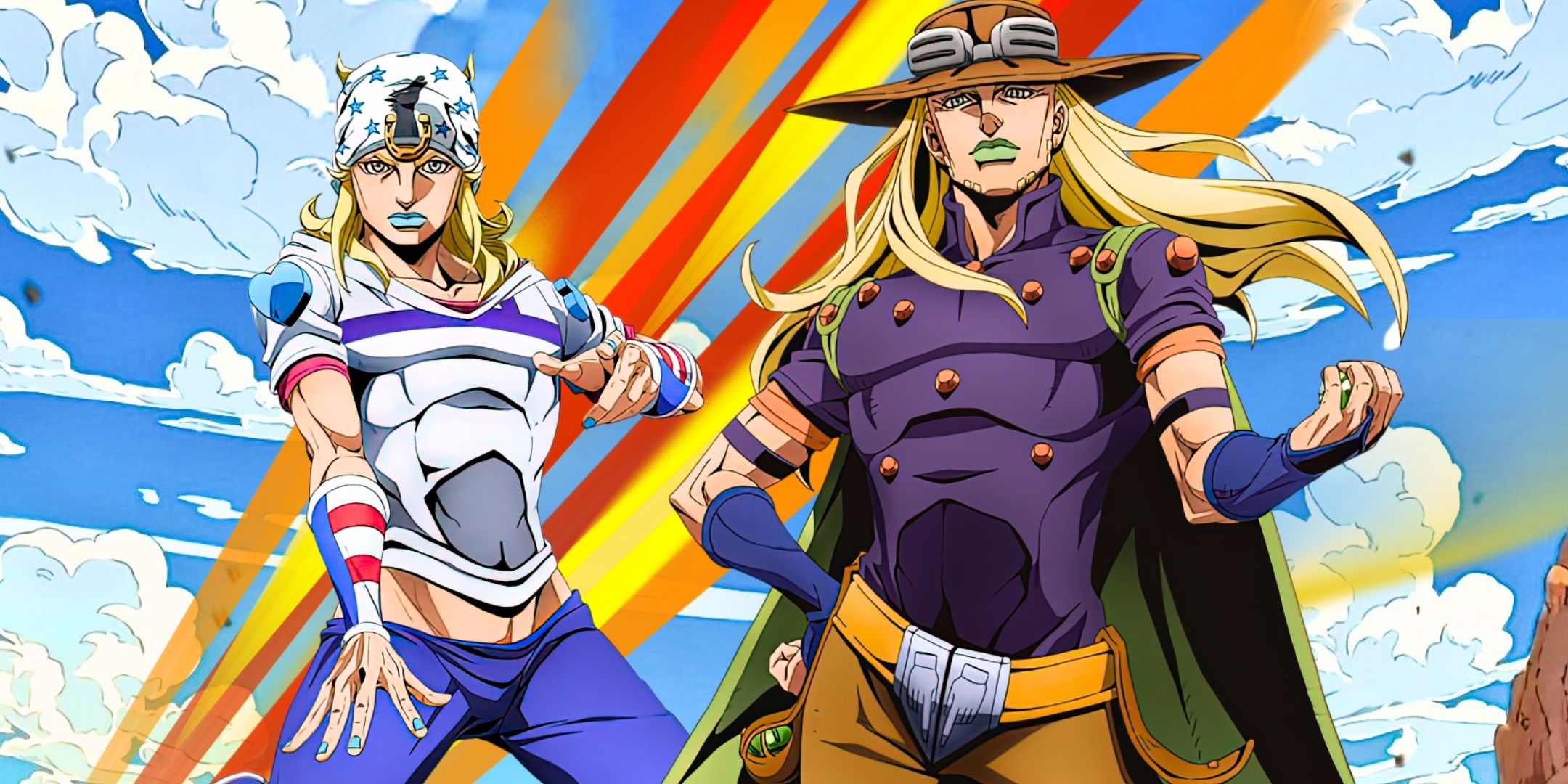
Ever since the tragic, cosmic reset of Stone Ocean brought Hirohiko Araki’s multi-generational Joestar bloodline to an operatic conclusion, an expectant hush has fallen over the anime landscape. For casual observers, the silence signals a franchise resting on its laurels. But for the initiated, this lull represents the calm before an earth-shattering storm. Among manga historians and die-hard anime fans, one title is spoken of with almost mythic reverence: JoJo’s Bizarre Adventure: Part 7 – Steel Ball Run. Universally lauded as Araki’s magnum opus, Part 7 doesn’t just turn the page for the venerable series—it shreds the book entirely, offering a gritty, profound, and transcendent re-imagining of its mythos. Now, as the community dissects every cryptic studio tease and production rumor, the collective gaze turns toward David Production for what promises to be the most technically demanding and culturally monumental anime adaptation of the decade.
The Great American Odyssey: Resetting the Multiverse and Raising the Stakes
To understand the unprecedented buzz surrounding Steel Ball Run, one must appreciate its tectonic narrative shift. Originally serialized in Weekly Shōnen Jump before making its pivotal jump to the monthly Ultra Jump in 2005, Part 7 unburdened Araki from the grueling weekly grind and the constraints of traditional youth demographics. The result was an artistic renaissance. SBR isn’t merely a sequel; it is a complete multiversal reboot set in an alternate 1890 America, chronicling a cross-country equestrian race spanning over 3,800 miles from the Pacific shores of San Diego to the bustling metropolis of New York City.
On its polished surface, the eponymous Steel Ball Run race—promoted by the eccentric Steven Steel—is a cutthroat sporting spectacle dangling a historic $50 million purse. Below that gilded veneer lies a masterstroke of historical revisionism, geopolitical conspiracy, and existential dread. Entrants race not just against blinding sandstorms, brutal terrain, and rival saboteurs, but toward a transcendent relic: the scattered mummified remains of a sacred Saint, secretly coveted by the cold, calculating President of the United States, Funny Valentine. By anchoring high-concept supernatural combat to the historical grit of the late 19th-century American frontier, Araki crafted an epic that feels both deeply American and unmistakably bizarre.
Broken Men and Spinning Steel: The Psychology of Johnny and Gyro
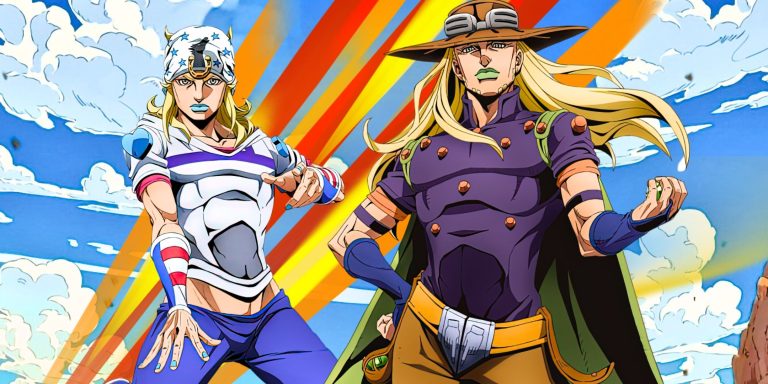
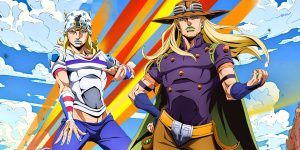
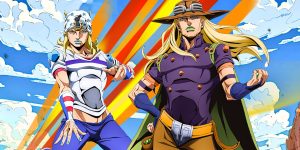
At the beating heart of Steel Ball Run lies arguably the greatest dual-protagonist dynamic in modern sequential art: Johnny Joestar and Gyro Zeppeli. Their journey abandons the pristine, chivalric heroics of classic JoJo leads, replacing them with flawed, morally gray humanism that resonated profoundly with readers.
Johnny Joestar: The Paralyzed Prodigy and Araki’s Darkest Hero
Johnny Joestar is deliberately constructed as the philosophical antithesis of Jonathan Joestar. A former horse-racing child prodigy ruined by narcissism and an impulsive tragedy that left him paraplegic, Johnny begins his odyssey not as a noble hero defending the weak, but as a bitter, hollow man discarded by high society. He enters the race not for glory or patriotism, but for a singular, desperate glimmer of personal salvation: the revelation that Gyro Zeppeli’s mystical Steel Balls possess a kinetic resonance capable of momentarily restoring movement to his paralyzed legs. Johnny is governed by what Araki calls “dark determination”—an unrelenting, borderline-terrifying willingness to kill and sacrifice everything just to bring his personal ledger from “negative back to zero.”
Gyro Zeppeli: The Executioner’s Heart and the Golden Ratio
Counterbalancing Johnny’s brooding desperation is Gyro Zeppeli, a disgraced Neapolitan royal executioner armed with absurd eccentricities, golden grillz, and an unexpectedly profound moral burden. Gyro joins the brutal race to win royal amnesty for an innocent child condemned to death by the state. Gyro functions as mentor, partner, and existential anchor to Johnny. Their relationship—punctuated by campfire conversations about terrible jokes, mozzarella cheese songs, and deeply traumatic confessions—transcends typical shōnen camaraderie. It is a tender, co-dependent brotherhood forged in gunpowder, blood, and mutual redemption.
From Hamon and Stands to Sacred Geometry: The Mechanics of the Spin
Where Stardust Crusaders established the concept of the punch-ghost Stand and Phantom Blood pioneered the solar respiration of Hamon, Steel Ball Run revolutionizes the franchise’s power scaling through The Spin (Kaiten). Grounded in Italian Renaissance mathematics, sacred geometry, and the organic symmetry of the Fibonacci Sequence, the Spin is a legacy martial art that channels the kinetic energy of the universe through the rotational force of iron spheres.
This ingenious mechanic elevates the tactical complexity of combat. Stand abilities in SBR do not operate as isolated magical superpowers; they are manifestations of psychological resolve harmonized with mathematical precision. Johnny’s Stand, Tusk, evolves across four distinct “Acts,” directly mirroring his psychological maturation and mastery over the Golden Rectangle. By the time this kinetic technique reaches its philosophical climax—pitting Johnny’s reality-piercing rotation against Funny Valentine’s dimensional-hopping Stand, Dirty Deeds Done Dirt Cheap (D4C)—the battle ceases to be a simple duel and transforms into a metaphysical treatise on causality, fate, and absolute resolve.
The David Production Dilemma: The Nightmare of Animating Horses
While the cultural appetite for a Steel Ball Run adaptation is at an all-time high, the sheer technical reality of animating it poses what veteran animators recognize as an absolute production nightmare. In the animation industry, horses are notorious. Their complex quadruped skeletal mechanics, constantly shifting muscle groups, synchronized trot-and-gallop cycles, and organic interaction with human riders make them notoriously difficult and cost-prohibitive to render in traditional 2D hand-drawn frames.
David Production has established an untouchable pedigree over six parts, defined by signature onomatopoeic visual typography, daring palette swaps, and reverence for Araki’s signature linework. Yet, animating a 3,800-mile race featuring hundreds of galloping horses across dynamic camera angles presents a formidable hurdle. Industry insiders widely speculate that the studio must pioneer a state-of-the-art hybrid pipeline: utilizing cutting-edge cell-shaded 3D CGI models for the horses—akin to specialized work by Studio Orange or MAPPA’s grander-scale set pieces—blended seamlessly with artisanal 2D hand-drawn animation for character faces, close-quarters combat, and expressive close-ups.
Getting this balance right is crucial. Lean too heavily on stiff, unrendered CGI, and the studio risks fracturing the visual immersion of Araki’s most meticulously cross-hatched illustrations. Master the hybrid approach, however, and David Production will set a new gold standard for kinetic sports-action cinematography in the television medium.
Destiny at the Finish Line: Araki’s Magnum Opus Awaits
The anticipation surrounding JoJo’s Bizarre Adventure: Steel Ball Run is more than ordinary anime hype; it is a collective recognition that we are on the precipice of witnessing one of sequential art’s greatest achievements translated into motion. Part 7 is Araki operating at the absolute peak of his creative powers—a searing blend of American Western grit, cosmic horror, psychological realism, and heartbreaking philosophical pathos.
When the starting pistol finally fires and the echoes of “Go! Go! Zeppeli!” reverberate through television speakers across the globe, the anime medium will never be the same. The question is no longer if David Production will announce the ride of a lifetime, but whether the anime landscape is genuinely prepared for the seismic reckoning that Johnny and Gyro are about to deliver.
Now it’s your turn, Wibux readers: How do you want David Production to tackle the equestrian animation challenge? Are you holding out for an expansive multi-cour run, or should Part 7 be handled as high-budget seasonal releases? Sound off with your voice-casting dreams and wildest Stand theories in the comments below!