

Few matchups in modern anime carry the historical weight, emotional resonance, and sheer kinetic poetry of Karasuno High versus Nekoma High. For over a decade across Haruichi Furudate’s manga and Production I.G’s sublime television adaptation, fans have watched the crows and cats circle one another. Theirs was a rivalry born not of vitriol, but of mutual respect—forged through endless practice matches, sweaty summer training camps, and an ancestral promise made between two aging coaches decades prior.
Now that Haikyu!! The Dumpster Battle (Gekijōban Haikyu!! Gomi Suteba no Kessen) has officially landed on global streaming platforms, the cinematic event that set Japanese box offices ablaze with over 11 billion yen is finally accessible to living rooms worldwide. And far from feeling like a truncated, studio-mandated sprint to the manga’s finish line, the film stands as an astonishing, laser-focused masterclass in sports storytelling. It proves definitively that when narrative stakes and technical execution align, sports anime can rival any prestige drama in global cinema.
A Feud Inherited: The Generational Catharsis of the Dumpster
To understand why The Dumpster Battle feels like such a monumental event, one has to look back at the architectural foundation Furudate laid down from the series’ earliest chapters. Most shonen sports rivalries thrive on hostility or individual vengeance. Think of Kageyama and Oikawa, or Midorima and Kagami in Kuroko’s Basketball. The tension is antagonistic, fueled by bruised egos and the desire to dominate.
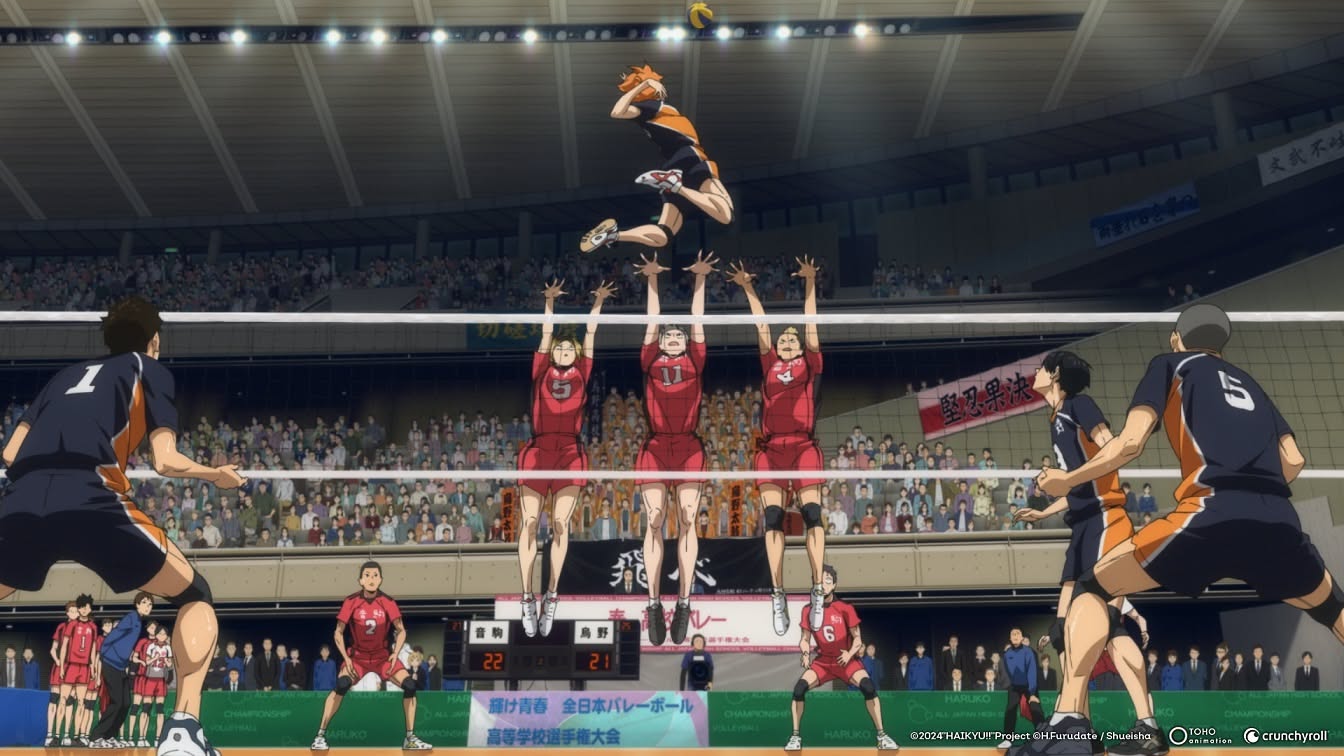
Karasuno and Nekoma could not be further from that mold. Their conflict is an inheritance. The original “Battle of the Garbage Dump” was the lifelong dream of former Karasuno coach Ikkei Ukai and Nekoma’s Yasufumi Nekomata—a dream constantly thwarted by missed qualifications and geographical distance. By the time their modern rosters finally collide on the orange hardwood of Tokyo’s Metropolitan Gymnasium in the third round of the Spring Tournament, the game carries the weight of an unresolved ancestral promise.
The Finality of the “Match That Cannot Be Replayed”
What elevates this clash beyond previous encounters is its terrifying, exhilarating finality. Through four seasons of television, Karasuno and Nekoma played countless practice sets. A loss simply meant doing penalty diving drills under the summer sun, laughing it off over watermelon slices, and setting up the net for another round. Kenma Kozume could afford to be indifferent; Shoyo Hinata could afford to experiment.
In the National Tournament, however, the safety net is completely gone. There are no penalty laps. There is no tomorrow. A single lost set puts a team on the brink of permanent dissolution, ending the high school careers of third-years like Tetsuro Kuroo, Daichi Sawamura, and Asahi Azumane. The film harnesses this existential terror brilliantly, transforming a friendly scrimmage into an emotional high-wire act where every single rally feels like a breath stolen from the dying embers of youth.
Mind Games on the Hardwood: Kenma Kozume’s Calculated Trap
While marketing naturally frames the film around the explosive physical duel between Karasuno’s offensive battery and Nekoma’s impenetrable “floor defense,” The Dumpster Battle is, at its beating heart, a psychological thriller anchored by Nekoma’s introverted brain: setter Kenma Kozume.
Kenma has always functioned as the antithesis of the traditional shonen protagonist. He is lethargic, physically unassuming, deeply anti-social, and motivated almost entirely by video games rather than athletic glory. Hinata, conversely, is a supernova of raw passion and instinct. From their serendipitous first meeting on a suburban street corner in season one, Hinata represented an anomaly that Kenma’s analytical mind couldn’t quite file away.
Clipping the Crow’s Wings
In The Dumpster Battle, Kenma approaches Karasuno not as a volleyball team, but as a punishing video game boss that must be systematically deconstructed. Recognizing that Hinata’s true weapon is not his spike, but the terrifying speed and lateral freedom that pulls blockers away from other hitters, Kenma designs an agonizing cage.
Through pinpoint serving, disciplined funneling, and calculated ball placement, Nekoma deprives Hinata of his runway. They rob him of the spatial acceleration required for his signature broad jump. The film meticulously visualizes this claustrophobia: Hinata’s wide, vibrant court gradually narrows into a digital cage, suffocating Karasuno’s offensive engine. It is a terrifying sequence of athletic problem-solving that highlights Furudate’s peerless tactical literacy—and sets up one of the most euphoric athletic breakthroughs in anime history when Kageyama and Hinata finally solve the puzzle with an arcing “Open Toss” that reaches toward the arena lights.
Kinetic Intimacy: Production I.G’s Directorial Evolution
When it was first announced that the climax of Haikyu!! would be adapted into a two-part theatrical film project rather than a multi-cour television season, skepticism ran rampant throughout the fandom. Condensing matches of this magnitude into feature runtimes felt like an impossible logistical compromise. Yet director Susumu Mitsunaka—returning to the helm after directing the critically acclaimed first three seasons—proves that cinema offers narrative tools television simply cannot replicate.
Clocking in at a razor-sharp 85 minutes, the film wastes zero frames. Pacing is relentless, mirroring the cardiovascular brutality of a professional rally. Production I.G pulls back on the hyper-stylized brushstrokes of Season 4 in favor of hyper-fluid, anatomically precise kineticism. The squeak of rubber against wax, the heavy rasp of oxygen-starved lungs, the visual distortion of sweat dripping across an eyelid—every sensory nuance of elite indoor volleyball is magnified to an astonishing degree.
The Legendary First-Person Sequence
The technical crown jewel of the film arrives during its climactic rally: a breathtaking, unbreaking sequence animated entirely from Kenma Kozume’s first-person perspective. The camera sways, dips, and blurs as Kenma stumbles across the floor, tracking the ball with bloodshot, exhausted eyes.
We do not just watch Kenma scramble; we inhabit his cognitive breakdown. We feel the burning lactic acid in his thighs, the disorienting glare of the stadium rafters, and the horrifying realization that his body is failing to keep up with his mind. It is a revolutionary piece of sports animation, eschewing triumphant grandeur for the dizzying, nauseating reality of athletic collapse. When the ball finally slips from Kenma’s sweat-soaked palms to end the match, the silence in the theater—and now in our living rooms—is absolute.
“Fun” as the Ultimate Victory Condition
Sports anime frequently defaults to victory as the sole metric of emotional fulfillment. You win the championship, or your journey was a tragedy. Haikyu!! has always rejected this binary, but The Dumpster Battle crystallizes Furudate’s overarching thematic thesis better than any arc before it.
Throughout his life, Kenma viewed volleyball as an obligation—something he did merely because his childhood friend Kuroo asked him to, or because people relied on him. He rarely smiled, never showed outward joy, and treated matches like chores to be cleared. Yet, pushed to the absolute edge of his physical limits by Karasuno’s ceaseless attacks, Kenma undergoes a profound, quiet metamorphosis.
As he lies sprawled on the floor, gasping for breath with his hair matted against his face, Kenma looks up at Kuroo and utters the words Kuroo had waited years to hear: “Kuro. Thank you for teaching me volleyball. It’s fun.”
In that singular moment, the scoreboard becomes completely irrelevant. Karasuno takes the match, but Nekoma claims the emotional summit. The rivalry was never about crushing the opponent; it was about dragging each other into the deep end of the pool until both teams fell unconditionally in love with the game. It is a thematic masterstroke that elevates The Dumpster Battle from a mere sports tournament film into a profound meditation on passion, companionship, and the fleeting beauty of youth.
The Verdict: An Unmissable Landmark in Anime History
As Haikyu!! The Dumpster Battle settles into its global streaming era, it stands not only as the pinnacle of the franchise, but as a high-water mark for the entire sports genre. Production I.G and Susumu Mitsunaka took what could have been a rushed cinematic adaptation and honed it into an intimate, thunderous epic where every dive carries emotional gravity and every glance speaks volumes.
Whether you are a longtime Karasuno faithful who has walked this road since 2014 or a newcomer hungry for elite-tier animation and psychological drama, this match demands your undivided attention. Turn off the lights, crank the audio, and bear witness to the greatest trash-heap brawl ever committed to screen.
Now that the dust has settled on the Metropolitan Gymnasium floor, where does the Dumpster Battle rank among your favorite anime matches of all time? Drop your thoughts, favorite rallies, and emotional breakdowns in the comments below!